Showing posts with label community management. Show all posts

Friday, August 20, 2010

Why Your Brand Should Care About Social Media Users


It is a common wisdom to say that bloggers, Twitters or other social media users could have a great impact on a brand. As they master a fast growing medium, which is actually difficult to handle for brands that don’t have any experience, they could have a great impact on your customers thanks to word of mouth.

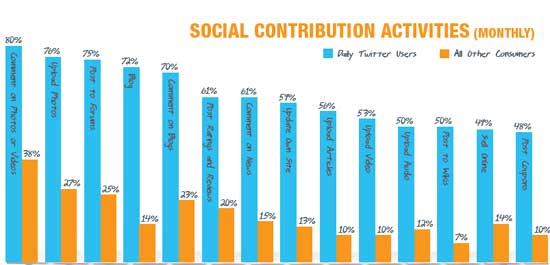
A recent study of Exact Target shows out that Twitter users, bloggers or regular comment reviews writers are 3 times more likely to impact brand’s online reputation.

"What happens on Twitter doesn't stay on Twitter. While the number of active Twitter users is less than Facebook or email, the concentration of highly engaged and influential content creators is unrivaled-it's become the gathering place for content creators whose influence spills over into every other corner of the Internet."Twitter users are the most influential online consumers - 72 percent publish blog posts at least monthly, 70 percent comment on blogs, 61 percent write at least one product review monthly and 61 percent comment on news sites.

According to these data we can see clearly that the “resonance concept” is true: Twitter users are more likely to spread the word of mouth at a high pace. All the different activities linked to twittering allow them to make a lot of noise on the web.

What does it mean for a company? It mainly means you must take care of your community. Community management is a key factor of success in order to spread positive vibes on these social media. You should not neglet this aspect, because if you don't take advantage out of your community by taking care of it, it will eventually cause you trouble if a crisis happen.
Also it is very important to take into consideration these data for customer relationship management purposes. Indeed, CRM is set to take care of the most important customers. Those customers might be important in terms of purchase power, but also due to their ability to spread good feedback about your products. You should find a way to evaluate the potential of these people, to act properly. Also, it would be a good idea to cross this information with your CRM data base, to see if some of your A+ customers are twitter users. It might help you go viral easilly in case you decide to plan such a campaign.

Sunday, July 25, 2010

Community Management: Why Creating A Facebook Page Is Not Enough


A lot of companies are very interested by what is going on with web 2.0. The high number of Facebook users is very interesting for businesses which would like to advertise. Nevertheless, even though the comon wisdom around social network is that they are free advertising you should not miss understand how it works.

Hence, developping a customer relationship management strategy using social network implies more than simply creating a Fan page where customers will be able to discuss about your brands. Indeed, like any other medium create before, social networks are used for malicious usages.

I have read not so long ago a book called the Victorian Internet, which explains the history of telegram, and how you could link its development and usage during its era with nowadays and the Internet. And since the beginning of telegram, telegrams have been used to "spam" users by providing commercial messages over the wires. I found thanks to @sleroux this link to the Ferrero Rocher's Facebook page.

What do you think you could find on Ferrero Rocher's Facebook page? Let's remember that Ferrero also owns Nutella, and has able thanks to this brand to create a strong community of lovers.
In my opinion, Ferrero Rocher could have done a page speaking about how to organize events, cocktails, which would be linked with their commercials and positioning in the market.

Instead, since they have not taken care of their community, the page is stacked with spam comments to win Ipads, naked girls pictures. It is a total failure. Now I don't know if you'd rather should not have a Facebook page, or own one but let people do whatever they want with. I believe this Ferrero Rocher page is a total failure, and it is one of the best example that you must have a community management strategy, which implies:
  • A goal which will link the brand and its customers by providing service or content to customers
  • Have some community management system to animate the community and to make sure it remains viable
  • Have specific metrics which will show out the interest of the project.

Now what will be interesting to see is how Ferrero Rocher will be able to turn the situation into its advantage, by retaking the leadership over. What do you think about it?

Wednesday, September 30, 2009

Social Media Marketing And Permission Marketing : The Return of Disruption

Social Media marketing is on the edge to become a major relationship medium for brands. The way it has been designed enable brands and customers to discuss, and interact in a very unique way, something which is not comparable to any other known medium.

Nevertheless, a French study shows out that French customers perceive social media marketing to be intrusive, and hence, are reluctant to its raise.

Permission Marketing
Seth Godin book “Permission Marketing” has changed deeply the way companies interact with companies, promoting one to one CRM techniques, and mainly pull marketing campaigns, asking for the customers’ permission to deliver promotional messages.

The concept is simple: due to the multiplication of media and brands, customers are overloaded with commercial messages which they are not asking for. Hence, in order to get the attention of customers and to optimize advertising budgets, you should set up a contract with the customer, to provide him an accurate and targeted messages, which will be delivered at the frequency and through the media he wants.

Social Media As A Permission Marketing Threat
Hence, when companies are discussing via social media, there is somekind of disruption that could appear. Of course, a customer could decide whether or not to follow a brand on Twitter or to become a fan of it on Facebook, but still, with community management springing up, brands are listening more and more to what is going on in social media.

I've attended a ecommerce diner where one of the invitee asked if social media users wouldn't feel oppressed by being watched by brands. If they talk about brands on social media, that doesn't necessarily mean he wants to discuss or even get in contact with it.

Community Management To Be defined
Is social media a threat for permission marketing? I believe that social media marketing experiences the same problems that occurred with emailing not so long ago. As the medium is relatively cheap and new, people are not really mastering the medium, and hence, are more in a disruptive mode. Moreover, there is a lack of tools to run this kind of techniques.

However, there are some ways to create bonds with customers thanks to social media marketing without being disruptive. When a customer adds a brand on its Facebook, it is a strong sign that he wants to establish some kind of relationship with the brand.

I believe this feeling of disruption results mainly of the large amount of messages spreaded on social media, which create a lot of noise.

That was the very same thing with emailing in the early age. The media was so cheap and easy to use spamming became an easy job. But permission marketing has been designed, which helped a lot to establish an ethical code to optimize the customer relationship. That would probably be the same with community management.

What do you think about it?


Tuesday, September 15, 2009

An Army Of Influencers

Leaders of opinion are a common target for marketers and PRs. They are suppose to influence people in their purchase and lifestyle. But the Internet, and more specifically the Instant Internet has changed the concept of leaders of opinion.

First of all, anyone could become a leader of opinion, if he wants to. You don't need to be a star, highly educated or so. You simply need, as would say Henri Kaufman "a pen... And a good idea". Well, I should be more precised. You need an Internet access, and something to say.

Secondly, which results of the first point, there is an army of influencers. There is no minority which could influence people. The Internet has enabled anyone to post, to be seen on the web, and hence, anyone could influence its community. That is the reason why PR must reinvent themselves, and turn into community managers that would be able to understand and leverage this mass of people which communicate and speak about brands and products.

I wanted to share with you this article:Over 100 Million Consumers Worldwide are Word of Mouth Advocates, Ground-Breaking Research by Zuberance Shows

This article explains how the game has changed, and how there are millions of influencers that are playing an active role in the customer decision making process. And thanks to mobile Internet, it will become even more true.

Advocates’ Recommendations are #1 Influencer of Consumers& Business Buyers’ Purchase Decisions

More than 100 million consumers worldwide are Word of Mouth Advocates, a massive, highly influential, yet under-leveraged sales and marketing force, according to ground-breaking research by Zuberance, the leading online Word of Mouth marketing company.

Advocates are people who frequently recommend brands and products. Empowered by Social Media, millions of Advocates are:

  • Evangelizing their favorite brands and products on Facebook, Twitter, MySpace, Bebo, LinkedIn, and on other social networks, online communities, and forums
  • Writing positive reviews on sites like Amazon.com, ePinions, and Angie’s List plus on e-tailers’ and manufacturer websites. (TripAdvisor boasts more than 20 million reviews while Yelp has 5 million user reviews with positive reviews outnumbering negative by 6:1.)
  • Posting positive comments about brands and products on YouTube, on blogs like Engadget and Gizmodo or even creating advocate blogs like ”Slave to Target”

In addition, millions of Advocates are spreading positive Word of Mouth about brands and products in face to face settings, such as offices, restaurants, golf courses, trade shows, and more.

”Army of Advocates”

”An army of Advocates is evangelizing companies, brands, and products online and offline, and these recommendations lead directly to purchases,” said Rob Fuggetta, Founder&CEO of Zuberance. ”Yet many companies are missing a major opportunity to increase sales because they are not identifying and mobilizing these influential Advocates,” Fuggetta added.

In the U.S. alone, about 30 million U.S. adult Internet users are ”Word of Mouth Influencers” - adults who are opinion leaders and whose advice is sought, trusted, and acted upon by other consumers, according to eMarketer.

Advocacy is a global phenomenon. According to GfK Roper, 80% of consumers surveyed in 25 countries across five continents frequently recommend brands and products to their friends and colleagues with the average consumer recommending 3.7 brands. The total adult population in the 25 countries included in the Roper study is more than one billion people.

Advocates are Brand’s Most Effective Salespeople

Advocates’ recommendations drive sales. Numerous surveys by independent market research firms have shown that Word of Mouth is up to five times more influential than advertising, email, and search engine marketing. According to a study by Forrester Research, Inc., 84% of business buyers said peers’ Word of Mouth recommendations influenced their purchase decisions while only 24% said blogs impacted their choices. In a global Neilsen survey, 78% of consumers said they trust Word of Mouth recommendations from other consumers while only 26% trust banner ads.

Key Findings of Zuberance Research

The Zuberance study found that:

  • Approximately 40% of a company’s customers -- a surprisingly high percentage -- are highly likely to recommend the company and its products or services to friends or colleagues. Among the companies included in the Zuberance study, the percentage of company’s customers who are highly likely to recommend ranged from 25% for a business products company to 76% for a consumer electronics manufacturer.
  • About 25% of a company’s customers are Advocates. This percentage can vary, depending on several factors including the type of company or product and how easy a company makes it for highly-satisfied customers to spread positive Word of Mouth.
  • Depending on the size of its customer base, a company may have hundreds of thousands to millions of Advocates. For example, a consumer electronics company with 10 million customers may have approximately one to two million Advocates.

Ground-Breaking Word of Mouth Research

Zuberance’s findings are included in a ground-breaking, five-part research report on the power of Word of Mouth Advocacy. Entitled ”Mobilizing Advocates, Driving Sales Now,” the report is one of the most comprehensive ever on Word of Mouth Advocates. To date, Zuberance has surveyed over 100,000 customers across numerous multiple industries and verticals including automotive, consumer electronics, consumer software, housewares, travel and tourism, and business products and services. In addition, the report leverages research on Word of Mouth and Advocates by highly-respected market research firms. The first report in the Zuberance series - ”An Army of Advocates” - is available now at www.zuberance.com/research.

About Zuberance

Zuberance is a leading online Word of Mouth marketing company. Global 2000 companies and others are using Zuberance’s ground-breaking Word of Mouth marketing platform now to identify and mobilize their highly-satisfied customers (AKA ”Advocates”), cost-effectively increasing sales. Headquartered in San Carlos, CA, Zuberance is backed by Emergence Capital Partners, the leading venture capital firm focused on early and growth-stage Technology-Enabled Services companies. For more information, visit Zuberance at www.zuberance.com, call 800.962.0590 or email info@zuberance.com.

Saturday, August 22, 2009

Social Media Metrics

It remains difficult so far to estimate social media metrics, as the topic has emerged recently, and that we have never seen anything comparable so far. I have already talked in the past about social media return on investment, inspired by the great work Safia Ouaissa on the topic. Now it is Christopher Carfi that explains us how to get metrics from social media efforts. People are working on this topic and we can see emerge clear tools and indicators to measure community management efficiency.


Wednesday, August 12, 2009

Social Media To Provide A New 360 Customer Relationship Management

Social Media is a great new medium that has been emerging now for about 3 years. Marketers are still defining the use of it on the long term, but we can have a clear view that social media change dramatically the marketing approach of customers. Prior to social media, CRM was based on customizing a customer relationship management, based on company owned data. It was pretty difficult already, but the goal was to limit cost and have an appropriate message, upon customers needs.

But social media has open the picture and it is clear that it will have a great impact on both customer experience and service. Therefore, in a global customer relationship management approach, you could have different company's department that would use social media abilities to create this great online customer experience. I found that great article on line, which explains well how to use social media for a customer relationship strategy:

  • SUPPORT DEPARTMENT: Strategic engagements in social media start therefor on the support side as we can see with companies like Comcast, Ford, Dell and many others.
  • PRODUCT DEVELOPMENT: A natural next step is to leverage the experience in the service and support departments to drive down product development cost, get early market feedback and in particular support during the product launch phase.
  • LOGISTICS AND PROCUREMENT: Social media is probably the most effective and the least expensive early warning system for everybody involved in procurement, logistics and production planning challenges.
  • SALES & MARKETING: With the experience from support, product development and logistics it is a natural to now leverage social media in sales and marketing. Why at last? Only happy customers become advocates, helper in the word of mouth campaign or any other function to help create buzz and become buzz drivers into a market. Frustrated customers do the other way around. So starting in marketing - while very counter intuitive - is probably the biggest mistake you can make when you engage in social media.
Of course such changes would drive a some major changes in business organization. Therefore, it is important to have a clear view on how companies are thinking about using social media to run their business. And that is also the reason why a community manager is important, as it could coordinate company's efforts.


Monday, July 27, 2009

De la difference entre l’animateur de communauté et le manager de communauté

Le Monde consacre un article sur son site Internet sur le métier de Community Manager : « Sur le Net, des journalistes se muent en animateurs pour doper les audiences »

Ainsi, le journaliste explique que l’ »on parle de community manager. En français, on dit « animateur de communauté ».
Néanmoins le métier de manageur de communauté et d’animateur de communauté est bien différent. C’est comme comparé un télémarketeur avec un directeur marketing.

Dans l’article, on décrit des personnes ayant un rôle d’animateur de communauté à mi-temps, où il s’agit de modérer les interventions dans les communautés, de réagir si besoin. Il y a ainsi un réel rôle d’écoute et d’interaction avec la communauté.

Mais le réel poste de community manager, comme il va le devenir, est un rôle beaucoup plus évolué. Il implique de gérer une communauté, qui potentiellement peut compter des dizaines de milliers de personnes, sur des réseaux multiples (Twitter, Facebook, Myspace, sans parler des autres), il est important d’avoir une stratégie clair en tête.

Le poste de community manager possède un rôle clé dans une optique d’entreprise orientée client.

C’est pour cela que je considère qu’il est dangereux de confondre Community Manager, et Community animator, qui n’ont pas le même rôle.

Sunday, June 28, 2009

Traditional VS Social CRM

Relationships between companies and customers have evolved throughout the times, so must CRM tools. Traditional customer relationship management programs aim to control interactions with customers in term of business process. The idea is to organize these interactions to make it simpler for the company to process. These CRM tools have shown their efficiency but also their limits in term of customer satisfaction.

Hence to create FAQs pages on websites and call centers to deal with customers' inquiries make sens in terms of investment and running cost, but how could you expect customers to be happy whereas human transactions have been left behind?

Social CRM is a vague term, and might not be appropriate. It aims though to use the new social media technologies and ideas to enhance these traditional crm tools to incorporate more its customers.

Indeed, it is difficult to make coexist both traditional and social CRM, because they don't have either the same goal nor usage. The idea is to keep CRM structures in terms of data collection and cross unit management, but also to get more content driven by using what is going on in online communities to bond with customers.

That is the reason why community management is so important. The community manager needs to mak the link between both traditional CRM and social CRM to have something that makes sense to end users.

Saturday, June 20, 2009

Twitter Is Revolutionning PR

What is interesting is with web 2.0, companies are loosing the control of what is published about them. With blogs and forums, people can express themselves about what they think about the products and services.

But I believe Twitter is changing even more the public relationship job. Indeed, public relationship used to be about thinking and taking the time to get the right message at the right time. Twittering is totally the opposite. It must be quick, it must be free of corporate tune, and it must be interracting with people on the web.

Also, PR are not addressing themselves to media anylonger. They must post everything public as the information will be faster to spread via individuals owning blogs, Facebook accounts and other Twitter accounts. Anyone is a media now, and in order to be efficient in spreading the information, traditionnal media are not fast enough.

A crisis could emerge fast in couple of Tweets, as we have seen for example during the riots in Iran. Hence, PR must be as reactive, meaning they must be alerted to what is going on Twitter at anytime, and being able to set up a strong community to react efficiently.

How does old public relationship managers are experiencing this great shift? It seems that these people have been educated and managing their jobs in a way which is not appropriate to nowadays media. They must adapt themselves to a kind of communication they are far to master. Actually, we could expect the community manager position to replace somehow public relationship, or even more precisely, to integrate it.

I'd like to have your feedback on this one.


Friday, June 19, 2009

Dell Generating Millions With Twitter


Nobody has been able to make money with Twitter yet? Well, apparently, computer constructor Dell seems to have found out a way to make its Twittering activities profitable.

According to a fresh Guardian article, Dell estimates it generated $3 millions thanks to its Twitter accounts.

"We're also seeing that it's driving interest in new product as well. We're seeing people come from @DellOutlet on Twitter into the Dell.com/outlet site, and then ultimately decide to purchase a new system from elsewhere on Dell.com. If we factor those new system purchases that come from @DellOutlet, we're actually eclipsed $3 million in overall sales."

We need to be objective, these $3 million is nothing compared to Dell's overall sales of $12bn in the last three months. However, it shows out that Twitter could be a profitable activity. What would be interesting is to evaluate the return on investment Dell got, taking into considering the money spend and the staff set up for such a community management action.

I believe this has been very profitable

Tuesday, June 02, 2009

Can You Build A Community?

Most of the companies are dreaming about creating their own community thanks to the new social media. Hence, there are many reasons why they would like to interact with such a community:
  • A community is a group of involved customers that would be the ambassadors of the brand
  • They know the products and could be used to improve products or identify new products defects
  • Having a community is a new medium which could provide a high return on investment during marketing campaigns as they have an emotional bond with the brand.
Therefore a lot of companies are embracing the idea of creating a community. Now that the hype has gone by, some people are wondering now if it is possible to build a community.

That is the question Loic Lemeur asked on his blog.


What is for sure is that building a community is not an easy task. We have already discussed about this topic on this blog.

In fact, even though you are a big corporation and you already own a great data base of customers, that doesn't imply you will be able to set up an active community. Indeed, the most difficult task is to get your community active. If someone has subscribe and entered its contact information, it doesn't mean his going to come back on a regular basis, nor to become a user and interact with the brand.

That is the reason why I believe any kind of community creation should be associated to a social media plateform like Facebook, in order to get people that participate and that would actually use your community, versus creating your own private community.

As a matter of fact, some brands struggle to generate a community for two main reasons:

- First, because most of the time they are creating a community which is a copycat of Facebook or a blog platform, that wouldn't create no added value to customers.

- Secondly, building a community requires time. Of course, if you are a big corporation, you could always leverage your customers' data base, and have a great marketing campaigns which would generate you leads, but a community needs to be active. It isn't a sprint but more like a marathon, and therefore it isn't an efficient way to create a community.

The key is therefore developping an added value service that will provided a daily service, which will create bonds with the community.


Friday, May 08, 2009

Enterprise Feedback Management And Community Management


Enterprise Feedback Management is an integrated approach to the management of all forms of feedback available to an organization. Therefore, wether you reached the customer service through the website, a visit at the store or on the phone, enterprise feedback management will be able to qualify the quality of the interaction.

Media are becoming more and more complex. Therefore enterprise feedback management is a great component of a crm strategy since it analyses the interraction the company has with customers upon the media. A great feedback could drive changes in the multichannel strategy.

I believe that the new social media are becoming an actual medium, where customers can interact with the company. Therefore, it would be interesting for enterprise feedback management to analyse the interaction through this medium.

Hence, after an interaction with a community manager, the customer could be satisfied or experienced problems. I believe that enterprise feedback management companies could leverage this new medium to provide a greater service, analysing interraction within social media.

It would be pretty simple to implement such an initiative. That would imply creating a form where customers could share their experience and thoughts.

What do you think about it? Do you believe enterprise feedback management could become a part of community management?

Thursday, May 07, 2009

Community Management and CRM

I have talked a lot lately about community management. Companies become more aware about the importance of community management, and more and more of them have decided to create such a position.

Community management is very important on a customer relationship management (CRM) prospective. Communities are places where customers talk about your brand and products and where new ideas emerge. That is a reason why corporations must take advantage of it and add this component to their customer relationship management strategies.
I have already discussed on this blog about social score, which is a way to evaluate community members on a CRM point of view. There are also new tools to evaluate a community management strategies. Of course not all companies can dedicate a specific staff for community management but all of them could benefit in monitoring social media and leverage them for new business opportunities.

Now I believe there is still a great challenge in joining the CRM effort of companies, which manage internal data, with community management, which is difficult to integrate into a traditional CRM program as data is very dynamic.

I believe community management and customer relationship management are already linked together, and we are still discovering the potential of such a strategy.