Friday, April 20, 2012

Walt Disney's Vision Of Disney's Business

Here is a very interesting mind map I found on the web: It has been drawn by Walt Disney himself, to picture his whole idea of the industry he will create, back in 1957. You can clearly see how everything is linked, to create the magic of Disney we all know.

Walt Disney understood perfectly how all the existing media were working, and get the best out of them (TV, movie theater, music...). It would have been fun to see how he would have used social media. By the way, I think that Disney is the strongest brand on social media nowadays.


Wednesday, April 18, 2012

Quelques pensées sur les publicités de l'application mobile Leclerc


Depuis quelques semaines, Leclerc multiplie les publicités télévisées au sujet de son application mobile permettant de comparer les prix via son téléphone portable, en situation de mobilité. Il y a quelques temps déjà, j'avais prévu que ce type d'application sera là, et que celles-ci allaient forcer les enseignes à chercher d'autres axes de différenciations que le simple prix.

Leclerc peut se le permettre: Ils sont les moins chers, et ont trouver le moyen d'être sûr d'être les moins chers (coûts d'exploitations faible grâce à la structure décentralisée, pas d'expansion internationale à financer, moins de contraintes régalienne que des géants comme Auchan ou Carrefour). Et cela marche: Ils gagnent des parts de marché sur tous les concurrents, et principalement sûr le leader Carrefour, qui devrait se faire rattraper dans les mois qui viennent (à ce rythme avant la fin 2012).

Cette application est d'autant plus l'arme ultime, que le marché de l'alimentaire répond à des besoins primaires, avec des produits simples et comparables (un paquet de pâtes = un paquet de pâtes), et le prix est le 2ème (souvent derrière la proximité géographique) 2ème critète de choix d'un magasin (surtout le premier actionnable).

Maintenant, il y a 3 choix pour les enseignes:

  1. Se battre sur ce registre, ce qui peût avoir des conséquences terribles en terme de marges.
  2. Développer une stratégie innovante, permettant de créer de la valeur ajoutée intangible, justifiant l'écart de prix.
  3. Trouver d'autres moyens de faire gagner de l'argent au client: Proposer de nouveaux services à prix casser.
En tout cas, Leclerc réussi dans cette période de crise à gagner des parts de marché. Une stratégie gagnante en attendant le retour de la croissance.


Monday, April 16, 2012

Samsung: Une entreprise pas comme les autres


Je souhaitais partager avec vous ce documentaire sur l'entreprise Coréenne Samsung. Ils ont réussi à dépasser le monstre Sony, et domine le monde de l'électronique. Ce qui est assez impressionant dans cette société, c'est les innovations qui arrivent, preuve que Samsung n'hésite pas à financer l'innovation, qui elle seule peut assurer un futur à long terme de la société (dans ce monde qui bouge si rapidement, il faut toujours avoir la vision de dans 8 - 10 ans, même si celle-ci ne se réalise pas).

Ce qui est aussi impressionant, c'est le côté "big brother", paternaliste, mais aussi très controversé.

Thursday, April 12, 2012

Employees Frist, Customers Second

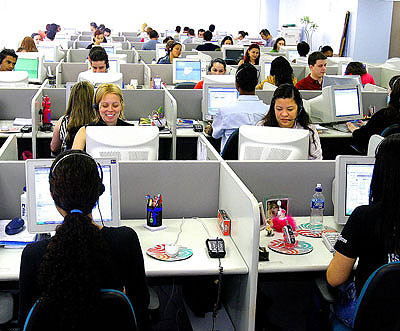
This title may seem awkward for a blog which is supposed to be discussing about customer relationship management, and the old adage "the customer is king". Nevertheless, I picked this title from an article I recently read from French Newspaper "Le Nouvel Economiste". This title refers to call centers' human resources policy, and how it can impact customer satisfaction.

Call centers had the culture of effectiveness based on data: number of people reached, how long the call lasts, how good the customer data base is filled in by the employee... But with this approach, employee's job is repetitive, and is not fun. This is the reason why customers have a bad experience. Moreover, call centers have high employee turnover. Turnover has a high cost for a company, needing to hire, and educate the new employees.

Let's not forget that customers are human beings, and as human beings, they like to be in relation with other of their peers. That means that whatever is robotized is a risk of lowering customer experience. I have always considered that the first contact customers or shopper have with a brand is the human face of a salesperson, or in that case, a call center employee. And therefore, they should be the most exited people about your brands and products. They should therefore be happy. 


he 10 Zappos Core Values:
  1. Deliver Wow through Service
  2. Be Passionate and Determined
  3. Embrace and Drive Change
  4. Build a Positive Team and Family Spirit
  5. Do More with Less
  6. Pursue Growth and Learning
  7. Create Fun and a Little Weirdness
  8. Build Open and Honest Relationships with Communication
  9. Be Adventurous, Creative and Open-Minded
  10. Be Humble

Zappos has a culture of delivering high customer service, which sets them apart from competition.

Hence, as a customer centric company, you should pay a close attention to the human resources policy, the management of employees.

Happy employees lead to happy customers. Employees happiness first, customers'one second.


Tuesday, April 10, 2012

Mon débrief du salon SECA (relation client, CRM et mobile)

Je me suis rendu, comme chaque année au salon SECA qui se tenait comme tous les ans à la porte de Versailles. Le SECA est le gros salon de la relation client en France, qui réunit la plupart des sociétés du secteur. Il est toujours intéressant d'aller à ce salon, car comme le métier évolue très rapidement (je me souvient qu'il y a à peine 6 ans, la grande majorité du salon était composée d'entreprises de mailing) le salon est souvent un bon reflet des tendances.

Pour être tout à fait honnête, j'ai été déçu du salon. Voici quelques remarques que je me suis faites et que je souhaitais partager avec vous:
  • La disparition des entreprises d'emailing: Je me souviens qu'il y a encore un ou deux ans, une centaines de prestataires travaillants autour de l'emailing (routeur, société conseil, de logiciels, de locations de base, etc...) tournaient comme des vautours autour des visiteurs qui auraient eu la malchance de s'égarer. De plus, la plupart de ces sociétés avaient des techniques et approches commerciales très aggressives, flyers dans les allées, pin up aguichants le challand, etc... Cette année, je n'ai pas vraiment vu ce type de démarche, tant mieux. Car pour être honnête, si je devais choisir un prestataire pour travailler, il serait hors de question que je choisisse une entreprise pratiquant ce type de démarchage, totalement contraire à l'idée de relation client de qualité.
  • Cette disparition a laissé place à une nouvelle race de société: Les sociétés de monitoring (ou veille) des médias sociaux. Je ne peux même pas me souvenir du nombre incroyable de société qui se sont lancés là dedans. Cela marque bien l'intérêt que le monde de l'entreprise porte au phénomène. Le problème, c'est qu'il y a très peu de différences entre elles... La plupart propose de pouvoir filtrer et analyser les contenus des fans et autres followers, pour permettre à la marque de pouvoir mieux comprendre son empreinte sur les réseaux sociaux. Le réel problème, une nouvelle fois, c'est que je n'ai rien trouvé de réellement innovant, ou bien de vraiment quelque chose sortant du lot. 
  • Le salon était couplé avec Buzzmobile, le salon du marketing mobile. Réellement, l'idée est très bonne: donner une nouvelle partie importante pour le mobile, qui est le média à privilégier pour toucher le shopper. Mais là encore, je trouve qu'il manquait réellement de nouveauté, ou bien de choses innovantes. La plupart des sociétés proposent de développer des applications, ou bien de faire de la publicité sur mobile (régie publicitaire). Je pense qu'il y a tellement de chose à venir sur mobile, tel que la géolocalisation (très peu de chose la dessus), la réalité augmentée, la NFC... 
  • Je trouve que cela manquait aussi d'acteurs de poids. Il est toujours intéressant de voir des starts up apportant de la nouveauté, mais il est tout aussi important d'avoir des leaders pouvant influencer le marché. Or, Orange, Soft Computing, ou autre Publicis, ne sont pas présents. Dommage...
En bref, on voit une réelle mutation du monde du feu Marketing Direct, vers le mobile et les réseaux sociaux, ce qui est logique, car le salon suit là dessus les évolutions du consommateur. Mais on peut voir au global qu'il y a énormément que prestataires sur le salon, qui au final se ressemble, et je pense que nous assisterons dans un futur proche à une concentration des acteurs, afin peut être de voir émerger des acteurs importants porteur de réelles innovations.

Thursday, April 05, 2012

Social Effects On Customers Retention

We all knows that the social community around one customer is a very important part of one customer decision making process. Depending on what friends, relatives or co workers buy, a person will be influenced and there are strong chances he will buy similar products,probably from the same manufacturer.

The social impact has been used a lot by advertisers in commercials. But social impact on customer choices has become even stronger lately as customers become more and more aware, and more and more connected, thanks to social media, like Twitter, or Facebook.

It is also true for the opposite, when people around a customer decides to switch from one brand to another, people around him may have the same reaction.

That is what this blog post is about: Researchers Irit Nitzan and Barak Libai analyzed the behavior of more than a million customers of a cell phone service provider to see how likely they were to defect to another service provider when one or more of the people in their calling network canceled their service. A year's worth of data revealed that approximately one-third of the customers studied saw at least one of their friends leave the service provider. The research reveals that after that friend or friends left, the probability that the remaining customer would also leave rose 80%.”

“Consumers who were closer to one another—defined by the volume of communications they used—were more likely to defect than consumers who spoke with the defecting friend less frequently, ostensibly because close friends share more purchase recommendations and opinions with those closest to them than with consumers to whom they speak less frequently, the authors say. The impact of these word-of-mouth opinions was less among consumers considered loyal to the carrier, as defined by how long they'd been customers of the mobile service provider and their usage level. In all instances, the impact of friends' defections to other carriers was felt most acutely shortly after they left and diminished within a few months' time.”

This should gives you extra arguments to look after what people says about your brand on social media. It also gives a very good data to look after: the volume of communications between individuals to evaluate how strong the chances are that this person will follow the decision of the other persons.

What do you think about it?


Monday, April 02, 2012

New Retail Trends From The NRF

The NRF is the National Retail Federation in the United States.Every year they host the NRF Expo, and this year, I believe it was in New York.

Thanks to Henri Kaufman's blog, we can access to this presentation (in French), which shows out the  new trends found during this event.

I am not going to comment the whole presentation  which is pretty complete. But Iwanted to share with you the results of the study showed on slide 22and 23.

Here are in 2011the ranking of the greatest influences during a product research:

  1. Retail store
  2. Search engine
  3. Retailer Website (this is something very interesting: Retailer websites seem to be a source customers rely more and more on)
  4. Familly and friends (wouldn't you have thought it would be higher?)
  5. traditionnal advertising
  6. mobile apps
  7. online streaming videos haul (like You tube)
  8. Shopping portail
  9. social media (this is what is interesting: so far social media is very low)
  10. magazines
  11. Email
I believe it is interesting to see that retails remain the n°1 source of information, and also the n°1 channel of consumption.However, ubiquity (meaning the fact that customers purchase and consume information on a vast number of media, from cell phones, to computers, to stores, to social media...) is becoming more and more important.Therefore, it is important to keep in mind that stores remain the core of business, and that companies should leverage their stores to generate more sales on line and on other platforms, like smartphones.


Thursday, March 29, 2012

Sandro Castaldo Trust Model


I discovered thanks to a post of Henri Kaufman the work of Sandro Castaldo on customer loyalty building process.Sandro Castaldo is an Italian professor who has worked to identify which are the components of customers trust in one brand. 

Trust is a very complex concept, and in terms of customer relationship with a company, there are many different components which can impact this trust:
  • The salespersons
  • The assortment
  • Sales promotion
  • Communication
Sandro Castaldo found out a way to analyse the interaction between those different factors in order to determine which of them has the most impact on trust.
Here is how it works:
  1. It defines the elements which may influence one customer trust.
  2. He also defines which of those elements impact either the perceived value, the store patronage, satisfaction, the behavioral loyalty intentions and the trust.
  3. He then conducts a survey on customers using the quota method
  4. He then is able, upon the survey, can set the priorities of each element
To understand better how it works, I invite you to visit this link.There is a very interesting paper about how private lable can impact store trust. The whole technique is detailed in this paper.

It would be very interesting to conduct such a survey for your company, in order to understand better the role of each of your customer relationship management components, and being able to monitor them. Sandro Castaldo wrote a book about it: Trust in Market Relationships.

What do you think about it?

Tuesday, March 27, 2012

As I have been running this blog for quite a while now, I have encountered a lot of great articles, which I have discussed here. But more that those great articles (and there are a lot), there are some quotes, which I always keep in mind, as they are food for thoughts. I wanted to share them with you, and I will update as often as I find something interesting here.

Hope you will enjoy it, and feel free to give me some more.

We always make our decision based on what we know and believe. Seth Godin

You can't turn the wind, so turn the sail.Kofi Annan, to President Bashar Assad about Syrian crisis.

Monday, March 26, 2012

We always make our decision based on what we know and believe.


I wanted to share with you a blog post I found on the always interesting blog of Seth Godin.For those of you whom may not know who Seth Godin is, he is a marketing guru, which was at the center of the permission marketing concept.

"We've decided to hire someone with totally different skills than yours..." and then they hire someone just like you, but more expensive and not as good.
"We're not going to buy a car this month, my husband wants to wait..." and then you see them driving a new car from that other dealer, the one with the lousy reputation.
"I'm just not interested..." and then you see the new RFP, one you could have helped them write to get a more profitable and productive outcome.
People lie to salesmen all the time. We do it because salespeople have trained us to, and because we're afraid.
Prospects (people like us) lie in many situations, because when we announce that we''ve made the decision to hire someone else, or when we tell the pitching entrepreneur we don't like her business model, or when we clearly articulate why we're not going to do business, the salesperson responds by questioning the judgment of the prospect.
In exchange for telling the truth, the prospect is disrespected.
Of course we don't tell the truth--if we do, we're often bullied or berated or made to feel dumb.
Is it any surprise that it's easier to just avoid the conflict altogether? Of course, there's an alternative, but it requires confidence and patience on the part of the seller and marketer.
Someone who chooses not to buy from you isn't stupid. They're not unable to process ideas logically, nor are they unethical or manipulated by others. No, it's simpler than that:
Given what they know and what they believe, the prospect is making exactly the right decision.
We always make our decision based on what we know and believe. That's a tautology, based on the definition... a decision is the path you take based on what you know and believe, right?
The challenge, then, it seems to me, is to realize that perhaps the prospect knows something you don't, or, just as likely, doesn't believe what you believe. Your job as a marketer is to figure out what your prospect's biases and worldview and fears and beliefs are, and as a salesperson, your job is to help them know what you know.

I wanted to comment the bold sentence: We always make our decision based on what we know and believe. That reminds me of my customer behavior classes in the United States: One customer decision making process is a complex process, which implies several phases and factors which will impact it.And I think it is very interesting that we should not blame one customer not to have picked our product or service, but we should focus on what triggered this decision, and especially, what we have not done to influence it toward our company.

The difficult part out of it is to be able to get this information, because as Seth is explaining, most of the time, the customer will keep this information for him, not to be judged.I also believe that in some ways, the customer may not be sure that he took the right decision. He would like to have but as nowadays we have always the choice with a large range of products whatever we buy, the decision making process is becoming more difficult.This is the reason why customers are seeking for customer reviews to make sure and to comfort their choices.

As long as there is a competition, there will always be customers not buying your products, but it is important to know what information they did not have, and what they believed, in order to get as few people as possible shoppers leaving your store with empty hands.

What do you think about it.

Friday, March 23, 2012

Backplane: Should Companies Create Private Virtual Communities?

It has been years now that Facebook interests companies in order to bond with their customers/communities. Marketers have understood how powerful social media could be to create brand awareness and to reach their customers in a unique way.

But Facebook almost monopoly on social communities bring some questions: Is it a good thing that companies rely on a private company's tool to connect with its customers? Indeed, it is a normal behavior for a company to want to master and control what it is doing. Indeed, Facebook can whenever it wants change its policy which could have great impact on people's community.You should see what is going on with Google's decision to charge company using Google Maps: People are moving away from Google's tool, which can have many consequences.

Also another important question is: Is Facebook really the best way to connect with my customers? Facebook has a specific way to create Facebook pages, and it is not as easy to customize the page.The main strength of Facebook is that it has already a large number of users, and it is therefore easier to grow a community quickly. But afterwards comes the will to animate this community, and maybe there are better tools than a Facebook page.

This is the reason why, a lot of companies are willing to create their own social media, outside of Facebook. And this is where comes Backplane. Backplane is a company which has built Lady Gaga's virtual community.The famous pop star is known for having a large community following her both on Facebook and Twitter. The Backplane's ambition is to leverage the know how brought by the Lady Gaga's experience to other companies willing to create a similar link with their communities.

"Backplane is exploring the possibilities for mainstream brands, from Nike to ExxonMobil, to create virtual communities that foster deeper relationships with customers. (In the case of ExxonMobil, the likeliest passion for the firm to tap is not for petroleum itself, but for the different brands of car it powers.) The trick is to find those key influencers and amplify their voices. Mr Carter says that experience with Lady Gaga has taught him that what a super fan says can sometimes have a bigger impact on fellow fans than a word from the Lady herself. "

It reminds me sort of of Tripnity, a company which has developped a long time ago now (at least 5 years) a community for Air France's passengers to connect with people taking the same flight at the same time (bluenity). The community is still on, but I am not really sure about the success.

The question is, should companies try to create their community outside of Facebook, and use the service of a company like Backplane?

I am not sure about the answer: I think it is risky to rely on Facebook, because Facebook could decide soon (as they will become more eager to generate profits as they will be in the stock exchange market) to charge professional use. We all know that, at the spike of the social commerce hype Facebook asked for huge commissions in order to use Facebook for selling purposes.

Now Facebook knows how to create powerful communities, as they have a long experience on it.Also, you have now a lot of people with the expertise of communities on Facebook (advertizing agencies, companies...) because they took part of several of them. It is therefore easier to leverage this expertise.

But I believe that the main strength of Facebook is that people are already registered in Facebook ,and entering a community is much easier for a user than to register on another service.I believe that the registering process is a real threshold, and Facebook has the chance to have people already on it.


Nevertheless, I think the question should be asked depending on the budgets and the ambitions of the brand.

What do you think about it?

Thursday, February 23, 2012

Customer Experience Is Key In Ecommerce

Great video I found on the Internet about online shopper experience, while going through the paying process.

It is very true that the whole process is very complicated, and is a real turn off. It is therefore important to pay a close attention to this key part. It should be an e-commerce website know-how to make the payment process easy.

In traditionnal retailing, it is the arrival of automatic cashiers that allowed supermarkets, hypermarkets, and the whole modern retailing to spring up. Payment is a basic thing, but it does matter.

Monday, February 20, 2012

Thoughts About The Non Searchable Web

The Internet is changing. And it is changing fast. Social Media is modifying the way we consume and find information online. And you can see it shifting on a daily basis. Prior to the rise of social network, especially Facebook and Twitter, search engines was the path to reach information on the Internet. Therefore websites, either information one or ecommerce websites, needed to apply the rules of Google (Mainly), Yahoo and Microsoft, in order to generate leads. 

Search engines have by the way been a key factor of the exponential growth of the information, making it simple to navigate online.

But now, people spends more and more time on social network, and hence, they tend to access information not through search engines, but Facebook or Twitter. And it is a very important part that business must take care of. 

Indeed, the old rule of search engine optimization are not the only way to get visibility. This is the reason why marketing departments are spending more and more money on Social Media in order to get exposure.

It is very different to try to get the best ranking possible on Google, with specific coding rules, and to get a great exposure thanks to Facebook. Both tools don't work the same at all. 


Here are the rules it implies:
Step 1:
  • Of course content needs to be planned for social media use.
  • Content needs to be designed to “enable” social dynamics.
  • In other words: the content must be created in a "socialisable" way from the start.

Step 2:
  • It is no longer possible to rely exclusively on the analysis of user behaviour and motivation without also considering the social context.
  • In designing social dynamics, user experience (UX) plays a very important role, so we should begin to place UX closer to [SEO] (Extension of SEO as Social Engine Optimization) than ever before. 
Social media is defenitely changing the web.

Monday, February 13, 2012

An Ode To Competition

I wanted to share with you some thoughts about several news which happened the past few months. All of them are linked with the competition concept.

 Competition is core to our capitalist society, and is supposed to stimulate low prices and innovation. Competition, as a matter of fact, is not something natural for companies. It is something that any corporation would try to avoid. Indeed, competition means that you can not master your business model. You have external factors, such as direct competitions (companies producing the same kind of products), indirect competition (companies which propose substitution products, or products which gets into the same budget for one client), customers, regulation, foreign companies getting into one market, and so on. To know more about these factors, you should look at the Porter matrix.


 Companies indeed try to escape from competition, it is the whole idea behind the Blue Ocean Strategy: Creating a space where you can not be compared, where your products/services are unique. Nevertheless, competition is something very important in business. Because competition is what drives innovation, and better prices for companies. Here is a video of Eric Schmidt, former CEO of Google, during Le Web 2011. He would like to see more competition in the Web 2.0 world outside of the Silicon Valley. He believes that it would stimulate the whole industry and therefore would benefit to innovation.


 There is also a very important part about competition: it forces companies to pay more attention to customers. This is when markets mature that you see companies developing customer relationship management strategy.

It also forces them to create new services. For example, when Pizza Hut proposes to deliver its pizzas in 30 minutes, then it forces the whole competition to follow the lead, and to propose the same.

 I take as an example what is going on in France, with the arrival of a new mobile network operator Free, which proposes new discounted fares. Prior to its arrival, there were three main competitors sharing the markets, with large margins, and therefore there was no real competition. But then, Free decided to enter the market, and to provide discounted prices, in order to cut the bills by half. After the arrival of this new competitor, other companies launched counter offers in order to align their fares. To sum up, we can say that competition, even though it is tough, is always a good thing, because it makes things going forward. What do you think about it?

Monday, January 09, 2012

Facebook And Profitability: Interesting Video And Some Thoughts About Potential IPO


Facebook keeps growing at a fast pace, and has matured as a strong marketing media, used by a large number of companies throughout the world.

I recently watched this video on Youtube, and wanted to share it with you.Unfortunately I am not able to upload it on my blog...

It is a CNN show where analysts discuss about the move of Godman Sachs to buy for $450 million of Facebook shares, evaluating it at $50 billions. It was on January 2011, a year ago.

At this time, Facebook was counting 600 million members, $2 billions in revenues. The analysts are discussing about the actual profitability Facebook may get. Indeed, it is very difficult, and it remains difficult now, to know exactly what kind of profitability Facebook is right now achieving. Also the fact that Facebook is not public, it does not need to give specific financial data, which could help us see how it works.

Facebook and social media company in overall is a brand new business modell. And as all new groundbreaking business modell, it is difficult to analyse the company's result and profitability in ten years from nom (which is what really matters).

Facebook has great ambition in 2012 to launch an IPO, and to enter stock exchange market. It will allow the company to raise massive money, and therefore give a lift to their effort of developping a leading advertizing hub, to attract advertizing budgets from companies and communication agencies.
 
This video has been published a year from now, and since then, very few information on the financial and business end of Facebook have been released. If Facebook actually really wants to enter the stock exchange market, they will have to publish some information about its profitability, and this is based on these information that the company will actually be rated.

The context is pretty tough for Facebook for a potential IPO:
  • The world is experiencing a major economical downturn, and it impacts most of the Index, including Nasdaq
  • The competition is getting tougher as Google is reaching more and more users with Google Plus.
  • A lot of regulation complains have come up with Facebook, and new laws restricting Facebook's terms of condition may hurt its will to master users' data for commercial purposes.
2012 will be a crucial year for Facebook, because even though the IPO does not happen this year, Facebook will have to prepare for it, and we will probably have more information about Facebook's actual results.

Wednesday, January 04, 2012

Some Thoughts About Tablets And The End Of Computers


Tablets have been the biggest success in the high tech market in 2011. We have seen tablets blossoming and most of the computer manufacturers have launched their products. The two great leaders remain Apple with its Ipad, and Samsung with the Galaxy Tablet, empowered with the Android O.S.

I remember having read couple of Loic Lemeur's about Steve Jobs considering that computers were "trucks", and that ultimately they may disappear. But I am not really into that state of mind.

Here is a very interesting video I found on Youtube, where Bill Gates give his thoughts on the Ipad.


Obviously, as Bill Gates explain, his opinion is biased. But I must agree also with one of his point: there is a lack of ability to edit things with a tablet.

I personnaly own a tablet (an Ipad 1) and I truly love it. I use it all the time, read news, watching videos. It is a great device, which actually is in a lot of cases easier to use and better than PCs, even laptops.

However, a tablet is not enough, if you have to own only one computer device. Indeed, I find it very hard to write a blog post, or to use a worksheet, or edit a powerpoint presentation. A computer remain by far the easiest way to create or edit something.

So I do agree with Bill Gates when he says there is a lot of room for improvement for tablets.

The fact is that I don't believe we will have a sole "computer device" at our hand. The tablet is the perfect example of what is happening: We did not really need a tablet, but it just expands our connection with Internet.


And computers, the ones we use to edit and create which will exist at least for the next decade and beyond, will be a slight part of our interaction with computers and Internet.

Most of our "products", or "things" will be connected:
  • We will have our smartphone, connected to the Internet, with enough computing power to play, to watch videos and so on.
  • Our tablets, to relax and have access to Internet
  • Our computers to work, to edit, for "inputs" as Bill Gates say
  • Our car, where we get more and more options to access to social media, to GPS information (traffic, restaurant yellow pages, among other things).
  • And all the things we are not aware of, but that will eventually come.


Sort of like in the Minority report film, we will have access to computers and Internet every where, and therefore, tablets will have its place, but I believe not the central place, and computer also will have an important place in it.

I believe that what will remain the core, will be the smartphones, as they are always on people, so the easiest way to get in contact with the Internet.

What do you think about it?

Saturday, December 31, 2011

2011: A Year To Remember

In these times, it is a tradition to look back and go through all the main events which happened last year. 2011 has been a long year, full of important moments.

Here is a melting pot of the different events that marked the year:
  • The Japanese Tsunami
  • Fukushima's nuclear catastrophe
  • Usama Bin Laden's death
  • The rise of democratic protests in the arabic world
  • The Greek crisis
  • Then, the following Euro crisis
  • The death of Steve Jobs
  • The Dominique Strauss Kahn affair
  • The Lybian war
I don't remember another year which could have been so full of important events. 

Wednesday, December 28, 2011

Some Facts About The Mobile Application Market

Mobile application has been a gold mine for a lot of people. And it is indeed a category still growing at a fast pace. I found this very good article which gives us some data about how mobile applications work.


It is a very interesting information. That shows you want should be your target depending on the platform in order to consider your application productive. You can see that there great gaps between the different services. That shows that a lot of the different services may disappear soon. For example, Blackberry has unfortunately failed at developping an interesting app plaftorm. Google has clearly become the leader in the market.


Freemium is becoming a more and more important part of the business model of mobile applications. The bigger the audience will be become, the larger the advertizing opportunities will be, and the easier it will be to propose free applications.


This is an interesting one, because supposely it explains that mobile advertizements are more efficient than Internet once. However, I would like to know what they consider as mobile campaigns. It is more and more difficult to identify mobile campaigns, as now they are closely linked to the Internet. The consumption of email and social media thanks to mobile devices constantly grow, and it is important to consider these new usage to propose an accurate way to deliver commercial messages through those devices.

I remain skeptical about the methodology of this chart, as I do not know the data itcomes from, but I believe there is something to digg there.

The mobile aplication market is for sure a marketing with a great future ahead:

  • The penetration rate of smartphones, and other mobile devices allowing to download and use applications is growing at a very fast pace.
  • The market is becoming mature, and users are increasing the number of applications they download.


Tuesday, December 27, 2011

Insights About Marketing On Facebook

I wanted to share with you a great article I found on a blog about the cost of marketing on Facebook. It has been a long time now that I have interested myself in social media marketing, and it is impressive how fast it grew. 

You can check the figures, they talk for themselves. But I just wanted to underline some facts about it, that I believe are interesting to understand and notice:
  • It does cost money to communicate on social media. A common wisdom, especially at an early stage was that it was cheap and almost free to communicate on social media. Also, a lot of people thought it would be a great opportunity for small business to communicate, as it was a fast growing medium, and the freedom of speech would bother and limitate big corporations. However, it is the total opposite that happened, as the medium became pricy, and the efforts need to be high in order to bond with the community.
  • There is no cost scaling possibilities.Whatever your number of followers/fans is, it will cost you per user about the same price. It is very diffferent from the other "direct marketing" tools, where the bigger the data base, the cheaper the costs are.
  • There are big gaps for cost per clicks. Now it would be interesting to see the return on investment of the different categories. Indeed, cost per click is not really important. What does really matter is the conversion rate, and the way you may transform one lead into a customer.

Friday, December 23, 2011

Quand Google prend la plume

Je souhaitais réagir à l’édito du numéro de décembre 2011 de Marketing Direct Magazine. En effet, cet édito est consacré à Google, et notamment à la stratégie de recrutement du géant de l’Internet.

Le cœur du modèle économique de Google est le « référencement payant », avec les fameux « keywords ». Google, et ce depuis de nombreuses années, à recours à des campagnes de marketing direct pour démarcher les entreprises, petites ou grandes, en offrant des offres de tests avec des bons de xxx € d’achats.

La rédactrice, Dominique Fèvre, met l’accent sur le côté incongru de cette société vivant sur la révolution du marketing direct vers le numérique, qui utilise un support pour le moins traditionnel, qui plus est en crise (il suffit de voir l’état économique de la poste américaine).

Mais, comme elle le signale, ce n’est pas si abérrant : le média papier, et courrier reste un média très important dans la relation client. En effet, parce qu’il se rarifie, il en prend encore plus de valeurs. Le média papier est beaucoup plus personnel que le média Internet. Il conserve par ailleurs d’excellent taux de transformations.

J’ai toujours été partisant du mailing. Il est d’ailleurs, bien qu’ancien, l’un des médias qui permet le plus de laisser libre court à la créativité (choix du papier, des couleurs, de la découpe etc…).

Google a bien raison d’utiliser un média papier, et depuis le temps qu’il le fait, je suis sûr que c’est pour une raison.

Et vous, qu’en pensez vous ?