Monday, November 23, 2015

Customer Relationship Management: Understanding The New Decision Making Process

Understanding the different components of the decision making process is a key factor of success for a customer relationship management program. It will enable you to trigger the accurate stimuli in order to lead sales.


The Traditional Decision Making Process
It has 3 main components:
  • The stimulus: The first contact with the potential customer. It could be by different advertizing media. Usually, before, mass media campaigns, such as TV or radio spots
  • The FMOT: the first moment of truth. The ten minutes the then shopper takes to pick up your product in a store.
  • The SMOT: the second moment of truth. The moment the shopper becomes a consumer of your product, experiencing if it is what he really expected.

Then the ZMOT shows Up
Then the Zmot appears. The ZMOT, or zero moment of truth is all the different interferences along the purchasing process created by Internet that could affent the brand image by the shopper. There are 4 main ZMOT:
  • Information search: products characteristics, pricing
  • Advice readings: comments, forums
  • Video reading
  • Social Media
The trick is that the ZMOT could happen at any time of the decision making process, making it difficult to influence and/or to master. 


The ZMOT is a real revolution in a way that customers now can interract with the brand, either while a prospect (looking for information to make the right decision), a shopper (while actually making the purchase), or a customer (using the product). The ZMOT is therefore a key for a CRM company to understand, even though it is nearly impossible to master it at a 100%.


Moreover, the multiplication of the stimuli (different media of advertizing) makes the communication to customer difficult to make, especially during push campaings. Attention of people is more and more difficult to get, therefore lowering the impact of advertisement, and highering its effective cost.

Now, I believe that ZMOT is actually a way to make people understand the importance of social media and new media such as mobile phones, tablets, augmented reality, in order to connect with people, in order to improve customer experience. 


Friday, November 20, 2015

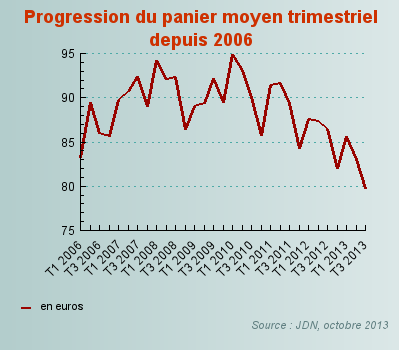
Quelques réflexions sur la baisse du panier moyen de l'Ecommerce


C'est une étude assez ancienne (2013), mais qui est basée sur une tendance de fond, et qui a été reprise depuis notamment par LSA. Le panier moyen du E commerce ne cesse de baisser. Cette baisse est bien trop importante pour être liée à une guerre des prix. En fait, cette baisse des prix est liée à 2 tendances :
  • Au développement de nouveaux segments du Ecommerce, souvent moins valorisés, tel que l'alimentaire.
  • A la hausse de la fréquence d'achat, notamment liée à la baisse des frais logistiques, qui incite les gens à passer de plus petites commandes, mais souvent.
D'ailleurs, ces 2 facteurs se voient bien dans la stratégie du leader Amazon: Des livraisons le même jour, et le développement de l'offre Amazon Fresh, ou encore les "Dash Buttons". 

C'est aussi la raison pour laquelle, il est de plus en plus difficile pour moi de parler de l'Ecommerce comme un marché à part entière. Nous sommes dans l'ère du multicanal depuis très longtemps déjà, et par ailleurs, comment comparer Expedia à Cdiscount ou bien Chronodrive? Sont ils réellement concurrents? 


Thursday, November 19, 2015

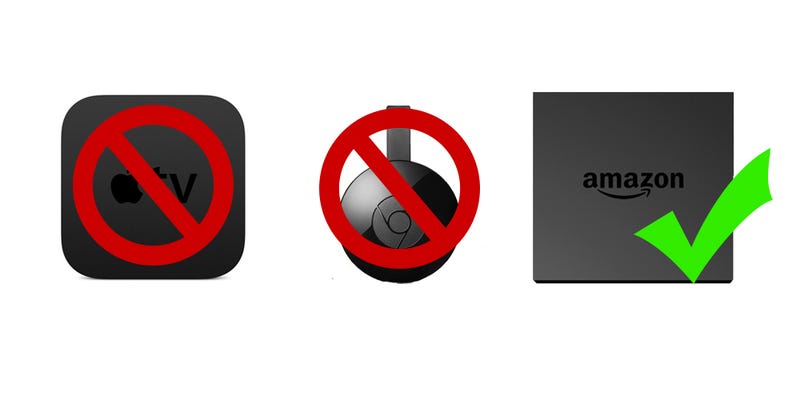
Some Thoughts On Amazon Banning Apple TV & Google Chromecast From Its Website


I recently learned that Amazon has stopped selling on its website both Apple TV & Google Chromecast. Both gears are aimed to plug online video features onto a TV set. Amazon has decided so as they have their own TV plug, the Amazon Fire TV.

This is actually a very interesting topic. Shall we blame Amazon to do so? On a customer stand point, you can obviously discuss the fact they are restraining competition. But Apple don't sell in its Apple Store neither Amazon Fire TV nor Chromecast. But obviously, when Amazon is aiming to be the all around retailer, expanding its categories way beyond cultural goods, how could they explain to avoid proposing good sellers?

But what is important to notice is to see how those companies, that based their initial expertise in different fields are now in direct competition from each others:
  • Apple is an electronic hardware manufacturer, that got into the cultural good market, thanks to Itunes, but other new platforms they are working on.
  • Google is a search engine company, that is now producing software for mobile gears as well as hardware;
  • Amazon is an online retailer that is building hardware to master the sell of cultural goods.

Because of this new kind of competition, you can clearly see that it is difficult to apprehend a competition that have different interests.
It will be interesting to see the new points those companies will have conflicts as their strategies expand.

Wednesday, November 18, 2015

Category Management Series: The New Age of Merchandizing


Merchandizing is a key element of a category management strategy. It is at the cross road of several key departments, and interests:
  • The supply chain, in order to maximize its efficiency and lower the potential stoc outs
  • The product range, in order to set it up clearly for customers
  • The maximization of products expositions depending on their performances.
Merchandizing must evolve. We are living in the age of big data, and customization. Therefore, merchandizing must take advantage of the new technologies in order to allow retailers to set up fast planograms that suits the local clientele by adaptating the product range and organization fast.

Moreover, merchandizing is probably an element that needs to benefit from big data in order to take into account more closely some other key elements of retail performance. For example, by being able to understand better the supply chain problematic, in order to propose at all time the most efficient supply chain by taking into account the pace of orders of the warehouses for example.

New technologies are coming out. Especially 3D schemes allowing to better understand the impact of certain choices.

New customer interface in store is also possible, by using new mobile technologies, augmented reality for example. 

Merchandizing is already at the moment a difficult art. The number of products listed has skyrocketed over the last decade, about 30% of the product range change each year with a high number of innovations coming in. But merchandizing as a high potential to go beyond, thanks to big data and new software, which will allow to better serve customers. 

Tuesday, November 17, 2015

Retail History: Letter of Michael Cullen (Founder Of King Kullen) To Kroger

I read a very interesting and old book named Les Inventeurs du Commerce Moderne by Ethienne Thil (which created Ed in France, and was the former chief of marketing of Carrefour in the 70s). In this book, the author gives example of the greatest story in the US of the creation of retailing.

One of the interesting story is the one of Michael Cullen. He was an employee of Kroger, which was already a pretty big retailer at the time. Michael Cullen had a vision of what modern commerce should be. He hence wrote a letter he sent to the CEO of Kroger to share his vision, with the aim to have the ability to practice his idea.

The letter is just awesome, this is the reason why I wanted to share it with you. 
  • It is so detailed it is crazy! He had a clear idea in mind of how it should work.
  • He pictures some key concepts of what discounter will use to leverage revenues, especially perequation and rationalization of operational costs.
  • He even envisionned how he would spread his store networks, and the impact it would have on inventory, purchasing power....
  • He was so passionate about his trade you can feel it all along the letter.
The letter has never been read by the CEO, which eventually resigned. Michael Kullen created the chain King Kullen and experienced much success with his concept.

The Letter
0 feet wide and 130 to 160 feet deep, and they ought to be located from one to three blocks out of a high-rent district with plenty of parking space, and same to be operated as a semi-service store -- 20% service and 80% self-service.

My grocery equipment would cost $2,500. My meat equipment would cost about $4,500 complete. A total outlay of $7,000 for equipment and a $23,000 stock of merchandise in each store. In other words, I would have an investment in each store of $30,000.

... I expect to do a grocery business of $8,500 per week per store [and] a fruit and vegetable business of $1,500 per week per store. In other words, the kind of stores I have in mind should do a grocery business of $10,000 a week and a meat business of $2,500 per week. On the grocery business, including fruit and vegetables, I can operate on a gross profit of 9%. ... Our meat department sales per store would be at least $2,500 per week, and we would make a net profit of at least 3% on this meat business.
This is the kind of cut-rate chain of wholesale-selling direct to the public that I want to operate:

I want to sell 300 items at cost.

I want to sell 200 items at 5% above cost.

I want to sell 300 items at 15% above cost.

I want to sell 300 items at 20% above cost.

I want to gross 9% and do a grocery, fruit and vegetable business of $10,000 per week and make a net profit of 2.5% on the grocery department and 3% on the meat department.
You need have no fear regarding the present overhead of the chain stores. My buying, advertising and hauling expense of $110 per week per store is more than enough to take care of the buying under my supervision, and this could be reduced 25 points after I had my fifth store opened.
I would bill all merchandise to the store at cost and adopt a cash register check system so that stealing or dishonesty would be impossible. I would inventory these stores every month at cost, and their stock gain less all current expenses would be our net profit per month per store.
It would be a little difficult to begin with to buy for my first store, but after my fifth store was opened, I could buy the minimum shipments and ship 80% of same F.O.B. to the store direct, thereby eliminating entirely a warehouse, which is not necessary when these monstrous stores could show a turnover such as I would get.

Can you imagine how the public would respond to a store of this kind? To think of it -- a man selling 300 items at cost and another 200 items at 5% above cost. Nobody in the world ever did this before. Nobody every flew the Atlantic either until Lindbergh did it.
When I come out with a two-page ad and advertise 300 items at cost and 200 items at practically cost, which would probably be all the advertising that I would ever have to do, the public ... would break my front doors down to get in. It would be a riot. I would have to call out the police and let the public in so many at a time. I would lead the public out of the high-priced houses of bondage into the low prices of the house of the promised land.
I would convince the public that I would be able to save them from $1 to $3 on their food bills. I would be the "miracle man" of the grocery business. The public would not and could not believe their eyes. Weekdays would be Saturdays, rainy days would be sunny days, and then when the great crowd of American people came to buy all those low-priced and 5% items, I would have them surrounded with 15%, 20% and in some cases 25% items. In other words, I could afford to sell a can of milk at cost if I could sell a can of peas and make 2 cents, and so on all through the grocery line.
The fruit and vegetable department of a store of this kind would be a gold mine. This department alone may make a net profit of 7% due to the tremendous turnover we would have after selling out daily and not throwing half the profit away, which is done at the present time in 25% of the chain stores throughout the land.

Then the big meat department. This would be a beehive. We would have the confidence of the public. They [would know] that every other grocery item they picked up they saved money on same, and our meat department would show us a very handsome profit. It wouldn't surprise me if they could not net 5% in this department.
... I was never so confident in my life as I am at the present time, and in order to prove to you my sincerity and my good faith, I am willing to invest $15,000 of my own money to prove this will be the biggest money-maker you have ever interested yourself in.

... Again, you may object to my locating two or three blocks from the business center of a big city. One great asset in being away from the business section is parking space. Another is, you can get generally the kind of store you want and on your own terms. The public will walk an extra block or two if they can save money, and one of our talking points would be, the reason we sell at wholesale prices is that we are out of the high-rent district.
... Don't let the buying worry you in any way whatever. I can handle the buying in fine shape. I could buy goods, ship them direct to my stores 3% cheaper than you could buy them, store them in a warehouse and put them all through the red tape that all Kroger items go through before they are sold.
... Before you throw this letter in the wastebasket, read it again and then wire me to come to Cincinnati so I can tell you more about this plan and what it will do for you and your company.
The one thought always uppermost in mind -- how can I undersell the other fellow? how can I beat the other fellow? how can I make my company more money? The answer is very simple: by keeping my overhead down, and only by keeping this overhead down, can I beat the other fellow.


Read More: http://supermarketnews.com/print/archive/letter-kroger#ixzz3gjIXYLCq

Monday, November 16, 2015

Walmart vs Amazon

Walmart is the largest retailer in the world, by far. It is at least 4 times bigger than its first competitors. It owns a great knowledge of all components in retailing: supply chain, store management, operational cost management, pricing, merchandizing, and even E commerce, as it has invested massively those past few years in this field.

Nevertheless, when you look at the capitalization of Walmart compared to its Ecommerce competitor Amazon, Walmart is by far less liked by the bull market. Why? It is far more profitable, and has been profitable for years, whereas Amazon so far has no profits to show out.


  • E commerce remain the fastest growing retail channel
  • They still have a lot of categories to develop, including food and cosmetics products
  • They have new businesses growing up, especially market place, their cloud services, or kindle activities
  • Moreover, as they don't own store, they are more flexible to face market issues or to grow new countries without having to develop a pricy store network.

Nevertheless, Walmart has some real potential of growth ahead of them:
  • Emerging markets to conquer. So Far Walmart's presence abroad remains weak and a small share of their overal sales. They have real potential to benefit from potential growth of some zones like South America, Asia, or maybe the Middle East
  • Strong projects in E commerce. I believe Walmart has a real edge on its brick & mortar competition on this topic. They have a strong know how in terms of SEO, or click & collect in the US (I believe Carrefour maybe in advance wordlwide, as France is way in advance on the topic). 

Now Walmart in my open remain a sure bet because of its long period of time of performance and its consistency. But there is one key factor that sets Walmart and Amazon: AWS. Amazon web service is all the cloud computing activities of Amazon. It is growing fast, and highly profitable. Way more profitable in terms of % of EBITDA than the discount retail could propose. And Walmart is lacking such a profitable activity. Because of this activity, Amazon has a potential cashflow source that will feed its long term growth.

Interesting article, even though I still believe Walmart has great assets in the competition.


Friday, November 13, 2015

Retail Strategy: Target Launches A New Ecommerce Presence In Over 200 Countries

Target is one of the leading retailers in the United States and Canada. Nevertheless, they have a limited presence abroad. French magazine LSA has recently published an article announcing the launch of its Ecommerce website in over 200 countries

- 50% of the product range available on the US website
- Same prices than in the US
- Available in 60 different currencies
- In large international markets like The European Union or China

This is a very interesting move, because it is quite innovative to see a brick & mortar retailer trying to conquier new markets thanks to its Ecommerce website. Actually, another remarkable move have been previously made by Costco, settling in China thanks to an Ecommerce partnership with Alibaba.

I believe that this is a very interesting move. Ecommerce allow more flexible approach of new markets, either geographically, as does Target, but also new category to approach.

Now the challenge will be vast:
  • The supply chain: Target needs to find a solution to ship products abroad, and there will be issues with the cost of shipping, but also the time to deliver the goods.
  • The marketing: How could Target compete with Amazon, already settled in most countries. Moreover, there is already brick & mortar competition, and I don't really know how Target could position itself different enough to gain marketshares.
  • How could they manage their websites? I don't believe Target will have local management for this initiative. And they'll need people in order to advertize, to boost the activity, in order to have real results.


Thursday, November 12, 2015

Incrementality


Les tendances de la Valley, par 1000mercis... par PetitShow

I wanted to write this blog post after having watched this video. CEO of 1000 mercis Yseulys Coste is speaking about the hypest words in the Silicon Valley at the moment: Incrementality and people based marketing. I wanted to get some thoughts on the first item.

Indeed, Incrementality is the graal of marketers: Being able to have a clear identifiable impact on sales, and hence, on the results of a company. Today, thanks to big data, we have more and more information that could help in this quest of identification. Same thing for category management and retailing: If I enter a new SKU, how much extra sales could I expect from it? Moreover, how much it will cost me to extend my product range (the infamous COGS I discussed several times here).

But this quest is far from being easy. Nowadays, we have so many factors that could impact sales that it is difficult in a 360 marketing approach to measure individually each factors:

  • The quality of the product: Something that people tend to forget, but if you have an average innovation launched in a crowded market, your elasticity will be low
  • The mass media advertizement. Even though going in limbo compared to Internet and social media budgets, mass media like TV, radios or billboarding are still very efficient sales booster, even though it is hard to link direct sales to it.
  • Retailing effort: You know it is my forté, but you need to invest in your retailing channel (as a brand). End of the aisle display, interractions with the shopper, make sure you have the right stock available in store not to miss sales.
  • Of course, Direct marketing campaigns, including social media, emailing, or even website visiting, where you can have a lot of info about the shopper path toward the sales.

Here are also some aspects you need to take into consideration:

Behavioral Data
One of the key component of segmentation today is to be based on customers behaviors. Indeed, social and geographical segmentation is no longer applicable, as customers adopt their consumption based on what they believe rather than historical background.

Dividing your Data Base into 2 Groups
One of the best ways to measure incrementality is to have two groups of people: One who will see the ad, and another one that won't see it (for example, one will receive an email, the other don't). Three aspects to keep in mind:

  • Let's not forget that you won't master the other aspect of your 360 marketing effort. For example, do you know that your first group of people has seen no products in its local store? It has not seen the billboard campaign? It has been away on vacation at the moment? 
  • One of the issue that I have is that it is ok to test, to experiment, in a R&D effort. But if you really want to have a deep impact on sales, it is also important to have an impact on 100% of your data base. And that is something sometimes CRM experts tend to forget.
  • You need to have large enough groups, and specifics group, in order to extract real information of the testing. If you do it on a data base lower than 10% of your overal data base, the info won't mean much. Moreover, if you have only 100 people for the test, it won't really be good infos either.


The topic is wide and interesting. I 'll probably write more in posts to come.


Wednesday, November 11, 2015

Is The Golden Age Of Western Corporation Coming To An End?

If you know me well enough, you may know about my passion of history. I am an adept of the adage "you need to know well your past in order to understand your future". Actually, I am currently writing a book which is mixing my interest in history and my professional skills and knowledge, but so far, can't talk much about the topic, as it is relatively new (I wrote about 50 pages so far...).

Among other topics, I love history of business. I read this very interesting article about the Economist, which put into prospective all the changes that happened the past two decades about the way we conduct business as westerners. Indeed, we, Westerners, meaning mostly Europeans & Norther Americans, share a strong culture:
  • We share the same Christian background
  • Core values where democracy is a key part
  • A common history, based on the colonies, but also the second world war and the cold war, that strengthen our relationship
  • Businesses that work about the same.
But that world, which has been thriving, experiencing one of the most tremendous growth ever the past few decades, is right now at a crucial stage. Our culture tended to assimilate other cultures, by bringing a "superior" culture to the new countries where we were going to. Now this concept is not so easy. We are in the globalization age, and global companies need to adapt at least as much as the local businesses need to.

Here are two of the main factors detailed in the article.

  • The emerging market growth: It is shaking up our world, as it is now leading some industries, innovating faster than us.
  • The growth of new technologies in the share of the global economy: This new competition is based on new business models, that are hurting traditional businesses, as we can see with Uber, Alibaba, Facebook or Netflix
It is actually when the Roman Empire was enable to assimilate any longer its barbarian people that it started to fall down. Because barbarian took benefit of the Roman weaknesses to take over the different provinces.

Is it the end of the golden age of Western corporation as the article explains? Probably. Probably something brand new is showing off. With a new way to conduct business. What could be interesting is to see how our "paradigms", our 4 Ps, our IPOs, our mission statements, our mass media campaigns adapt to the new landscape. 
 
The crisis we are experiencing right now, may actually be a stage toward a new world, that could be ten times better than ours.

Tuesday, November 10, 2015

Quelques pensées sur l'arrivée de Whilelm Hubner à la tête d'Auchan Retail

C'est l'une des nouvelles les plus importantes qu'il y ait eu ces dernières semaines dans la distribution en France, les changements à la tête du groupe Auchan, qui ont conduit Whilelm Hubner à la tête de la division Retail.

Cette réorganisation intervient alors que les résultats de la division française sont difficiles et ce depuis plusieurs années. Les modifications de structure opérées par la précédente direction n'ont pas permis ni d'améliorer la rentabilité, ni de pouvoir influer sur la baisse de chiffre d'affaires notamment de la branche hypermarché.

On lit beaucoup de choses dans la presse sur Whilelm Hubner, comme quoi se serait notamment une personne très peu connue de la direction d'Auchan, et que sa nomination est une petite surprise. Pourtant, Whilelm Hubner:
  • a été directeur de plusieurs magasins en France, notamment dans le nord de la France, le giron historique de l'enseigne
  •  a été patron d'Auchan Vélizy, 1er magasin européen toute enseigne confondu avec ses 300 millions € annuels. Il a été notamment présent lors de la rénovation de ce magasin à la fin des années 2000.
  • a été patron, très peu de temps, de l'Ile de France, la 2ème région française
  • a été patron de la Russie, le pays fort de l'enseigne, avec des magasins dépassant les 300 millions d'euros, des croissances bien souvent à 2 chiffres ces dernières années.

 J'ai eu l'occasion, bien que peu de temps, de travailler avec Whilelm Hubner, lorsque j'étais chef de rayon à Auchan Vélizy. J'ai beaucoup apprécié sa personnalité, son charisme, sa gestion des équipes. Il incarne pour moi le meilleur des valeurs d'Auchan: le commerce, le management d'équipe, la maîtrise des basiques, mais aussi un réel esprit d'entreprise. C'est une personne ambitieuse, avec une vrai force de conviction, basée sur son charisme, mais surtout sa connaissance du commerce.

Maintenant, le grand challenge sera effectivement de pouvoir bien appréhender le multi canal, et notamment la partie E-commerce (mais je ne m'en fait pas trop, il y a de vrais compétences pour l'épauler à Auchan, et Whilelm sait déleguer). Mais également la gestion des autres formats que l'hyper, pour un pur produit de l'hyper. Car aujourd'hui Auchan a beaucoup de tests et de formats qu'il faut consolider: les Simply Market, les A 2 Pas en proximité (qui est un vrai savoir-faire encore sous développé chez Auchan), etc...

Je souhaite bonne chance à Whilelm, et suis certain de sa capacité à pouvoir relever l'intégralité de ces défis. S'il y a bien quelque chose qui me surprend dans sa nomination, finalement, c'est qu'elle ne se soit pas fait avant...


Monday, November 09, 2015

Drugstore and Pharmacy Business: Rite Aid To Merge With Wallgreens

It is very interesting what is going on in the healthcare retail business. Indeed, we can clearly see a lot of transformation into this business:
  • Less regulation, and the will of governments to empower more retailers in order to ease the access to medications.
  • New category approaches by market leaders, especially CVS
  • A lot of new competition coming from other retailers, especially FMCG specialists such as Walmart or Target.
Recently, Rite Aids and Walgreens have agreed to merge their business, to create a healthcare tycoon counting for 40% of market shares.

Obviously, the terms are still discussed, especially as antitrust regulation will probably apply. But why this deal? Primarly because the market is getting tougher, and in order to secure high profitability for both companies, they'll need to leverage synergies, especially in terms of negotiation powers against the major pharmaceutical companies.

This merger has also a strong goal:
“With the physician shortage, the access to primary care physicians will likely be lowered for many patients,” Turk said. “Instead of seeing your primary care provider, you may have to interface with someone at Walgreens to help you dispense your medication.”

Obviously, it is a main trend going on in the healthcare business, and having a strong network of pharmacies with skilled and trained employees to help you with your medication is a key in order to keep groing the business and also to answer some real questions about what the future of health care will look like.

Friday, November 06, 2015

Sephora Flash

Sephora has recently opened a new store concept in Paris named Sephora Flash. The purpose of the store is to try the new technologies in store to improve the shopping experience. You will see a video (in French) below showing you how the shopping experience goes.


The key concept in the shopping experience is the NFC cards allowing the shopper to get information on the product and compose their "digital basket". The idea is simple, based on showrooming: The store, whith counts only for 100 square meters, holds as much products as their larger store of 1 500 m2. How, simply because they have very few stock in the shop. They count on home delivery and the day after delivery in store.

Now, to me, the concept has been base on the problematic of the size of the store. The goal is probably to propose the larger product range as possible (the one the standard concept needs) in smaller places.

Moreover, the retailer has an opportunity to test its new technologies in order to understand better how to use them in terms of customer relationship management. This is the reason why they have a robot to give advices on top of the standard employees they usually have.

Now The only thing that seems to be lacking is obviously beacons. Because why would people use small NFC cards while they could use their phones to have extra content, even maybe more personalized?

Also, it is interesting to have a look at what Sephora does with this store, as obiously the luxury goods and cosmetics product categories are most of the time in advance in terms of usage of new technology and new trends. Even if you are a FMCG retailer you shall have a look at this cutting edge concept.


Thursday, November 05, 2015

Thoughts On The New "Like Button" Of Twitter

This week Twitter changed its favorite button to a "Like" Button. The new button has replaced the star icon by a red heart one. Why such a move? Actually I am really wondering why they have changed.

Moreover, I believe there are features missing in Twitter, and it has been a while they could have add them up:
  • Categorize a tweet in a specific category
  • Add a keep it for later category.
Actually, I was using the favorite button for that matter: keeping some interesting tweets to read and think about later. Which was actually not really a "favortie" action. I actually was eager to have a button just to show my acceptance of something, but my usage of it did not allow me to.

Moreover, why using the "like" word? To look a bit more like Facebook? I am a bit lost in this change.

Also, I have noticed recently they added a poll feature, which is actually really cool an d easy to use. 

Hope the new features I need will be available soon.

Wednesday, November 04, 2015

Why A Weaker Black Friday Is A Good Thing For Retailers


We are approaching the time of Black Friday soon. Black Friday is obviously a key date for any US retailers. It is the day when usually retailers start to break the even point and earn money. It is so huge in the results of US retailers that French retailers have started last year to launch this sales season, in order to boost sales before Christmas.


But I believe that this change in consumer habits is a good thing for retailers. Indeed, it is never good to concentrate too many sales on such a short period. Also, promotions are great to generate traffic, boost sales, and get marketshares, but as everyone concentrates their effort on the same date, a lower promotional pressure may allow retailers to improve profitability.

Anyway, Black Friday will still remain one of the top date for retailers, and an important event not to miss.

Tuesday, November 03, 2015

Récoltez des avis consommateur en magasin


Une présentation intéressante réalisée par Altavia sur les différentes alternatives à mettre en place en magasin afin de récolter les avis de consommateur. En effet, il est toujours intéressant d'avoir le ressenti des consommateurs lors de leur parcours d'achat, et en essayant un maximum d'avoir des informations sur leur ressenti, et ce de manière récurrente, cela permet de pouvoir travailler l'expérience client de manière assez poussée.


How to Pack Like A Pro

Wether it is for leisure or business, packing to travel (especially by airplanes) could be a hard task. You need not to forget anything, but also make sure everything fits perfectly.
Here is a very interesting video about some techniques to use while packing. Some of them I was not doing, especially folding clothing one in another. Quite interesting.

We are approaching the Christmas holidays season, some it could be good if you watch it before flying to your vacation house.


Monday, November 02, 2015

Category Management: Du rôle de la MDD

La marque de distributeur, ou marque propre (ou MDD), représente les produits qui sont commercialisés par une enseigne sous sa marque. En conséquence, elle revêt un intérêt stratégique:
  • Elle porte le nom de la marque de l'enseigne, donc est vecteur d'image
  • Elle permet de se différencier. En effet, la MDD est unique à l'enseigne, et donc différent des produits de marque nationale que l'on peut retrouver dans toutes les autres enseignes.

Depuis quelques années dans la grande distribution française son rôle est mis à mal. En effet, face à la guerre des prix, 2 facteurs concomitant ont réduit l'intérêt des MDD:
  • La baisse des prix de marque nationale ont diminué l'intérêt relatif pour le consommateur de payer moins cher une MDD.
  • La MDD a bien souvent été utilisée comme outil de péréquation pour recouvrir des marges mises à mal.
Néanmoins, je reste souvent surpris du manque d'intérêt actuel pour ces marques. Le seul distributeur qui joue clairement la carte de la MDD aujourd'hui, c'est Intermarché, notamment du fait qu'il est producteur d'une grande partie de ses produits MDD.

J'ai trouvé ci dessous un schéma clair, expliquant les fonctions de la MDD. 

Je pense que la MDD devrait revenir au coeur des stratégies des enseignes prochainement, car leur intérêt est indégnable.


Wednesday, October 28, 2015

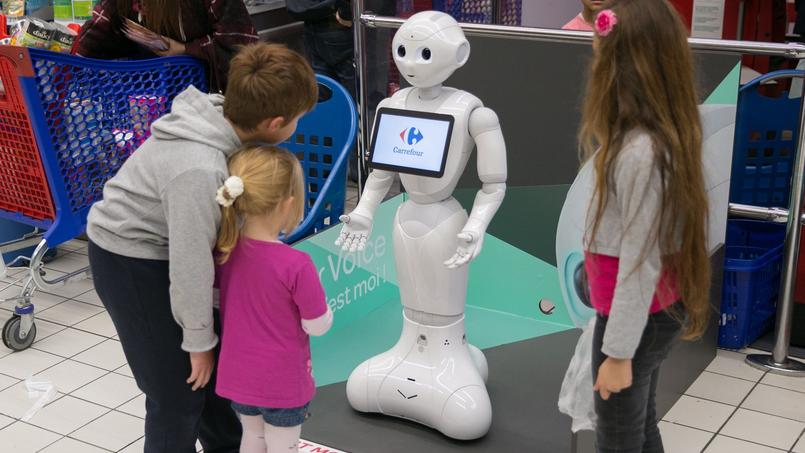
Customer Relationship Management & Retail: Carrefour Testing Robots To Help Customers In Store

Carrefour has launch a test in its Claye Souilly store 4 robots named Pepper, to help customers in their decision making process in store. The robot gives information on the loyalty reward card & program, advices on wines or other technical products, entertain kids.

Now is it the future of customer relationship management in store? Not so sure, I strongly believe the human interactions remain the best way to interact with customers. Actually, I love the way the company building those robots is selling it: it can interract with people, read the emotions of people to understand their mood... Do we really need robots for that?

Nevertheless, Carrefour is right to test the concept.Noone can deny that eventually sooner or later some kind of robots will be used in retailing for customer experience purposes. Obviously the technology is there, promising, and the usage needs to be understood. This is therefore interesting for Carrefour to keep an advantage on the competition by testing before anyone those robots.


Tuesday, October 27, 2015

Category Management: The Lean Strategy Of Global FMCG suppliers

Interesting era right now form FMCG suppliers. For years, FMCG Leaders like P&G, Mondelez, Unilever, or L'Oréal were keen on growing their brand portfolios in order to master their categories and getting bigger to be more cost efficient.

But lately, a new era has started: downsizing. 
Why? In order to focus on more profitable activities, especially focused on global brands, such as Pampers or Always for P&G, or Milka for Mondelez. 

Moreover, as P&G CEO has previously explained, maybe we have come to a stage where it is too complicated to manage so many categories and different brands to be efficient, and customers are willing to limit their choice in order to be more efficient in store.

Today, we are facing a very interesting time of the FMCG world. Indeed, those structures are changing, and there are 3 potential outcomes:

  • We may see emerge new global actors, that will be able to thrive with those brands for sale.
  • We may see potential mergers of those actors, that will be leaner and therefore it would be easier to see a venture, to create new tycoons.
  • We may have less and less global companies, like Nestlé, Unilever or even Mondelez, focused on several categories at the same time, to have real champions on only one business.
But as a matter of fact, we can clearly see that the strategies of those companies are clearly dictated by stock exchange markets, eager to cash back as much as possible, without a clear industrial view. 

Moreover, we can see more and more a reverse strategy from global to local. And local brands, even though numerous, could be very profitable, and more adapted to customers needs. Probably a lot of potential for new comers or company that will seize the opportunity. 


Monday, October 26, 2015

US Magazines Try New Business Modells To Boost ROI of Advertizers

ROI is a key performance index for marketers, and new technologies allow to have a clear picture of the performances of new digital media. This is one of the reason why some more traditional media such as newspapers and magazines are struggling.

I read this very interesting article, discussing about a Wall Street Journal article. In Norther America, some magazine companies have implemented a new interesting business model. If an advertizing campaign has not significantly increase sales, the magazine company will give money back. 

3 conditions:
  • Your campaigns need to be set to reach 125 million readers (about 40% of the US population, which means a huge campaign) at least three times during a 12 months time frame. 
  • Brands need to raise their budgets at the magazine company in order to cover the potential cash back cost.
  • Products sold by the company needs to be monitored by third party market research companies: Nielsen Panels, Catalina loyalty reward program monitoring... The idea is to have a clear third party able to identify objectively the impact of the campaign.

Studies established by the Time Magazine Company shows that one dollar invested in advertizing with them triggers $17 incremented sales. 

I believe the initiative is great. For sure mass market media are key marketing tools to launch new products or set strong brand equity. Actually, I am kind of deceived on how advertizers use social media like Youtube or Facebook to advertize, as it looks more like spamming than anything else. 

It is kind of a cultural revolution for those companies to think that way which I actually like. They have a strong tool to advertize, and the risk of losing is low. 

Friday, October 23, 2015

Social Media & Retailing: Walmart & The Get On The Shelf Program

Probably an information you already know about as it exists since 2012. But I recently learned about it: the Get On The Shelf Program of Walmart. Walmart indeed leverages the crowdsourcing concept by allowing its customers to select a product that will, as a prize, be listed in Walmart. 

It allows Walmart to have a clear feedback on the interest of one product
It implicates its customers in the selection process of the product
It provides a clear opportunity for the supplier, being listed in the most important store network in the world. 

This is a great way for a large retailer like Walmart to interact on the social media with its customers.


Thursday, October 22, 2015

Global Retail News

I met lately Sophie Baqué, who is the chief publisher of Global Retail News, A business newspaper dedicated for retailers. I did not know about the publication prior having met Sophie, but I had the opportunity to read some samples of those editions. It is very interesting. Retailing is a global business. It is actually what I try to share with my audience on this blog, with examples from all over the world. Actually, less than 50% of my audience come from France and the US, which are my main countries. And Global Retail News provides insights from all over the world, market leaders, which are sometimes not so much known in Europe or Northern America.

Indeed, we always discuss about the high potential of Asian, African or the Middle East markets, but very few infos are available. 

 I highly liked the october edition, dedicated to the health & beauty business, with interviews of L'Occitane CEO Nicolas Siriez.

It is always great to be able to think outside the box, and see what is going on around the world, as new opportunities could come wherever and whenever. Global Retail News is available both in French & English. 

Wednesday, October 21, 2015

Show-Roomer: Solution communautaire pour tester les produits avant l'achat sur du Ecommerce

Aujourd'hui, présentation d'une start up française rencontrée lors de la Paris Retail Week: Show-Roomer. L'idée est simple: proposer aux clients d'un E-commerçant de tester un produit (impliquant, type canapé) chez un consommateur actuel, avant sa prise de décision.

En effet, certains produits sont difficile à acheter car impliquant et cher, et donc ces achats restent peu développer en ligne. Donc Show-Roomer permet de trouver les clients d'un produit et de venir l'essayer "en vrai" chez la personne.

L'idée est intéressante, et surfe sur plusieurs tendances:
  • Déjà le "show rooming", souvent vécu mal par les commerçants traditionnels qui voient les clients venir se renseigner sur les produits avant de les acheter en ligne. 
  • Le web communautaire, avec les réseaux sociaux, et donc l'aide en ligne.
  • La géolocalisation, avec l'idée de pouvoir trouver un endroit proche pour tester le produit.

Maintenant, je reste dubitatif sur la capacité à développer le concept:
  • Y a t il beaucoup de gens qui souhaitent s'investir dans une marque en proposant à d'autres personnes de tester leur produit chez eux? J'ai du mal à me voir attendre quelqu'un pour essayer mon canapé chez moi alors que je ne le connais pas, et ce même via rétribution.
  • L'obsolecence des modèles: Beaucoup de modèles évoluent très vite, et pour avoir une base de "consommateur" assez large pour pouvoir répondre au besoin, il va falloir avoir énormément de personnes dans le système.

Maintenant, je souhaite tout de même bonne chance à cette start up avec une idée originale, qui crée vraiment de la valeur et qui répond à un besoin consommateur réel.

Tuesday, October 20, 2015

Billions in Change

I saw a very interesting commercial on Youtube last week. It was called "Billions in Change". It is actually difficult to see what actually the commercial sales. 

"Billions in Change is a movement to save the world by creating and implementing solutions to the most basic global problems – water, energy and health. Doing so will raise billions of people out of poverty and improve the lives of everyone – rich and poor."

It tells the story of the founder and the CEO of 5 hours energy drink. After having reached a fortune of $4 billions he started to launch new projects aiming to help "those who have left).

The philosophy: 
The more you are given, the more you are asked. It is a weight. If you are given more, you need to give back more.


At the time I am writting these lines, the video has been watched almost 1 million times. And trust me it is worth watching. Very inspiring.

Monday, October 19, 2015

Marketing To The Bottom Of The Pyramid

I wanted to share with you extra thoughts on the idea of marketing to the bottom of the pyramid
I have seen that the topic has interested much of my audience, and I understand the reason why. 

Indeed, there are large markets to cover for people earning less than $2.5 a day. And this task is different from marketing to a western cultural millennials clientele. 

It inspired me 2 thoughts:

You need Other Attributes To Succeed In Those Countries
You shall not use the same marketing technique, the same strategies in those countries and for those customers. This is the reason why it is such a hard task. You need a specific marketing approach. So far, I don't think much has been written about the topic, and I don't think any classes are dealing with the topics.

The Importance of Western Developped Countries
As a Health & Beauty purchaser, I constantly have in front of me global companies chatting about how the French market does not interest much their head offices. They rather invest in new growing countries, where growth is, and profitability higher, whereas France is growing slowly with high competition. 
But marketing to growing country is a much different task. Moreover, thank god there are developped countries: It is where innovation lands. It is where you are able to test new products, new marketing approaches, it is where you can have volumes. Therefore it is important not to neglect developped countries, because it is where innovation can be built for long term growth.

Friday, October 16, 2015

Some Thoughts On Accenture's Retailers at Risk Analysis


This is an interesting chart, because it shows clearly two things:
  • The strategy of some manufacturers, eager to deal directly with the end consumer.
  • What new technologies allows to do in terms of automation of orders.
There is actually a third part, not really shown by the chart: the fact that market places are booming, which gives less power to retailers in terms of product selection. As market places allow different retailers to propose a wide range of products, there is less value for the retailer to select products.


Nevertheless, I am not sure that a value chain where customers will directly order from the suppliers without any retailers in between is realistic. Indeed, customers are not sheep that are always ordering the same products, from the same companies. The will of customers to choose from wide ranges of options will still give an edge to retailers. Moreover, let's not forget, especially in the CPG world that we are talking about fast moving items, purchased frequently, but from different categories of products, which means in terms of cost efficiency (logistics) need someone able to retail and get the order together.

I am not that much inspired by initiatives like the dash button, because it costly for the supplier, and the customer benefits very low. Moreover the execution for the retailer is also a bargain.

What do you think about it?


Thursday, October 15, 2015

The Positive Side Of Writting In Business

As a blogger I highly estimate the importance of writting. Actually, one of the reason why I blog, is that I have access to a lot of very interesting information, that I need to write down in a blog post to process it and make it mine. The writting process is therefore a way to learn, and to assimilate the information.


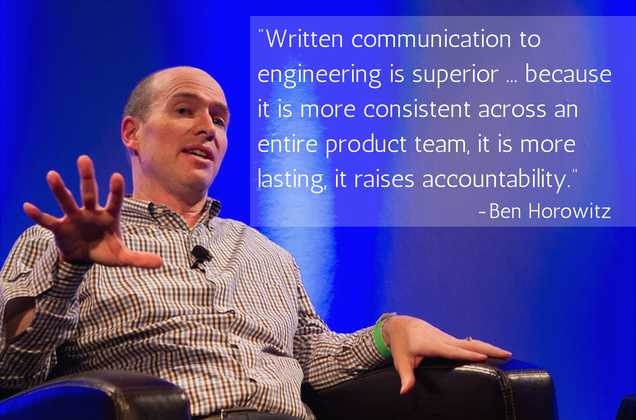
And actually I 100% agree about it. Of course, a lot of people believe that writting notes are a waste of time and energy, and that oral communication or Powerpoint presentations are way better media to share information. But actually, what a lot of business are lacking is consistency in their decisions. And by writting it down, you allow:
  • The decisions to spread easier in the company
  • To stick, which actually matters, as it will be more respected.
In our constantly changing world, there is a deep added value to write down and think through your decisions in order to make it right, and make it consistent.

Here are some very powerful insights:
“There is no way to write a six-page, narratively structured memo and not have clear thinking.” 
Jeff Bezos, Amazon
The main point of writing is to force yourself “to be more precise than [you] might be verbally.” That self-imposed precision, according to Grove, is a “safety-net” for your thought process that you should always be doing to “catch … anything you may have missed.”


Wednesday, October 14, 2015

A Quick Outlook at Wegmans

Wegmans is a US grocery retailer I did not know much about, as I have mostly lived in California, whereas Wegmans is on the East Coast (Greater New York Area). It is a familly operated business of a pretty large size, with 77 stores. 


A perfect employer: employees are well treated and love to work at Wegmans. Same thing for Costco, another outperforming retailer. Customer relationship is key in retailing, and by having appropriate staff management, you have employees that will share their happiness on being there.

An amazing customer experience: beyond the conctact with employee, Wegmans put a lot of effort in merchandizing, in order to create a warm place where customers love to spend time to shop. The way the store is set up allows to have breaks with different "environment" or "ambiance". 

A pioneer: They are most of the time the first to adopt new technologies to help customer experience.

Be active in the community: to have clear mission statement and proper value, it matters bond with the community. 

To go a bit furhter, I invite to check the 25 reasons why Wegmans is loved by its customers. Below couple of chosen picks. Actually, I have also been impressed by their website: simple, full of interesting content.


Thursday, October 08, 2015

How To Think Visually


At the age of big data and reporting, we constantly present different kinds of charts to managing staffs, clients... But it is not that easy to create top of the line presentations that actually interest the audience.

Most of the time, sunk by the numerous data, diagrams presented, the audience tend not to listen.
Also, another very annoying habit I find most of the time of my suppliers: the ever growing market syndrome. The supplier comes with a 40 pages presentation with graphs only showing numbers growing, 1st position ranking, and so on... So annoying, as it does not reflect the truth of the situation.


Here is an interesting infographic showing the different ways you may present your point, either with data or by making some visual analogies. A great infographic to look at before creating a power point presentation, to assess the question: Am I clear in the analysis I made?

What really matters is to be able to use the right analogy to provide the right message.

How To Think Visually Using Visual Analogies #infographicYou can also find more infographics at Visualistan

Négociations annuelles 2016


Jeudi 7 octobre dernier avait lieu la conférence annuelle sur les négociations commerciales 2016 organisée par LSA.

Je n'y étais malheureusement pas convié, mais un post très court pour partagé avec vous les Tweets de la conférence. Peu de tweets, pas de Periscope, cela reste encore très "brick & mortar" comme événement.

Bientôt un article récapitulatif sur LSA.

Wednesday, October 07, 2015

Knowing When To Use Big Data

Interesting talk at NBA Open Court. Former NBA legends are chatting at the beginning of the video about basketball stats and what it means. They are discussing about “the Player Impact Estimate”. The player impact estimate ambition to encompass all the different statistics of one player in order to evaluate its impact on the game, beyond the simple number of points it scores. 

Here is how it is calculated:
"PIE measures a player's overall statistical contribution against the total statistics in games they play in. PIE yields results which are comparable to other advanced statistics (e.g. PER) using a simple formula.(PTS + FGM + FTM - FGA - FTA + DREB + (.5 * OREB) + AST + STL + (.5 * BLK) - PF - TO) / (GmPTS + GmFGM + GmFTM - GmFGA - GmFTA + GmDREB + (.5 * GmOREB) + GmAST + GmSTL + (.5 * GmBLK) - GmPF - GmTO)"


We see more and more data being used in order to prepare basketball players to perform, & make the right decisions. Same things for coach and general managers, using data to understand which trade would make the more sense, and how it will affect the overal team. This is how the Houston Rockets is managing their team, with complex data analytics. The Kellogg University recently published an article about it: Daryl Morey loves good data, and lots of it. As general manager of the Houston Rockets, the Northwestern graduate has made a name for himself with his devotion to using data analytics to make team decisions—everything from where to shoot from on the floor to whom to acquire in a mid-season trade.


In the business world, nowadays, we are submerged by data, thanks to big data, storage capabilities, and analysis tools. But as Reggie Miller points out, especially in retailing, entrepreneur mindset, personal instinct are key to make the right decisions.

It is important not to overate data in order to make decisions. Indeed, making decisions by itself creates more value than the analysis by itself. And understanding customers by the numbers sometimes don't matter more that understanding them with a down to earth conversation.

Personal interactions will always been key in business.

Tuesday, October 06, 2015

Will Electronic Price Tags Allow Retailers To Use Yield Management Pricing Strategies?

I remember as a business school student to have worked on case studies where companies were using yield management pricing. It was especially the case for airplane companies, changing their pricing depending on the demand and the filling of aircraft. The purpose was simple for those companies: maximizing profits while securing a rate of filling close to 100%. 

In retailing, E merchants tend to use the same techniques. They are indeed able to benchmark prices in real time in order to keep competitive prices upon competition. It is key for merchants as price search engines are numerous, and shoppers tend to compare prices more than in brick & mortar world. Actually, in the brick & mortar world, most of the time, shoppers tend to check prices online, either to get a discount in store, or to purchase what they found online, the infamous "show rooming" trend.

  • It secures more accurate pricing in store
  • It saves on operational costs while there are perequations happening
  • It also provides a better customer experience, with better naming of products, and more information.
But the article also outlines that this new technology allow brick & mortar retailers to compete with Amazon, and other e-retailers. I agree on the fact that electronic price tags allow faster changes in terms of prices. But the article goes beyond, and believe it could empower stores to change their pricing depending on the time, the day of the week, to maximize profits and to compete with Amazon.

I believe indeed pricing will evolve fast, in order to maximize profits, and automated pricing moves could for sure happen soon enough, thanks to big data. But I don't really believe that stores are actually adopting electronic price tags to do so.

But the article remains interesting, because the potential is there, and it would be interesting to test the technology, to see if it is really accurate.

Now, on FMCG products, it seems difficult to twist so much the prices, because you might loose your customers in such complexity, which will eventually be figured out.

What do you think about it? 

Monday, October 05, 2015

Category Management: Partnership Between Fnac and Microsoft

The Fnac has hit the headlines last week with its public offer to exchange with Darty, which would create a tycoon of the hardward retailing world in France.

This initiative have started in 2012, and the article is showing how to benefit of such a category management effort, especially in a market decreasing by 9% in 2015. Actually, let's remember that Walmart has set up its first category management initiatives while it was experiencing issues with its sales growth.

There are 6 pillars to this initiative:
  • Microsoft's shop in shop, with specific merchandising.
  • Microsoft staff in 40 of the largest stores. They aim to promote and demonstrate the products, enhancing the shopping experience and helping shoppers.
  • Exclusive premiere launch, like for the new Surface tablet, available 1 month in advance. It allows the Fnac to create differenciation through its product range.
  • Cocreation of products: they are exchanging information in order to create unique products, like the 365 Office Pack including Bitdefender
  • 4 Microsoft employees dedicated to the Fnac.
  • Data Exchange about sales and marketing.
Obviously, the partnership makes sense, as Microsoft is among the largest supplier of la Fnac, with a clear know how in terms of promoting high tech products, and la Fnac is  the biggest client of Microsoft (40% of shares in France), with a know how in terms of theatralization in store.

Those category management examples are pretty rare for different reasons in France, and I believe it was interesting for me to share with you those insights.


Thursday, October 01, 2015

Category Management Strategies: Conducting A Proper Shopper Market Research

The shopper is a key target to take into consideration in category management. Most of the time category manager will stick to its panel and market information in order to make decisions to improve its categories. It is an easy bet, with extensive data available. But let's not forget the key remains the customer, and at a higher extense the shopper. 

Understanding the shopper habit is key in order to think out of the box, and to make right category management decision. It will allow the category to react to potential shopping habits.


If you were to conduct such a research, I highly recommend you to read with close attention this document, as it gives you a clear step through.

Two points I wanted to highlight about the process:
You need to understand the shopper environment. And it encompasses its shopping activities, but also different aspect listed below.


Also, the checklist of things to verify if you have not forgotten to conduct your research.