Wednesday, June 05, 2013

Study Questions Social Media As A Traffic Source For E-Retailers

Social media's budgets and expenses have raised fast those past few years. As social media gained exposure , companies tried to leverage these new media in order to raise sales, especially by reaching customers in a brand new way. Hence, a lot of market studies and professional articles discussed about how an appropriate social media strategy helped companies to trigger sales, and raise revenues.

Nevertheless, it seems that the real potential of social media as a revenue generator is still questioned. A recent study showed that social media is already lagging as a direct traffic source for e-merchants

"Social media represented just 1.55 percent of all ecommerce traffic, way behind search (31.43 percent) and trailing email (2.82 percent). And social media traffic numbers were down from Q1, 2012, when they were 2.36 percent. The data lead to the question: Should brands change their approach to social marketing?"

I have always been an early user of social media, but also an evangelist. Despite these facts, I have also studied a lot how to use social media like Facebook, Twitter among others in order to generate more business, and in general to improve customer relationship management. And as I have become an expert of the question, I still wonder sometimes how to use these tools in order to have concrete business results.

By the nature of social media, even though they are set with a large amount of customer data available (what people calls "big data"), it is difficult to link one sales to one action on social media. 

What is for sure is that companies that have invested important budgets in social media most of the time are the ones who thrives the most on their market. This study is for sure very interesting because it sets two facts we should never forget:
  • Social media remains small compared to other mass media like TV, radios, or even newspapers
  • Social media return on investment is not that easy to measure. 
I believe that social media is here to stay, and that there is a lot of room for improvement in order to have better results with their usages. 

Saturday, June 01, 2013

How To Leverage The Potential Of Web to Store?

I'd like to thank PPC, a famous French blogger and friend, that tweeted a grat article (in French) on how to leverage the potential of Web to Store.

Indeed, a lot of retail professional complains on the new hype of "show rooming", the fact that customers tend to visit stores to see and touch products, get information by the sales person, and then compare prices at home to finish up buying at home, most of the time on a competitor's website.

The show rooming trend is hitting hard some retailers working on the cultural goods, like Virgin in France, Barnes & Noble in the US, and also the high tech retailers, like Best Buy, or Darty in France.

Nevertheless, there are also ways to leverage the Internet in order to create foot traffic in stores. This is what the article calls "the Web to Store".

There are 4 ways to use the web to store approach:
  1. Couponning: Propose to customers to print online coupons to use in stores.
  2. Store locator: Allow customers to prepare their visits on line by giving them extensive information on how to get to your point of sales.
  3. Click & Collect: The shopper shops on line, but get its product at the point of sales. The advantage for both the customers and the retailer is that you save expenses on the delivery trip. The retailer may also trigger additional sales thanks to the visit.
  4. The shopping preparation: Sometimes the web is better to get information, and to finish up the work in store. I believe that works a lot for purchases with a long decision making process, that will need the advocacy of a sales representative.
Despite the fact I believe web to store may help one store to raise its sales and in overal, grow the whole business (both online and in store), I believe that in overal, the rise of Internet will destruct in the end the performances of traditional stores. But in the end, companies that will be able to set a strong position online with a great quality network of stores have a great advantage upon competition. 

What do you think about it?


Friday, May 31, 2013

Le category management à l'ère du multicanal et du digital


Un petit article en français pour souligner l'exellent travail entre autres part le master distribution et relation client de l'Université Paris Dauphine.

Le travail porte sur les évolutions du métier de category manager causées par l'avénement du Drive. En effet, le drive ne cesse de gagner des parts de marché sur les magasins traditionnels, et bien évidemment, les techniques se doivent de s'adapter à ce canal de vente.

Cela me rappelle un peu la problématique soulevée par Henri Isaac au sujet de l'évolution des techniques de merchandising en ligne. Le category management des points de ventes virtuels en ligne n'en est qu'à son début, et je suis sûr que les présentations de produits et les techniques de vente vont s'améliorer et se développer très rapidement.

Le travail se focalise principalement sur la structure de management de l'offre: Est ce que les équipes dédiées à la gestion de catégorie des drives doivent elles être différentes des équipes gérant les points de vente classique?


Il est sûr qu'il est intéressant d'avoir des category managers qui gèrent les 2 parties de l'offre, car le client ainsi que le produit reste le même. Néanmoins, je pense qu'il y a énormément de compétences à développer via le drive et les courses en ligne, afin de capitaliser sur la croissance déjà existante.

Monday, May 27, 2013

French Retailer Intermarché Tests Connected Glass For In Store Usage

There is a lot of hype around Google glass now that Google allowed few people to test them, like Loic Lemeur. I have seen this cool video of Sergey Brin explaining how Google Glass works.


Technologywise, for sure, Google Glass has great potential. The technology is very advanced, but there will be a long time (at least 3 years I believe, as the cost when they'll be on the market is going to be outrageous) before it may actually be available to the mass market. Nevertheless, it is interesting to see how people and companies will be able to leverage the potential of this device in order to improve people's lives.

Companies that will test and try these technologies now will get a very important advantage upon competition.

French retailer Intermarché is conducting right now some tests of connected glasses technology to see how it could be used by shoppers in store. They set up a partnership with French agency Digitas.

Here is a video showing their works.


They have identified 5 main usages:

  • Indoor GPS: It may be very interesting, even though I think that their example is a little bit too limited to show how it may improve shopper experience. I believe that this application should be connected to the grocery shopping list to save time and being more efficient.
  • Product scanning: Pretty cool, it already exists at Auchan with self scanning, even though you need a remote control to do so. But the cool thing is all the added infos you may get through it.
  • Customized promotions: I don't know about this one, because I am affraid this may be too disruptive for customers.
  • Cross and up sell: Let's be careful with this one too.
  • Easy-Check out: This is just awesome! I believe a lot in it, even though there must be a lot of control to avoid stealing.


I believe they have already thought through a lot how to use  these glasses. Here are some thoughts that crossed my mind while watching this video:

  • These applications will actually be able to be proposed to customers once the customers will own some connected glasses. Same things with smartphones, it would be too costly for a store to borrow some of theses glasses to shop, as they must keep razor thin margins.
  • It is important to create real added value, and the technology must not be too disruptive. For instance, proposing recipes when you buy a product is a cool idea, but pretty scary in terms of usage. Once marketers will use these kinds of techniques, it will scare shoppers off to use these glasses.
  • I love the payment system. Retailers may save lot of money thanks to it (as cashiers are one of their biggest expenses) and customers will save times.

Friday, May 24, 2013

Demand and Sales Data: How To Leverage Both

As a category manager, I am used to deal with a lot of data: Sales statistics, market research, among others. The purpose of a category manager is to understand how to build the offer of one store in order to respond to consumers' demand and hence increase sales.

I read the article of the Harvard Business review: Demand and Sales Aren't Equivalent with a lot of interest. Indeed, the goal of this article is to show that sales figures don't really necessarily translates what consumers really need. And I must admit that as a category manager, with the hands full of sales data, we tend to focus on sales data.

But as the article details, there are a lot of reasons why both are different:
  • Sales data don't show you the detail of how one household consume a product. One shopper may buy 3 different kinds of milk, but you may not know what will be the usage of it. Is there any milk that has been bought because you were out of stock of another milk? Is it because of a specific recipe? Is it a recurrent need?
  • Sales data won't show you if your products match one consumer needs: If you sell for example shampoo bottles of 600 ml and only 600 ml, you will never know if this is too much, not enough. Consumers will buy it because they won't have the choice. 
  • Sales data are mostly analysis of the past. It is tough to forecast future consumers behavior based on sales data (even though you may expect high increases of sales in different segments, but once you notice them, it is already too late). Markets evolve faster and faster, and it is important to have ways to watch what will be next.
Therefore, it is important to have data tools that will allow you to analyse the demand, and sales.

Wednesday, May 22, 2013

Some Thoughts About Yahoo! Buyout Of Tumblr

I am not used to comment fresh news on this blog anymore, as my schedule don't really allow me to write on a daily basis. Nevertheless, there has been a lot of buzz around the buyout of Tumblr by Yahoo! those past few days. 

I have never really used Tumblr, even though I reckon it is a great service, as I already owned my blogspot blog, which I find to be fine for my usage. I followed a bunch of blogs on the service. Probably Tumblr was a fresher and more adapted blogging service than the historical ones, and this is the reason why it works so well.


  • Yahoo has probably made the moves in order to strengthen its audience, especially leveraging the social media hype. Yahoo has for sure a strategy based on content. They have abandonned their own search engine, and is the 4th world most visited web page. But how will Yahoo find synergies between its actual services and Tumblr? It seems difficult to tell.
  • Tumblr has never been oriented yet toward making a profitable business model. They have not earned any money yet. How will they be able to change quickly their service in order to turn Yahoo's investment into a profitable action?
  • In overall, most of buyouts like this one, never really benefits the service for its customers. Orange for example is trying to sell Dailymotion, skype has been sold by Ebay not a long time after it acquired it, without making any improvements to the service. Sometimes the service even stop existing. So users most of the time are sacrified.
I also read another interesting article (I don't find the link back though), which was interesting: Yahoo, despite all, remains a profitable business, that has been able to adapt the different cycles of the web history. Yahoo has always been able to adapt itself to adapt its business model. Maybe Tumblr's acquisition is one of many moves that will secure Yahoo's future.

Nevertheless, what has just happened is symptomatic of what happens in a lot of cases with start ups in the Internet world: A lot of companies develop cool products that interest a massive amount of people fast, but with no business model, hoping a bigger company will buy it out before they need to prove any consistent ways to generate revenues. And I believe that this fact will end soon, as Internet companies start to get bigger and bigger.


Wednesday, May 15, 2013

Henri Isaac: Building A New Path For E-Merchandising


Henri Isaac is a great source of inspiration for me. He was my teacher as a student @ Paris Dauphine, and I have always loved his passion for what his does, and his ability to envision what technology may bring to customer experience.

I had the opportunity to discuss with him not a long time ago, and he told me how furstrated he was to see how e-retailers were conceiving their merchandising approach. Indeed, whereas the Internet world has changed a lot those past 10 years, with the arrival of social media, smartphones, tablets, and new technologies, product pages have not evolved that much. 

Henri recently published an article about this topic. He explains that the products catalog concept, which is used by most of e-merchants is not adapted to the best online shopper experience. Even though products catalog have improved, it is important to have a better way to link the different products of the offer together, in order to improve the shopping experience.

He also believes that brand content will be key in order to raise the shopping experience.

I must say I totally agree with him, especially when it comes to tablet. I ve tried several times to shop on different websites, and most of the time it is almost impossible to shop with a tablet.

In my opinion, it would be interesting to see what kind of merchandising concepts will appear within the next few years (I shall say few months...) in order to benefit 100% from the different platforms that exist (tablets, smartphones...). And probably this will come from a new comer, as e-retailers for most of them are already too big to try some of these actions.

If some of you owns any kind of examples or great websites to check which are highly innovative in terms of e-merchandising, I'd be thrilled to know. Feel free to comment on this blog about it.

What do you think about it?

Saturday, May 11, 2013

Some Thoughts About My Kindle Fire


Since this Christmas, I am the owner of a Kindle Fire from Amazon.
I already own at home:
  • A Samsung laptop
  • An Ipad (1st generation) which is still working great
  • A Blackberry bold
But I was eager to add a new peace, especially for all what is to read things. Here are my different uses of the gears I own at home:
  • The Laptop: I use it to blog, to do my Exel's spreadsheets, sometimes to go on the Internet, to upload photos. I still believe nothing replace a computer when it comes to editing and creating things.
  • The Ipad: I use it to watch youtube videos mostly, which I do a lot. I also use it to read my Flipboard, or some newspapers like Lefigaro, or the Huffington Post. I also uses several apps, but to be honest, it is not something I do on a daily basis.
  • The Blackberry:   I use it for social media usage, such as tweeting, Foursquare's checks in, or Facebook reading. I also uses it to get fast info, for example on websites like wikipedia.
What I use the Kindle for:
  • Read books: I got couple of books, and I am pretty happy about it. It is easy to read
  • Watch US channels. I don't know how, nor why, but I am able to watch some US TV channels on the Kindle... Like History Channel, Showtime, ESPN, ABC... Love it
  • Read websites and blogs: I love the screen and the size is perfect. I love the flipboard app.
I love the Kindle Fire, and I believe this is what I use the most now. The size, the screen quality, the battery life are just great. Also, what I love is how sharp the digital keyboard is. I have always been a fan of Blackberry because I always consider nothing compares to a hard concrete keyboard. The Kindle fire is amazing, especially when I go to conferences to take notes, even though I experienced some problems after a little while, the app to take notes (I use the draft of the email app) tends to bug and freeze. Maybe there are better applications I need to look for. Also, I love the book store. Really well done, it is always easy to find what you are looking for.

What I don't like
  • The limited number of applications: All the apps I own are great. But Kindle is working on Android, which counts a huge number of apps. Nevertheless, I can't download (at least officially) any of them! This is silly.
  • The bug when I take long notes as I already said.
  • The OS is not as simple as the Ipad's one. At the beginning, you struggle to closes some apps or to look for them. But after a while, you adapt. But there is still room for improvement.
  • Some videos I can't watch on websites, due to restriction of the web browser. Nevertheless, it is ten times less frequent than the problems I have on my Ipad...

I highly recommend the Kindle, which is cheap compared to the competition, and propose a great added value to a computer, smartphone and traditionnal tablet; 

Thursday, May 09, 2013

Social Media And Retailing: How Lidl Uses Facebook In France

Social medias uses in business and retailing starts to be common. Most of retailers on a fan page on Facebook, and sometimes a Twitter account. But today I wanted to write about not a standard retailer, but a hard discount retailer that have decided to communicate on social media : Facebook.

Lidl is one of the largest retailer in the world. Despite a low cost model, short product ranges and very little advertising, it has been able to spead all around Europe, and (even though they don't communicate their sales figures) it is believed they are in the top 5 ranking of the largest retailers.

Lidl has never communicate much. It is in its strategy. As a hard discounter, its goal is to minimize every cost possible, in order to sell its goods as cheap as possible, maximizing the mergins. 

But Lidl has changed over the time, as the hard discount model is starting to go in limbo. They have hence decided last year in France to create a Facebook Fan's page. After one year, they already have 280 000 fans! What is even more impressive, is that they have way more fans than retailers that are at least twice bigger than them in France: Intermarché (200 K), Leclerc (133 K) and Carrefour (the largest one with only 34 Ks). 

We must say that a year ago, Lidl has made a large advertising campaigns on its leaflets in order to launch their fan page.  But nevertheless, even though they don't communicate that much now about it, the fan community growth pace is still fast.

What does Lidl post on it?
Well, mostly, promotions and products reviews. Clearly they don't have a budget to animate the community, like some other brands have (proposing games, specific discounts, content such as receipes...). Despite the little budget they own (once again there are only two people dealing with the whole Internet presence, which is also encompassing emailing campaigns and the website maintenance), they really bond with the customers, as they have a 10% interaction rate on most of their posts...

Some thoughts about Lidl
Even though Lidl is a concept based on private label, and on proposing no brands, Lidl is not a no-brand, it is actually a strong brand, with which customers bond. This is the reason why they have been able to create such a connection with their community.

Social Media in Lidl Strategy
Lidl is evolving fast, leaving the traditional hard discount concept to a more modern one. Nicolas Calo, the communication manager of Lidl France, declares that the social media investment is part of the overal strategy of the group to modernize their concept. He also adds that "the concept goes more toward modernity and proximity: that is what Facebook is bringing to us: Modernity of communication, and proximity to our clientele".

I find that amazing that Lidl, despite very little budgets compare to its competition, despite a concept that is based on very little advertizing and customer service, has been able to become one of the best success story in the Facebook's retailing world.

What do you think about it?

Wednesday, May 01, 2013

Should You Still Believe In Foursquare?

I have been a big fan of Foursquare since I have tried it couple of years ago. I believe the technology is great, and you can clearly see how businesses could use the service to generate in-store traffic, and therefore revenues.

But for a little while, whereas geolocalization has been a hot trend lately, Foursquare seems to struggle. I recently read an article about why people stop using Foursquare. And I must admit I understand them. After a fast start, with a high adoption, a lot of place registered, and even some specials. 

But still, with all this potential, they haven't been able to convert the service to its full potential. Still I believe Foursquare has a bright future ahead of it. 

Recently, Foursquare raised $41 millions in order to keep on building its capacity to generate revenues. Let's hope it will be enought to buy some time to develop the business model: Foursquare is worth $600 million but only got $2 millions in revenues last year.

Mon feedback sur les salons M Direct Expo, SEMO, et relation client 2013


Comme tous les ans, (ou presque), je me suis rendu aux salons du marketing direct, des études marketing, de la relation client. Cette année, comme ce fut le cas ces dernières années, ces salons ont été rassemblés autour d'un même événement, ce qui est plutôt intelligent, car cela permet de pouvoir voir l'ensemble des intervenants sur la même date.


Mais cette année, plus que les années précédentes, je fus déçus:
  • Les conférences étaient à mon goût de moins bonne qualité. Hormis l'excellente conférence sur le neuromarketing, qui a elle seule valait le coût de venir, les autres n'étaient pas forcément aussi intéressante.
  • La taille du salon a réellement fondue. Certainement que les prix pour la participation à ce type d'événement à augmenter fortement. Qui plus est avec la crise, beaucoup d'intervenants ont certainement souhaité faire des économies. J'ai participé à d'autres salons professionnels ces 2 dernières années, et pour avoir discuté avec des exposants, beaucoup ont décidé d'abandonner ce type de salon.
  • Peu d'intervenants réellement majeurs étaient présent. Ce particulièrement dans les études. Pa de IRI, de Kantar, pour les études, de Soft Computing (qui était présent il y a quelques années), de Microsoft pour le MD. Alors certains étaient quand même présent, notamment Orange et La Poste, mais cela manque de locomotive, qui pourrait faire bouger l'ensemble du marché.
  • Une mention spécial pour le SEMO, le salon des études. D'une qualité exceptionnel il y a 5 ans par la qualité des exposants et des conférences, qui remplissait le palais des congrès, il a fondu quasiment totalement. Très dommage.

Je trouve très dommage que ce salon que je qualifierai "du Marketing", n'existe quasiment plus. La France est un grand pays du marketing, avec des agences de communication renommées comme Publicis, des vrais experts des études tel qu'IRI, pour ne citer qu'eux... J'espère vraiment que les organisateurs arriveront à repartir du bon pas, et que les différents acteurs du marketing arriveront à relever le défi de construire un salon digne de ce nom pour la profession.

Tuesday, April 30, 2013

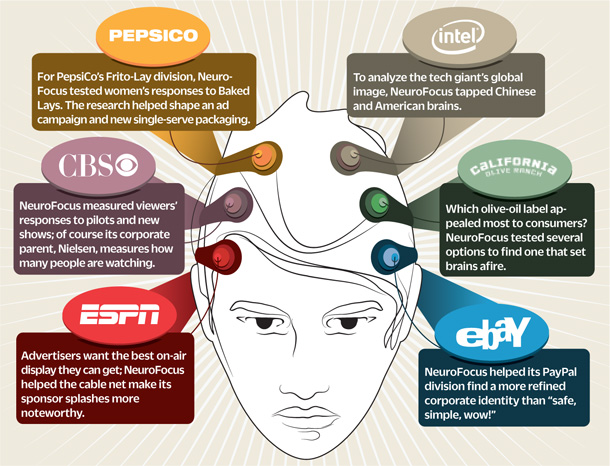
Neuromarketing Conference In Paris


I attended couple of weeks ago a neuromarketing conference held in Paris during the MD Expo.

I did not know much about Neuromarketing before coming to this event. My knowledge was mainly based on the Neuromarketing blog, which I actually read quite often.

The conference had a prestigious panel: 
  • Henri Kaufman was the host, and animator of the conference.
  • Pierre Gomy  Marketing director at France Millward Brown France, which talked about the company's experiences held in Great Britain.
  • Mark Van Rymenant  founder of Netway, a Belgian company specialized in Neuromarketing since 1997.
  • Marie de Linage Europe CRM manager Sony, which talked about her experience with neuromarketing techniques.
  • Bruno Teboul, an expert of neuromarketing, soon to get his Phd, he is studying the usage of neurosciences for marketing purposes around the globe. He is also the author of "L'Absolu Marketing",  which explains all the new marketing trends from the big data to neuromarketing. I haven't read it yet, but I am planning to soon.
Here are some highlights of the conference:

Read Montague's Study
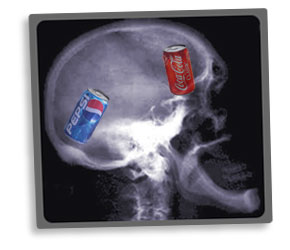
Neuromarketing has really emerged in 2003, when Read Montague studied thanks to IRM scans 50 volunteers to taste Coke and Pepsi sodas. It appears that out of these 50 people, 49 prefered Pepsi while blindfolded, but once people knew which brand was which soda, the results were reversed. The study showed how brands could change one product perception. Its since this research thanks to IRM that neuromarketing really started.


The button to buy
There is no real trigger in the brain that you need to push for someone to buy. Though there are some well known now zones that have a key role during the decision making process. There is such a high complexity in the brain that the interconnections between the different zones makes it impossible to resume the action of neuromarketing by simply pressing one button.

The brain map
Thanks to the important work of research around neurosciences, scientists have been able to set up a map of the brain. There are 52 zones in the brain that have been noticed. Each zones have different roles. Actually, the researches have also established that human brains are similar to other human brains by 99%. 
 It is thanks to this map that we are now able to understand and make experimentations through IRM and use them.

Why Neuromarketing Matters
  • 5% of what we do is conscious
  • 95% is unconscious
Marketers have spent years to work on the conscious part, trying to understand the logical aspect of customers' decision making process. But now neuromarketing techniques allow to explore the other 95%.
Also:
  • 85% of decision made are based on emotions
  • 15% by rational thoughts.
How That Works?
There are 3 techniques that are used:
  • Eye Tracking: We use technologies following the eye movements in order to see what catches the attention of someone.
  • Electrophalogram: The most used techniques
  • IRM: The most precised one, but the most difficult to use. 
About the IRM technique, most of the time it is used only on 6 to 8 people, because it is pricy, difficult to get (you need to use hospital material), but also because it is enough to have usable results.
Even though it is the most famous technique, it only represents 15% of the researches conducted.

Culture, Sociology and the Brain
There is a certain "plasticity" to the brain. Indeed, people from certain cultures may have been used to certain cultural or social things that may shape the way they percieve things. Even though studies seem to tell that there is no particularity. For example, the color red is associated with stopping, because the color red has been chosen for the red lights. You may change the red light color for yellow, it will take a while for people to adapt and the red to get back to a normal color. 
So far I believe it is too early to say if culture and society may impact neuromarketing results.

Sony Case's Study
Sony Europe had issues with the different local marketing departments to implement the European guidelines about Sony's brand content. Most of the time, local branches argued that the European guidelines were sometimes not adapted to local market. Sony decided to use neuromarketing in order to test then its messages and brand components thanks to the eye tracking techniques. Through small tests, on some emailing campaigns, they experienced great results, which pushed them to experiment more. It helped Sony to rationalized its European guidelines, thanks to the neuromarketing results they got. 


I will post soon a new note about what I think about neuromarketing. The aim of this article is to sare with you the great knowledge I got thanks to this conference.


Sunday, April 28, 2013

Carrefour: Un Combat Pour La Liberté: Mon opinion

Il y a quelques semaines de celà, j'ai eu l'occasion de rencontrer Yves Soulabail lors d'une conférence se déroulant à Paris Dauphine. Yves est bien connu du monde de la distribution pour son ouvrage "Carrefour un combat pour la liberté". Je connaissais aussi déjà bien son oeuvre, visitant très régulièrement le blog Carrefouruncombatpourlaliberte.fr

Le Pitch

1976, Carrefour existe depuis plus de dix ans, et la croissance folle du début est difficile à maintenir. Carrefour est en pleine remise en question. Cette année, notamment Etienne Thil, directeur marketing et communication, et les directeurs de Carrefour, décide de lancer les produits libres, qui deviendront bientôt les MDD, qui à l'époque est une véritable révolution dans un monde de la distribution dominé par les marques (Nestlé, Coca Cola, etc...).

Ce que j'ai aimé
  • Énormément de moments historiques de la distribution française (fondation de Leclerc, début de Carrefour, lancement des MDD chez les concurrents) sont présentés dans ce livre.
  • L'incroyable précision et le détail des données du livre. On y apprend les volumes, les chiffres d'affaires, les marges, etc... Bien évidemment, elles sont très loin de celles de nos jours, mais dans un monde de la distribution où il y a énormément de secret, c'est formidable d'avoir pu aller si loin.
  • Un ouvrage rare, qui donne beaucoup d'informations sur l'histoire (même avant les produits libres) de Carrefour. Ces origines, sa manière de fonctionner, les hommes importants. Carrefour reste, malgré les problèmes actuelles, une formidable histoire, qui part d'une petite épicerie il y a 50 ans à devenir la 2ème entreprise mondiale de distribution.
  • Une vrai leçon de bon sens et de principe pour les distributeurs. Il remet bien en place ce qui est vraiment important pour un distributeur, le volume, l'image prix, les basiques, la gestion des hommes... Etc. Une très grande leçon, que chaque direction de grande distribution devrait garder en tête.
Ce que j'ai moins aimé
  • Parfois, le livre est un peu brouillon, car très axé sur donner de l'information "brute" (notes de réunions, articles, données chiffrées, etc...). Ce qui rend la lecture parfois difficile, sur certains moment, surtout au milieu.
  • J'aurai aimé avoir plus d'informations sur Bernardo Trujilo, car je sais qu'Yves est le spécialiste de ce génie très méconnu du monde de l'entreprise. Il a façonné l'ensemble de la distribution mondiale, néanmoins il reste quasiment inconnu du grand public. Néanmoins reconnaissons que cela n'était pas le sujet principal du livre. Peut être pour un autre livre?
En résumé
Ce livre est une formidable leçon au sujet de la grande distribution. Il retrace avec détail et précision les phases de lancement des produits libres, et explique bien dans quel mesure ce lancement a changé profondémment le monde de la distribution, mais aussi donné une longueur d'avance à Carrefour.

Je le recommande à tous professionels de la grande distribution.

Monday, April 01, 2013

Auchan's Entreprise Feedback Management: Leveraging Store's Feedback

Enterprise feedback management is an important part of a comprehensive customer relationship management strategy. EFM aims to collect and organize customer's feedback from whereever it may come. With nowadays over connected world, feedback may come from in store comments, emails, mailings, social media, phone calls, blogs, among others.

I have been reading in Linéaires an article about the CRM manager at Auchan Jérôme Desreumaux, one of the largest retailer in France, selling mostly fast moving goods. Each Auchan stores in France welcome every day on average 10 000 different customers! Therefore leveraging the informations these customers may give can be a powerful tool in order to improve the commercial concept. Auchan recieves every year 200 000 feedback. It is important to know how to give meaning to these feedbacks, but also it is very important to know how to collect those.

What is interesting in this article, is the split between the different sources of feedback:
  • 25% comes from store comments left in a ballot by customers
  • 25% comes from employees from the frontdesks who type in customers' comments
  • 25% comes from notes taken by store and department managers
  • 25% comes from other media, such as mailing, emailing...
What is fascinating, is that still 75% of comments come from the store! Indeed, in retail, stores remain the main medium of communication. 

It is always more difficult to get these insights, as it is difficult to automate feedback in store. It is interesting to see how Auchan succeeds in getting so many feedback from stores.


Monday, February 25, 2013

Conversion rate: Working on the other 96%

I was listening to the radio this week end when I heard a very interesting interview of a Google France representative. He was discussing the kind of added value Google Analytics products could deliver to one company. 
"A good conversion rate in the web today turns around 2 to 4%, the goal of Google Analytics is to make the best of the other 96%."

Now that e-commerce is a mature market, and e-merchand websites tend to have a large volume of visits every day, it is important to be efficient. For instance, Jean-Emile Rosenblum, CEO of Pixmania France, is shutting down its stores he opened couple of years ago, saying "it costs less money to open stores than to lead a new customer online"!

Indeed, in terms of efficiency, every visits to a website must count. And there are different ways to see how you may create value from a visit which did not lead to a purchase:
  • Some of the value created is by advertisement: You may advertise for some products which will give you some ad money
  • Some of the value is about the data you may collect:  Why didn't the shopper completed its purchase? This analytics is possible thanks to adword.
  • We all know that people don't necessarily buy the first time they visit a website. The ability of the company to send the proper message after this lost visitor leave. Being able to keep a track of when he stopped to trigger a new visit is also something important.


Friday, February 15, 2013

Some Thoughts About Barnes & Nobel Falls

I have always loved Barnes & Nobel store concepts. When I go to the US, I love to go to one of its shops, and to hang around, to see what kind of books I can find interesting. I have never been really a big book reader (even though I recently own a Kindle Fire, which I count on to really boost my reading habits), but there is something about its concept that gives you the will to sit down and read. 

Barnes & Nobel is about customer experience, to provide you a large choice of cultural products and, a top of the line shopping experience. But with the rise of online competition, Barnes & Nobel results have not stopped to fall.

There are several reasons for Barnes &Noblel's problems:
  • Dematerialization: : Cultural goods tends to dematerialize more than other products. Now music can be downloaded, same thing for movies, video games, or even books.
  • Retailing costs are very high compared to E commerce website. Therefore it is almost impossible to be aligned with online competition and keep being profitable.
To me, Barnes & Nobel has always been a great example on how shopping experience and customer relationship could create value for a retailer. But unfortunately, due to the fast changes of the competition landscape, Barnes and Nobel were not able to keep up. 

So what should have they done? Of course, it is easier to say than to do, but there were other strategies to take into consideration:
  • Find new correlated products with high mergins to be able to compensate with the decrease of its traditionnal goods. We can think of electronic goods, even though this market is also tough, or maybe premium grocery products, to match with its positionning.
  • They could have sold some part of its real estate: Not to shut down stores, but to limit the square meters of each stores to lower the cost of production.
  • They probably should have found a way to create added value, in order to set apart from the basic price comparison.
Virgin, a cultural goods retailer in France, is also shutting down its activities. It is sad to see that we are in an era where we never consumed more cultural goods and services, but with a very poor health of the business.

I really hope Barnes & Nobel's will be able to find a solution.

Sunday, February 10, 2013

Lance Armstrong: The Limit Of Storytelling


I wanted to share you some thoughts I have about the big scandal that happened couple of weeks ago. After years of having denied he took performance enhancing drugs, Lance Armstrong was forced to admit publicly his system. Of course, it has been a big scandal.

Lance Armstrong is a controversial character.
  •  On one hand, he has been a great champion, a great professional, who has had a strong will power to win 7 Tour de France in a row. Doped or not, it is still a performance.
  • He has been a role model, for its capacity to overcome his cancer.
  • On the other one, there has always been suspicious about his drug use. Also, as a cyclist, other professionals have always pictured Armstrong as a cocky person, very selfish.
Now, I don't want to take a side. But what is true, is that the whole story around Armstrong may have been too nice. The whole story Armstrong created around his character allowed him to become way bigger than his sports.

Storytelling is a communication technique that has been around for quite a while now. Not a global company, not a political campaign, are built without a story to give meaning to it. The whole concept is to be able to create an authentic story around a concept. But sometimes it has some limits, especially when there is no true story behind, or when the story is twisted.

But the story was too nice: probably too well written. And the problem is now everything falls apart.


My whole point is to say: You should not use storytelling when there is nothing authentic behind. Because when the true story unveils then everything you built breaks down. 

Monday, January 28, 2013

Some Thoughts About Neuromarketing

I had the opportunity to read couple of weeks ago the excellent work Yasmina Chikh made to publish her thesis. She picked a very interesting and controversial topic: Neuromarketing.

Actually, the hype around neuromarketing seemed to have vanished. Indeed, a lot of work have been published about it, especially about how ethical this discipline may be, but also because of all the scientific work that has been undertaken in this field. I believe that now neuromarketing is operationnal, in terms of techniques. 

Nevertheless, and that is what Yasmina has underlined in her work, ethical issues remain. How far can we go to trigger a sale? Should we use these techniques, that are not based on arguments, but on irrational behaviors someone may get, because of how our brain functions?

In France, very few cases are available, as neuromarketing is forbidden. But I don't believe it will remain for long. European large companies have embraced the techniques, and soon, lobbies will force the European Union to validate its use in our country. 

Now will we see a lot of neuromarketing campaigns? It still needs to be seen, because these techniques are pretty pricy. You need a sophisticated equipment, most of the time you need to go through a university in order to use it. I believe the challenge of this kind of field is to be cost efficient, and to have clear results in the real life. So far, most of the findings have been made by scientific studies, and not yet in the real business field.

What I also really liked in Yasmina's report, is how extensive she has been in listing all the techniques you may use in neuromarketing.You should try to add her on LinkedIn, she may share with you that work (in French though).


Thursday, January 24, 2013

Why You Should Not Spend Too Much Times In Concept Stores

As a retail and customer relationship management expert, I spend a lot of time in stores. As I have said most of the time, even though retailing online is growing fast, and customer experience in the E-commerce is constantly improving, the main customer relationship medium remains the retail. 

A lot of companies have understood it:
  • Nespresso, who built its business model and customer service excellence on the Internet, has built a strong store network in order to be closer to its clientele.
  • Apple doesn't stop opening stores, even though they are an hardware company, in order to master the way its products are distributed. 
  • French E-commerce leader Cdiscount has strong ambitions in developping a store network.
  • French Mayo and mustard producer Maille (Unilever group) owns two stores in France where they sell some premium products.
Most of the time, the idea of these companies are to use the point of sale as a showroom which emphasizes on the products, and on the greatness of their brands. Some may earn money (I believe it is the case of Apple's store), some are pure advertisement (like direct banking company ING Direct, or online Internet provider Free).

Not only "suppliers" or service companies are opening concept stores. Some retailers also have concept stores in order to prepare the future of their banners. One of the most well known concept store that has been launched those past few years was Carrefour Planet. Not only because it was the concept store of the largest retailer in the world beside Walmart, but also because it was innovative.

As a pro, I am seeking for those kind of initiatives to visits. Because they always have the most updated tools , but also because you can see in it what is the best service one company can provide to its customers.

But it is always interesting to put them into prospectives. Indeed, with concept stores, most of the time, you are in front of a non profitable store: a lot of tests are put in place in order to see what suits the most the customer, and what is the most efficient. It is always important to have that in mind. This is the reason why, it is always important to understand where profitability is, and where the cosmetic part is.

This is the reason why, you should not spend too much time in concept stores, because most of the time it can't be implemented at a large scale.

Wednesday, January 23, 2013

Why We Should Believe In Costco In France

I wanted to share with you some thoughts I had about the conference I attended about Costco at Paris Dauphine. As I have explained in a previous post, I really believe in the concept, and that it has some chances to grow in France. But during the Q&A session, I could feel how skeptical a large part of the audience was. Here are some of the issues they have pointed out, which I must admit will be some challenges to overcome for Costco in France:
  • France is a very tough market. Carrefour, Casino and Auchan are among the largest grocery retailers in the world, and they excel in retailing. Furthermore, even though these 3 companies cruises in the international market, they have an even stronger local competitor, which gains marketshares month after Months: Leclerc. How can Costco find his place in between?
  • France proposes very low margins: Due to the competition, prices are low, and therefore the French market tends to be less "profitable" in terms of %margins. 
  • France has specific concepts, and don't know how a membership wholesale works. It will be difficult to explain the concept and to convince French people to pay 55€ to become members.

I know all of those problems: I experience them every day as a category manager at DIA. France is for sure a very difficult market. But what I notice, is that even though people who raise these issues are for sure retail experts, they are very pessimistic and negatives. We all know how negative French mindset can be. What these people calls obstacles I'd rather consider them as challenges. Here is how I see it:
  • Sure the French market has a tough competition. But isn't Walmart a tough competitor in the US? Walmart succeeded in settling down in England, where there is Tesco, and where Carrefour failed couple of years ago. Also, they are in Japan, also a tough country where Carrefour failed.
  • The French market proposes low margins? Costco knows how to work with low margins. And they know how to work with it everywhere. Yes it will be difficult, but Costco knows how to work with international suppliers, so they should be able to get strong partnership even in France.
  • People don't know how a membership wholesaler works? Japanese got it, English got it. As long as you propose true advantages to a customer, he will get it. Costco has strong ambitions in France, so they should have the money to communicate on how it works.
Something that marked me, in the answers Costco's CEO gave, is that it seems they don't pay much attention to the competition's landscape. Indeed, they have their own concept, a unique concept, and therefore, they don't really have a true competitor, that proposes the same service. In the retail world, where pricing is one of the single factor of differenciation, I think it is a tremendous technique. They know that if they deliver what Costco's knows how to deliver, things would work. And I believe it is the right mindset. By focusing too much on competition and how a market is at a specific time, you don't focus on what is really important: satisfying customers.

Sunday, January 20, 2013

Retail is Art: Gregoire Kaufman's Book "Retailart"

Grégoire Kaufman is working as a top manager of Group Carrefour. As an exeperienced manager, he has sailed the seven seas to look for new store concepts, and to study how different countries distributes fast moving consumer goods. 

Grégoire believes retail is somehow an art. It also pictures well the social and cultural landscape of one region or country. It is always interesting to visit stores in foreign countries, because you will always encounter new ideas, products you don't know, and different ways to promote products.

He has already published a bunch of his thoughts and pictures in his blog, couple of years ago. Unfortunately, he does not publish anymore (even though I understand: he is very busy as a professionnal). Nevertheless, he went a step further, as he published an online book, you will find on Blurb's website.

If you are a retailing professional, or simply curious about Gregoire's work, I highly recommend you to have a look at his work. 

What is very funny with retailing, is that the rules of the industry are very simple, and basically to keep it simple. Most of retailers have been inspired by Bernardo Trujillio, who held seminars for most of nowadays retail tycoons' founders (Carrefour, Auchan, Darty for French people)... But when you see how those rules are applied in different countries, you can clearly see the cultural aspect of retailing). If nothing looks like more a starbucks than an other starbucks, you should check out how in a global company like Walmart or Carrefour adapts to its clientele.


Here's a picture I liked of Gregoire's blog, about how an Argentinian Carrefour took advantage of the Soccer World Cup to animate its store.

Thursday, January 17, 2013

Costco France's Conference at Paris Dauphine

Yesterday I attended a conference organized by my former business school, Paris Dauphine, Master "Distribution et relation client". This master often organizes conferences around the topic of retail and customer relationship management, and we had the opportunity to meet with CEO of Costco France, Gary Swindells.

The topic is very interesting to me, as I have always been a fan of this commercial concept:
  •  I used to be a card member while I lived in the US.
  • When I came back to France I had the opportunity to prepare a presentation for Auchan's marketing department, as I was eager to convince people in France of how good the concept was.
  • I asked Lars Oloffson while he was CEO of Carrefour what he thought about the concept, if he was eager to try it in Europe, especially as he owns Promo cash, a btob card member wholesale chain. He responded to me that it was interesting, that they owned in Brazil Atacadao which is a concept close to Costco, and that they were on their way to launch a test, in the northern part of France. I don't think the project ever happened though.
It was also a good opportunity to see how Dauphine changes, as the main hall and the conference room has been fully renovated. It has been also my pleasure to have the opportunity to meet with Yves Soulabail, one of the main expert of Carrefour's history in France, but also an expert in Bernardo Trujillo's history, the person who invented the "modern retail". He owns a blog I visit almost daily, Carrefour un combat pour la liberté.

What is Costco
Costco is a warehouse, where both professionals and individuals may found products in large formats, at a great price/kg. In order to access their stores, you need to own a membership car you need to pay. Here is a great presentation.


Key figures and quotes of the conference:
  • Costco works with a sales margin of 14%, which is actually very low compared to what other retailers have usually. But actually, I don't think that in this margin they count the money they get from the membership fee people needs to pay to get in ($55, $2 billion in membership yearly). What is interesting with the concept is that the membership fees is somehow the profitability they reach with each customers up front, even before they have bought any products... Which allows them to propose better pricing.
  • $92 billion expected in 2012, which is I believe the 5th retailer worldwide.
  • $148 millions in sales per stores, 13 205 m2 per stores. They even own a store in Korea that makes $478 M a year!
  • 4 000 listed products: 3 500 listed permanently  500 which are in & out promotions, that goes from lobsters to cars, to pants...
  • Customers visit stores on avarage every 10 days, which is actually high... I did not use to go that often...
  • Costco don't communicate, meaning they don't do any flyers, any TV or radio promotions. They just have sometimes local campaigns for store openings. 
  • Sometimes, they lend parts of their stores for "road shows", people that comes with a specific offer, and that shows products. 
  • They believe they would be profitable once they would reach 3 or 4 stores! Which is not a lot actually.
  • They forecast to own 10 to 12 stores in 10 years, and 20 in 15 years. You can clearly see they have a map and are eager to invest large amounts of money to settle in France.
  • The average basket is 130$

Tuesday, January 15, 2013

Best Wishes for 2013

It has been a while I haven't posted something on my blog. As some of you may know, 2012 has been a very busy year on a personnal basis. I have moved to another appartment, became a landlord of my former appartment, and couple of days ago, I embraced parenthood. All these changes have kept me away from this blog. Also, as a category manager of DIA France, I extended my perimeter with new categories to deal with, which also took a lot of my available time.

2012 has in a certain sense allow me to grow my level of responsabilities, and I am quite happy about it, as I have always been eager to take some, both in my professionnal and personnal life.

As I have said, couple of years ago, while the beginning of the subprime crisis started, I expected as certain expert thought that the end of the crisis would approach in 2012. I believe my forecast was not that bad. But I don't believed that actually, 2013 would also be a tough year.

I have never been pessimistic, and I believe that 2013 will be a difficult year. But also, it will be great. Great because we will be forced to look after new opportunites, new way to create values. It is when times are difficult that you are actually forced to do more, and better.

I wish to all of you a happy 2013 year. I don't want in this post to make any forecasts, because 2013 will obviously be full of surprise. But what I wish you, is that 2013 will propose you the challenges and the opportunity that you need.

Monday, November 19, 2012

Orchestra Loyalty Program


As some of you may know, I am on my way to embrace fatherhood. This may explain the reason why I don't spend much time on this blog anymore, even though I still have the will to get back on track, and to blog as much as I can. 

As I am preparing the arrival of my child, I spend a lot of time in baby stores. And last week I went to Orchestra, a French retailer of baby clothes. Orchestra has invented a very smart loyalty reward programs.

As most of loyalty reward programs, you have a loyalty cards, which allows you to benefit from discounts. 
But there are several aspects that makes Orchestra's card remarkable:
  • You need to pay for it: Some people may think it is awkward  but actually, I don't understand why not so many loyalty programs are payable ones. Indeed, for a customer to enter a loyalty reward programs, it needs to engage with the brand, and therefore, if it is accessible to anyone, the relationship is weaker. Paying a membership fee is a great way to engage, because it is a tangible sign the customers makes to enter into the club
  • You also need to pay every year a fee, 10 € (to compare with the 30 € you need to get in), in order to  keep the benefits. This is also a good idea, because the customers who really wants to be in the club needs to renew its "vows".
  • It offers you 50% off all your purchases years around. Of course, the prices of Orchestra are very expensive. They are far more expensive than the competition. But thanks to the discount, it becomes affordable.
Thanks to this system, Orchestra:
  • Has a loyalty reward programs including people that are really loyal to the brand. I would like to know how much is the average budget of one customer in terms of baby clothings, but paying 30 € simply to get the card is not miscellaneous. That means it is worth getting it if you buy at least 60 € of clothings.
  • The facial value of the benefits (50% off all year around) is so high that it pushes the shopper to get it at the first place, but also to purchase at least for 60 € the first time to benefit from the advantages right away. It improves the probability of a big shopping right from the beginning.
  • They must have a high % of customers that use their card. This is important when you want to make data mining, or simply to target specific customer groups for a campaign, because your transformation rates will be high
  • Because of the investment the customer make, he will tend more to make it profitable, so you will have a higher probability he will come back to your store.
I believe this is a very smart, and I believe that it is very innovative. 


Thursday, October 18, 2012

Reverse Innovation Process: Procter & Gamble Case Study

I found this very interesting article about Procter and Gamble strategy in the emerging market. Procter & Gamble masters the worldwide market of shaver with its brand Gillette. Gillette products are very priy, all over the world, and they have succeeded in increasing the proposed value to customers through innovation. It is so pricy that in some French stores, those products have specific security measures to avoid robbery. 

But in a market like India, where people have low incomes, it is a challenged to propose an appropriate product to customers. India is a very interesting market as it is the biggest market in volumes of razors.  

Procter & Gamble had to apply a strategy I did not hear of, but which is very interesting: Reverse Innovation. For years, in its domestic market, Gillette did not stop innovating, proposing more and more complex products. But in India, Gillette needed to adapt to the level of development of the country.

Therefore they developed a specific product for the local market, with one single bladed, design for the specific needs of Indians. 

It is becoming more and more difficult to find revenue growth in our western countries market, and it is important to find new ways to conquer new foreign markets. This is somehow the same strategy Renault used with its Logan brand to get market shares in Eastern Europe countries.

What is also interesting in the article is that the author considers possible that Gillette may sell the products they defined for the Indian market in the US market. And hence, the reverse innovation process would be complete. I believe that sometimes, it is important that companies question their own business model, even when it is working and doing fine. Because someday, you will always find a disruptive competitors, which will be able to innovate where you simply wanted to keep revenues flows.

I believe it is interesting to read this article, and to see the whole process Procter and Gamble applied in order to get into the Indian market. It is especially interesting to see how they had a local approach, instead of simply focusing on selling their international products.


Monday, October 15, 2012

Looking For A Business Model For Start Ups: Freemium

I believe the economical crisis hitting the world right now has affected the social media business. Despite the fact the market still grows, and there are a lot of room for innovation, entrepreneurs have been challenged by the lower capacity to raise money, but also the aim to find a strong business model. I posted last week an article about how we could imagine someday Facebook asking users to pay for the service, as they were looking for sustainable sources of revenues.

For the longest time, the Internet companies have based their business model on the revenues of advertising. As the market was growing, it was easy for companies to get attention from brands to advertize on websites. 


Also, another very common business model strategy for Internet companies was  what iscold freemium: Propose a free service to user, attractive enough to get them hooked, and to convince them to upgrade to a version they would pay for.

But Freemium still remains a problem. 


In the oft-cited Hershey’s experiment that started the free-mania, behavioral economists from MIT tested customer preference for Hershey’s and Ferrero Rocher chocolates at two different price points. For one group, they offered Hershey’s at one cent and Ferrero Rocher for 26 cents. For another, they offered the chocolates at zero cents and 25 cents respectively. When the Hershey’s chocolate was free and the Ferrero Rocher chocolate was 25 cents, 90 percent of the participants chose Hershey’s. $0 price seems to have done the magic in driving customer adoption. The result became the foundation of the freemium school of thought — free is free marketing. First use the free version to drive adoption and build a large customer base, and then find ways to monetize that base by upselling the paid version and selling extras.

Thursday, October 11, 2012

Questionning the business model of Facebook And Twitter

Would you pay for an add free Twitter or Facebook? This is the title of an article CNN published on its website couple of months ago. 

And this is a very interesting question. You know that even though I am an early adopter and strong believer in Twitter and Facebook future as a mass media, I am still wondering about how those companies are going to become profitable in the next few years. Indeed, I have always questioned the strategy of many Web 2.0 start up to focus on developping a large base of users without even thinking for a second about how to make profits out of it.

And so far, I have been right: Facebook's IPO has been a failure, I believe no one could say the contrary. Investors are worried about the revenue growth pace of Facebook, and its ability to perform as expected.

Same thing for Twitter, where most of their initiatives to implement ads to generate revenues has failed.

Now, people have been used to a free Internet, where services are paid by companies through ads. But the thing is there are way too many services on the Internet which base their revenues on ads for brands to finance all of them! And with the economical crisis, we all know that advertising budget is the first one to be frozen.

So now, would people pay to use Twitter or Facebook? The article has a good point: "If we're selling a service, our customers are our users and our job is to make our users happy,". Indeed, that is what Facebook and Twitter have been working on: Having a great product for users. But they have not integrated at an early stage of the process the way to get their "clients" (brands) involved in it. If users pay for the service, Facebook and Twitter will go on being interesting, but if now their main focus is to get as much advertising money as possible, I believe the service will deteriorate and in the end, they will never be able to become as profitable as they could be.

I would personnaly pay for Facebook or Twitter. The access to my network and to the information it allows me to get is just great, and I don't see myself living without it. Now the thing is how much am I eager to make out of it? VCs have based the value of these companies on how much money they can generate from an average user. Am I eager to pay that kind of money to use these services?

This is the answer to be asked. And let me be more precise about my thought: On the long run, to be honest, I don't see how Twitter or Facebook would be free.

Is Customer Loyalty A Myth?

Customer loyalty is a goal any companies is willing to achieve. All companies know how pricy the aquisition of one new prospect may be, and companies would rather make sure they keep a strong loyal customer base, securing their revenue flows at the same time.

Customer loyalty strategies have been set up when markets started to become mature, and as the "external growth opportunities" were starting to shrink. A bunch of strategies and tools are available to marketers in order to trigger customer retention or loyalty: Loyalty reward programs, data mining, create emotional bond with one brand...

But we all know, as marketing managers, it is tough to accomplish. 

I read a very interesting article not so long ago in French Newspaper website Le Monde, which questions the whole concept of customer loyalty. Indeed, Andrew Ehrenberg demonstrated while ago that customers tend in a natural way not to stick with one brand. On the long run, according to the article, only 5% of people remain loyal to one product on a one year basis.

Nevertheless the natural unloyalty of customers needs to be counterbalanced by the fact that loyal customers are the ones who built the profitability of one company. They are the one who counts for 80% of the business, and most of the time, for 80% or more of the profits.

The article does not really give any answers to this question. But the question is right to be set. Especially during economical crisis, customers are eager to find the best deal, more than securing quality through a brand they trust. But customer loyalty is a very complex concept. It implies several aspects, both statistical and emotional. Working on growing a loyal customer data base is something any company should go after.

Tuesday, September 11, 2012

No experiment should be believed until it has been confirmed by theory

This is a phrase you should meditate. I read it in a New York Times article, dealing with an experiment which you have probably heard of. Some scientists made an experimentation where they were able to make some neutrinos faster than the speed of light, which according to the relativity theory of Albert Einstein, was supposed to be the fastest speed possible. The theory of relativity is one of the base of all the physics laws.Breaking up the speed of light meant to think through all the discovers found out based on the Einstein theory. 

Nevertheless, it appeared that this results seemed to have no theory backing it up, meaning it was an abnormal results, rather than a truth. 

"No experiment should be believed until it has been confirmed by theory". Scientists should have confirmed their results through theory. What does that mean? It means that experiments results must be understood and then explained by a theory before they actually mean somethig.

This point is very interesting, and you could correlate it to the world of business. A lot of the times, you may experiment some marketing techniques, sales concept, or new products, experience success. But it is very important to get a theory (or I should say a strategy) behind in order to make sure you may turn your experiment into a success on a larger scale. Too many times, because companies implies to have results fast, managers implement fast new concept stores, or marketing techniques, even before having thought them enough to make sure they would work.

I believe this story and line is very interesting and should be thought while defining one strategy.

What do you think about it?

Monday, September 10, 2012

Some Thoughts About Apple vs Samsung's Trial Results: Copying Could Be Good

I know what you may say, I am a little late to give some thoughts about the news which hit all the headlines for days couple of weeks ago. Appel vs Samsung's trial result has been indeed huge, because of the amounts that were at stake. But actually, sometimes it is also good to step back in order to get a clear view of what happened.

I wanted mainly to comment an article I found during this trial on the Harvard Business Review website. Indeed, I really liked the point it was making. 

We can all agree that Apple has inspired most of smartphones manufacturers since the launch of the first Iphone. When most of smartphone was operated with keyboards, now about 90 % of them have tactile screen, have a system including applications to download. 

Now, does this imply the competitors have copied Apple? In some way, of course, the original idea comes from Apple, but having invented a cool tactile phone should not prevent anyone to be able to improve this idea. Most of the time, great innovations are built on existing one. The problem with the outcome of this trial, is that intellectual property patents have gone too far: for a good competition, and in order to emulate innovation thanks to competition, Samsung should not be considered as a copycat. Actually, because they have brought both innovation and competition, they have contributed as much as Apple to the growth of the cell phone market.

Let's also think about it, if Samsung needs to stop its tactile screen phone activities, who would be left in the market? Apple would probably be dominating the market and then they could be considered in a  monopolistic position. 

Because Samsung is in the market Apple needs to keep on innovating, and it is because of competition, even though companies dislike that, that innovation comes through.

I remember once one of my teacher in Dauphine telling me that companies dislike competitions. Of course they don't because it is costly to fight with others. But if there is no competition, one company has actually no much reasons to satisfy customers or to seek for innovation.

That is the reason why, I am not quite happy about the trial outcomes.

What do you think about it.

Tuesday, July 17, 2012

What Could Help Facebook Stock To Rise?

Facebook IPO has not been as succesful as expected. The financial world was looking forward one of the most profitable IPO, for one of the hypest company to enter the stock exchange for a long time. During these difficult times, to see such a success story would have been a great opportunity to get some of the lost money for them.

Nevertheless, there was no miracle. Hopes were too high, and the stock prices lost about 30% of its value. What could explain such a fall? Well, of course the price of the stock was way to high. It was calculated on an expected growth of revenue, whereas the company is experimenting a new business model (social media, based on several sources of revenues including advertizing, but also selling access to its network to applications company and so on). 

What could help Facebook to Rise its Stock Price? 
Well, Facebook had a great growth of its audience since its foundation. Now the audience growth is going to remain, but the pace will slow down. It is now time to find ways to generate as much revenues as expected.

The best way Facebook could improve its stock price is to match the stock market expectations in terms of growth pace. But to be honest, I don't see it happening. I believe expectations have been to high, and it is not helping Facebook to have to keep up with a revenue growth pace, while they are still luring to find the good chemistry.

I have always been frightened by companies who are focusing on recruiting new users instead of building up business model, but right now, Facebook needs to find the best way to monetize its audience.

If Facebook tries to near the gap between its entry stock price and its actual price right now, it is a lost battle. The should rather instead focus on long term revenues, the ones that they may achieved in 3 to  5 years.

What do you think about it?

Monday, July 16, 2012

Why I Still Love Blackberry

Blackberry have made the headlines lately because of their downturn. Nobody knows where the Canadian company is heading and people may doubt if Blackberry will still exists in the next few years, or even few months. People blame the company for not having been able to follow Apple's lead, which defined with its Iphone the landscape of smartphones right now. 

I find very sad what is happening to Blackberry. Indeed, as a lot of you may know, I am a fan of Blackberry. You may call me a has-been, but I love their keyboard, which allows me to type in a glance, emails, tweets, new appointments or tasks.

Here are the main reasons why I love my Blackberry bold:
  • Once again, I love the keyboard. It is sharp, and I can type like crazy. I bet no one can type as fast as me on a Blackberry keyboard while using any touch screen device. However, I believe that the Bold with its tactile screen is also great, because it ads a better experience while surfing on the Internet I must admit. Nevertheless, both are key to me.
  • I love the way I can manage my schedule, my tasks, and all my pros activities. My blackberry is at the core of my Getting Things Done Strategy. The only thing I regret is that I would love to have an online web interface while sitting in front of a computer, or also a tablet application (I own an Ipad, don't plan to by their Blackberry book). 
  • The handheld is of great quality. In terms of the components, the camera is great.
Now here are where they could have improvements:
  • They could have a better battery life: I am constantly charging my phone. I must admit though I am using it like crazy.
  • The lack of applications. I have great applications. For example, the trip app is just awesome. Also, the one to deal with social media, and Twitter. Nevertheless, they have never achieved to get enough applications in their Blackberry app world to really get the most of the phone. They came to late on that market, when Iphone has been a trail blazer, and Google generate a lot of attention by creating an open market place, then for Blackberry it was hard to find its place. And to be honest, I think they will never get back.
Now that Blackberry said they would focus on tactile screen and abandon their keyboard, I have no idea what will be my next phone. But I really hope Blackberry find its way out.

Monday, June 18, 2012

Great Interview Of Loic Lemeur

Loic Lemeur  may have been experiencing problems with his latest start up seesmic, he remains one of the best French entrepreneurs, an example to follow. I watched recently this video interview, which is very interesting. Loic speaks frankly about the issue he faced as the CEO of Seesmic, his mistake, and his will to keep moving forward. This is very inspiring, especially in these times, when it is so difficult to experience success.

I wish Loic good luck for the future, and I hope LeWeb 2012 in Paris will be successfull.

Thursday, June 07, 2012

Comment améliorer sa DN et DV

Ce post fait suite à une question que j'ai reçue au sujet d'un ancien article que j'ai publié sur mon blog il y a 6 ans, expliquant les concepts de la DN et la DV.

La DN, Distribution numérique, et la DV, distribution valeur, sont 2 très grands enjeux dans le monde de la distribution, et particulièrement dans le domaine de l'alimentaire, et l'augmentation de celle-ci pour un fournisseur est clé pour le succès d'un produit.

Alors comment augmenter sa DN et/ou sa DV? Il faut tout d'abord comprendre les facteurs qui peuvent influer sur celle-ci

Calcul de la détention par les panels
Tout d'abord, je souhaitais faire un rappel sur la manière dont est calculée la DN et la DV par les panélistes. Les 2 plus gros acteurs sont Nielsen et IRI. Ces 2 sociétés ont accès aux informations de sorties caisses des distributeurs, et considère qu'un produit est détenu à partir du moment où le produit concerné a été vendu au moins 1 fois dans le point de vente, sur une période d'un mois. Aussi, le produit ayant des rotations faibles, va peut être avoir des chiffres de DN et DV faible, car plus la VMM (vente moyenne magasin) est proche de 0, plus un nombre non négligeable de magasin va être considéré comme non distributeur, alors qu'ils ont bien eu sur leurs étagères le produit.

Comment augmenter la DN et la DV
Voici les facteurs qui peuvent influencer la DN et la DV:
  • Référencer le produit auprès du plus de distributeur possible. Les plus gros produits sont incontournables, tels que le Coca Cola 1L, ou bien le pack d'Evian par exemple. Ces produits là sont référencés par le distributeur dans tous ses magasins. Par contre, pour bons nombres d'autres produits, ce n'est pas le cas. C'est le premier levier pour gagner de la DN et DV: convaincre le distributeur de réserver de la place en magasin et de le renseigner dans son système. D'où viennent mais 2 prochains points:
  • Avoir une bonne rentabilité du produit: Il faut que le produit ait un intérêt pour le distributeur, et qu'il s'intègre bien dans la catégorie. C'est la condition sinéquanone. Donc il faut trouver le bon produit déjà. Souvent, la DN et la DV pour un distributeur est un indicateur de la légitimité d'un produit lorsque celui ci existe déjà sur le marché.
  • Mais imaginons que le produit soit référencer. L'un des points à vérifier est la bonne détention du produit: Est ce que le produit est bien sur le planogramme, là où il devrait l'être. Est ce que le magasin le mets bien en magasin. Pour cela, il faut un suivi sur le terrain, ou bien vérifier sur les panels si la DN DV théorique = celle constatée. Cela demande un suivi.
  • Les rotations. Plus le produit a de basse rotation, moins sa DN-DV va être bonne car le calcul sera moins fiable. En conséquence, pour augmenter la détention, notamment sur le début, il faut faire de la promotion afin de pouvoir déclencher les actes d'achats, mais aussi que les réassortsse fassent bien. Il est important le plus vite possible d'atteindre les VMM (ventes moyenes magasins) ambitionnées.
  • Les problèmes de ruptures: Les problèmes de ruptures peuvent venir soit du fournisseur, soit des approvisionnements du distributeur, soit de problèmes opérationnels des magasins. Pour influer sur les ruptures, pour un industriel, c'est déjà avoir un taux de service à 100%, c'est à dire honoré l'ensemble des commandes passées par le distributeur. Par ailleurs, les grosses entreprises ayant beaucoup de moyen tel Coca Cola, va avoir une force de vente qui va vérifier en magasin que les produits soient bien détenus, et s'assurer du bon fonctionnement en magasin. C'est la raison pour laquelle, bien que les échanges commerciaux se font de plus en plus au national, les gros fournisseurs ont une force de vente pléthorique pour vérifier ces points.
  • Maintenir une bonne détention, c'est aussi voir ce que fait la concurrence, qui pourrait sortir un produit comparable, qui va peut être impacter la détention du produit existant. Pour cela, il faut être capable dêtre réactif et de proposer ce qu'il faut pour maintenir sa détention, soit par de la promotion, soit par une meilleure rentabilité du produit

Voilà, j'espère que c'était clair, et que je n'ai rien oublié. N'hésitez pas à compléter en commentaire si vous avez d'autres idées...