Tuesday, November 01, 2011

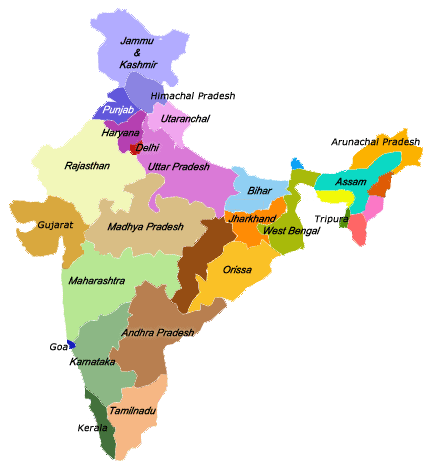
E Commerce Struggles To Spring Up In India

India is a very interesting market to invest in. It has a high growth rate, a large population, and also a great population of computer engineers, which allows the country to be among the greatest country for high tech companies.

Nevertheless, India is not such a friendly country to approach for business men. Indian culture and infrastructures are far from being ready to welcome "western life style", unlike China or Brazil, the two other next to become super power countries. For example, in the retail business, it is hard for companies to settle in India, as roads are not that good, and it is therefore difficult to set up an efficient supply chain.

It is the same thing for telecom infrastructure. This is the reason why mobile phones have experienced such a great success: As the country is very large, it is faster and cheaper to organize a wireless network than an actual cabled one. This is also for that reasons that some experts think India will be one of the leaders of mobile Internet, skipping one technology (wired), and obliged to innovate.

I read not so long ago a very interesting article, detailing the different reasons why Ecommerce struggles to take off in India.

What is very interesting in this article, is that you may think it is because of the lack of Internet equipment that India's Internet commerce is growing slowly, but as a matter of fact, it is mainly due to the lack of credit card penetration. Hence, it is difficult to purchase online if you don't own a credit card. And because India has a low penetration rate for credit card, it is difficult for Indians to buy online.

This is a very interesting concept, because it shows how important the credit card penetration  rate is important in order for a e-business to blossom.
What do you think about it?

Friday, October 28, 2011

Fight Opel Renault In France

Opel has launched a new advertizing strategy this year. In order to build on the famous german car manufacturer's quality, Opel, which is owned by the US tycoon General Motor by the way, has decided to broadcast these TV commercials, where its car is introduced by a german host, subtitled in French.


I believe it is very smart of them, because even though german car companies are very famous and acknowledged for their quality, Opel is a little bit left behind.

But couple of days ago, new commercials of French car manufacturer Renault have shown up, mocking the Opel's ones.


It is a funny way to leverage the buzz around one competitor's commercial. Opel has responsed to this campaign with a press ad.

But there several questions I have about these campaigns:
  1. Does Renault has the right to copy Opel's commercial. It is clearly a copycat, and I find weird the fact they have been able to do it.
  2. It seems like Opel and Renault have played together to create the buzz around this campaign. Have they agreed on it? Was Opel aware of Renault's idea to take over the ad idea?
  3. Renault's commercial is clearly funny, and mark people's mind. But does it really show well the car they want to sell? I mean, people are more into the fun and the fact they mock Opel than into listening to the arguments of the guy.


What do you think about it?

Wednesday, October 26, 2011

Hommage To Steve Jobs

I have been so busy those past few days that I have not been able to blog about one of the trendest issue in the news: the death of Steve Jobs. I have been surprised by the large numer of media covering this topic. Indeed, it is very rare to see the death of a business man hitting so much the headlines. I actually don't remember such a fuzz around the death of a CEO like this one. Except maybe the sudden death of Michelin's president couple of years ago, in a plane crash

Obviously, Steve Jobs was not anykind of business man. A lot of people have compared him to Thomas Edison or Graham Bell for his contribution to help humanity to reach another level of modernity. Steve jobs was not what we can call an inventor as Edison was. He was a visionaire, he was able to forecast what will be people use of technology, and more important, how to adapt technology to people usages.

I used my first computer at age 4 or 5. It was the famous Macintosh (my parents where among the first generation to own a personal computer), and I remember how much I loved it. My parents have always been fan of Apple, and now still own a Macbook and a power Mac. The first computer plugged to the Internet was actually the Imac (the original with the blue color). It still works fine, which shows how good those computers were.At this time, a lot of people were mocking us as Apple was going in limbo.

But since then, Apple has experienced nothing but success, thanks to Steve Jobs.

I wanted to share with you his famous inspirational speech at Stanford couple of years ago. 


Tuesday, October 25, 2011

How I Deal With My Stress


Stress is the hypest topic since the beginning of this fall. A new financial crisis is happening, a lot of companies have seen those past few months their shares collapsing, and facing this difficult time is causing a lot of stress. This is the reason why French magazine "Management" is dedicating its headline of its september issue to methods to fight against stress.

Also, the excellent Henri Kaufman  has edited a video about how to deal with stress at work.


The goal of all these techniques is to avoid the "burn out": it is when a person has lost all its energy and is not able to perform anymore. The worst with the burn out is that it is very difficult to recover from it.

As I am dealing with a very stressful period of time, I wanted to share with you my techniques in order not to be stressed, or at least to master it:

1: Understanding what is stress
As David Allen explains it in Getting Things Done, stress comes from a situation you can not control. That means when you face a situation, you are stressed. That also means that you need to understand the situation in order to take the control over. That also means that there are also some situations you can not control. And those situation, you should forget about them, because there are nothing that you can do about it. Hence, it should not stress you, and you should not think about it.

2. Eating
It is very important, while you are experiencing work overload, to have proper eating habits. "You are what you eat", or "what you eat is the fuel of your engine" are actually right. Therefore, I try:

  • Not to eat to much, because digestion is requiring a lot of energy.
  • Drink a lot of water because it irrigates the brain and therefore avoids migrains
  • Eat a lot of fruits + take vitamin pills to have a lot of energy.
  • Take coffee as a stimulating products, but not more than three a day to avoid heart issues.
Also, when I eat, I don't eat at my desk: I need to rest and to enjoy my eating time to relax.

3. Workout
Sport is very important to be in shape. It releases dopamine which helps you to feel good about yourself. It also helps me to be awake and actually to avoid tireness.

Therefore I swim for 30-40 minutes at my lunch break almost everyday, and play basketball three times a week.

Also, I am used to walk a lot in my offices and the walking process helps to irrigate the brain...

4. Talk about the stressful situation
It is important to talk and speak out the stressful situation you may face. Because most of the time, by simply saying it out loud, you clear up your mind. Also, by discussing it and sharing your thoughts with others, new solutions may spring up, and the serendipity may work.

5. Sleep
Sleeping and resting is very important. You need to recover from all the work you have to do.

6. Keep on being organized.

A lot of the time, as work piles up, a lot of people give up with the organizing process they have, because it requires most of the time a lot of time, and because they feel it won't help them. I believe it is wrong. Even though it may implies you will not complete all the work you are supposed to do, keeping on organizing your work will help you to remain efficient, and even though you want do all the work, you will be able to choose the less important tasks to leave aside.

7. What I refuse to do:
I refuse to be stressed by things I have no control over (see 1 section). If it is an unachievable task, then I don't want to feel bad about failing to achieve it.

I also refuse to take any kind of drugs. I believe this is false solutions.

8. Set up a deadline
You can not be stressed and fear a burn out on a long period of time. You must be able to identify how long the situation will be. Most of the time, there will be a clear deadline (a project deadline). If there are none, then you should give up right away. No one is immuned to burn out, so you are almost sure to get the wall. 


Hopefully it helps you.

Do  you have any tips you would like to share?

Sunday, October 23, 2011

Why I Go On Blogging

I must be honest with you I enter a very busy time of my business life, and it is hard for me to keep on blogging at the same pace I used to. Nevertheless, as you may know, blogging is to me a very important thing. It is somehow what helps me to clear up my mind with some thoughts I may have with things I experience or learn.

Couple of days ago, I talked to one of my co worker who has actually bumped into my blog for the first time, thanks to LinkedIn  (by the way I know you are a bunch of folks following my blog thanks to LinkedIn, thanks a lot). She was surprised of the work I put into this activity, and moreover she congratulated me for it. 

I must say I am always happy when people congratulate me for the blog. It is nice to see that actually people like what you are doing. For the past year, I haven't interacted as much as I used to with people reading my blog and I regret it a little bit. 

I feel a little bit as blogging is "old school": a lot of Internet expert have given up with their blog. I especially think about Loic Lemeur, who is not blogging as much as he used to. A lot of people have shifted from blogging to interracting thanks to Twitter and Facebook. It is somehow normal as it is where people are now. 

But still, blogging is much different and I still believe it is important to keep on blogging. You will never be able to propose more added value than by blogging.

This is the reason why even though I am very busy right now, and I may not blog as often as before (my goal has always been able to right at least 5 posts a week), I will force myself to go on.

I want to thank this person (hopefully she will read this post, and recognize her), because she actually gave me the fuel to write this post after a two week pause.

Thursday, September 29, 2011

Mobile Commerce Struggling: Tablet Sales Outcasts Smartphones'

Mobile commerce is a hype issue. A lot of people foresee in the incredible growth of smartphone users the next  trend in E-commerce. And they must be right: People now are able to buy any kind of goods in any situation. This is all the purpose of ubiquity: People can access information wherever and whenever they want, so why would they have to wait to be home or in front of a computer to buy what they want?


martphones may be good for mobile shopping, but tablets are where buying gets done. That's the implication of new research from e-commerce software firm Ability Commerce, which shows the iPad has driven more revenues for retail clients than smartphones, even though handsets account for the bulk of their mobile traffic.
Data provided for the three m-commerce clients indicates that the majority of their traffic from mobile platforms comes from smartphones, and typically from the iPhone and Android devices. For each retailer, those two platforms accounted for between 69%, 71%, and 43% of their visits, respectively, over the last year.

The iPad typically had a smaller share of mobile traffic, reflecting the lower penetration of tablets compared to smartphones generally. About 5% of U.S. consumers surveyed by Nielsen in the first quarter had tablets, versus 36% that had smartphones.

The Apple tablet made up 17%, 15% and 49% of traffic for the three retail clients studied by Ability Commerce, respectively. In the last instance, the retailer had an iPad-specific app that helped boost its share of traffic.

When it came to generating revenue, however, the iPad accounted for a disproportionate amount of m-commerce activity. The retailer, with 17% traffic from the iPad, got 35% of its sales across mobile platforms from the Apple tablet. The one with 15% iPad traffic got 51.5% of revenues from that device, and the retailer with an iPad app got 91.5% of sales from the tablet.

"The trend we are seeing is that while there is a significant increase in Web site traffic due to mobile phones, there is still a much higher percentage of conversion rates on tablets," said Jennifer Tonisson, marketing manager at Ability Commerce.

Research has shown that people tend to use tablets more at home than when they are out. A first-quarter Nielsen survey found about 70% of tablet owners use the devices while watching TV. People used tablets least while shopping or running errands (21%), or commuting (20%). About the same proportion (68%) of smartphone owners use their handsets while watching TV. But 59% use their phones while shopping or running errands.

Taken together with the Ability Commerce data, that suggests people may browse or research retail purchases using their ubiquitous smartphones, but wait to make purchases at home using the iPad or another tablet model. The larger tablet screen naturally makes it easier to complete a transaction than on a smartphone.
"Shopping on a tablet isn't that much different from shopping on a laptop or a home computer," said Tonisson. "You see the same amount of information and product detail. Shopping on a mobile phone is different. Graphics are downsized, descriptions are shorter."
New research from Forrester indicates that among online shoppers who have tablets, most prefer tablets to smartphones when buying online. Most find their tablet as easy to use as their computer when doing so. Specifically, 72% of Gen Xers, 67% of boomers, and 65% of Gen Yers say they use their tablet more than their smartphone to shop online.


This article shows three main things:

1 - Tablets Are Well Designed For E commerce
Tablets, thanks to its tactile interface, allows the customer to easilly interact with the products they want to buy. This is good news for retailers, but that also means that to get the full potential of tablets, they will have to design specific interface and boutique for this new channel.

2 Mobile Commerce On Smartphone Requires Adaptation
I believe that this study shows out that buying on smartphones is something which still needs to be unfold. Some goods may be easy to be bought on smartphones, especially goods linked to smartphones (ringtones, music, videos, apps...), but maybe others are more difficult. Therefore, retailers need to innovate, and to find new ways to make the buying experience better on smartphones. I am sure there is a sky of opportunities for smartphone commerce, but yet, I haven't seen anything convincing so far. 

3 We Should Not Mix Tablet Commerce and Mobile Commerce
As shown in the article, tablets are most of the time used at home. So should we consider tablet commerce as mobile? I don't think so. The use of tablets in a mobile condition will for sure grow, but yet, the two devices are very different, in terms of use and size. A retail strategy on tablets should for sure be different than on a smartphone. Also, I believe that the type of products shopped on both devices must be very different, which explains why we have so much difference in data analysis.


What do you think about it?

Tuesday, September 27, 2011

Discount/Low Cost And Customer Relationship Management: Ikea's Case Study

Customer relationship management and low cost business seems to be unlikely to coexist. Nevertheless, I wanted to share with you a thought I had once I went to an Ikea store.

Indeed, Ikea sets its success on its low cost strategy. They have been able for years now to gain market shares by proposing furnitures at the lowest price. Most of the time people make fun of those furnitures which you have to assemble. But when Ikea has been funded, it invented this way to retail furnitures, and now, it became almost like the standard of the business.

How to approach customer relationship management in a low cost business is an uneasy task. Low cost implies you to look after any kind of unnecessary expenses, and by doing so, you are not supposed to have any kind of mergins which would allow one company to proposes vouchers. Therefore, the traditionnal approach of CRM which is to give discounts to loyal customers as a reward is not possible.

Rather than on focusing on giving rewards out, which is not really what assure customers' loyalty, low cost firms need to set up a partnership with its customers. This is what Ikea did, by explaining the whole philosophy behind its model

The company agrees to keep its prices low by cutting all kinds of non necessary costs, and the customer remain loyal because it finds what it is looking for: affordable products.

Also, on the other hand, the customer agrees to have a limited service, to assemble by himself its furniture, and so on.

Most of the time companies in need of securing market shares are luring on customer relationship management strategies, and are looking for reward based strategies, which may not always be the best way, as it can become very expensive. Ikea focused on its philosophy, delivering what the customer is expecting them to deliver, and then secures customer loyalty.

Monday, September 26, 2011

Fermeture de Zlio: Mon opinion

J'ai appris à la fin de cet été que le site de création d'e-boutique Zlio allait fermer ses portes. J'ai utilisé le service Zlio depuis pas mal de temps sur mon site Internet. Je trouvais le concept très intéressant: pouvoir ouvrir une boutique, très simplement, sans à avoir à gérer la partie technique (logistique - programmation - hébergement), demandant beaucoup de temps et de travail. Je n'ai pour être tout à fait honnête jamais considéré Zlio comme une réelle source de revenue, mais plutôt un moyen de partager avec les personnes faisant partie de ma communauté, et plus particulièrement les lecteurs de ce blog, mes lectures, mes sources d'inspiration, en leur proposant un moyen simple de pouvoir acquérir tout ces produits.

Déjà à l'époque Loic Lemeur avait émis quelques doutes sur le succès du site.


Sur le blog de zlio, la société estime que c'est sa baisse du classement dans Google qui a engendré la perte du système. Il est bien entendu très important pour Zlio de proposer un moyen efficace d'être vu sur les moteurs de recherche. Car avec le nombre exponentiel de boutiques existant sur le web, il est très difficile de survivre si on n'a pas un bon classement. Mais j'ai aussi l'impression qu'ils n'ont pas réussis à intéressé les e-marchants, qui ont décidé pour la plupart d'arrêter leur collaboration avec Zlio...

Je trouve cela bien dommage, et j'espère que les différents salariés et créateurs de Zlio réussiront à relever la tête et trouver de nouveaux challenges intéressants.

Sunday, September 25, 2011

Has Groupon A Future ?


Groupon has been the last couple of months the hypest story in the Internet business. Groupon has emerged as a new business model emerged from the web, and has experienced a great growth at a high pace.

In 2010, Groupon has generated $644 million, and the number of users has skyrocketed. What I have always been impressed by with Groupon, was there ability at a very early stage to generate revenues, whereas most of the Web 2.0 actors are focusing on growing their audience than finding an actual business model.

As an evidence of its success, Groupon has seen a lot of copycats blossoming in the different countries where it settled.

Groupon ambitions to go on the stock exchange market soon, but bad news came up, as its audience seems to be decreasing since June. http://www.mediapost.com/publications/?fa=Articles.showArticle&art_aid=157597

Even worst, Forrester forecasts that by 2016 daily deal market will be miscellaneous.

"Standing out above the clutter [will become] harder for marketers as ad exposures grow," Forrester analyst Shar VanBoskirk explained in a report released last week."Consumers will grow so conditioned to micro-impulse offers they'll lose practice at considered decisions ... Facing a cultural descent into maladroit judgment, employers (and spouses) will blacklist impulse deals to keep people intentional," he noted.

Moreover, it seems that its operating costs are growing faster than its sales.

Here are some thoughts I have:
- In July and August, it is normal that the audience decrease as people go on vacations. Nevertheless, Groupon is still a start up, and despite a decrease in the pace, they should still grow.
- Groupon is probably hurt by its problems of executions. Countless of articles have been written because they oversell their deals. If execution is not there, even though the offer is good it can’t work.
- What is funny is that as a matter of fact, Groupon is not so much an innovation. There were already websites with coupons, they just added the possibility to get great coupons by the large number of people going on the website.

Does Groupon really have a future? I think it will, but its future may not be as bright as people expected. I believe they should focus on their operation and execution, in order to reach profitability. The good point about the story is that they are already able to generate comfortable revenues, whereas other websites of the web 2.0 sphere did not.

Tuesday, September 20, 2011

Customer Relationship Management And Serendipity?

Have you ever heard about serendipity? This term has become very popular lately. I am sure that French Internet guru Henri Kaufman would surely agree, as he has recently published a book about serendipity, where he explains the concept, and how to leverage its wonderful potential.

Serendipity , as defined by Wikipedia: is the moment when someone finds something he was not expecting to find. More than that, serendipity implies finding most of the time the best ideas when it is not expected.

Two factors created the basements for serendipity to grow:
- The information age, where we are facing both information overload
- The new media allowing this information to spread fast.

Hence, one of the key challenges for people willing to create value is to help those moments to come, meaning, to be able to create such a momentum, where people, information and things can be brought together, in order to create something unique and valuable.

I read this very interesting article explaining clearly what kind of challenges companies will be facing to keep up with the innovation pace they must to face competition.


Because even though serendipity is by definition unexpected, and therefore can’t be found by a standard process, as you can force the chance so you can create space for it to grow.

What do you think about it?


Monday, September 19, 2011

Albertson Removes Its Self Service Cash desks


Albertson is a large US grocery retailer, located especially in the Southern and Western part of the country. I actually visited quite a while these stores as I used to live nearby one of them when I was living in the US.

Albertson set up some self service checkout lanes in its stores as most of the chains in the US. The goal is simple: one of the largest expenses line of a retailer is its wages, and one of the activity which needs the most of one workforce time is the cash desk one.

Hence a lot of retailers, especially in France where the workforce cost a lot, decided to implement those kind of cashier, where customers deal by themselves with the check out.

Of course, it is difficult to explain the benefit to customers, as there are basically none (except by cutting the expenses, the retailer don’t have to increase its price to keep its profitability fine).

I learnt recently that the company decided to remove those vendors.


Probably Albertson found out that the total cost savings were not as expected + customers were not accepting this system.

It is interesting if we consider the customer relationship management side of it: To customers, the human touch is a key component of their satisfaction.

I also believe that the mistake of Albertson was not to think about customers benefits to use those cashiers:
- Was there a discount to get? (In order to share the cost)
- Was it faster, more convenient, or more fun?
- Was it compensated by something else (better prices, new service, new area in the store thanks to some space saving?)?
What do you think about it?

Sunday, September 18, 2011

Will The Internet Kill Mass Media Marketing?


The communication market is changing fast due to the rise of Internet usage, and more especially the spike of social media usage. For over 30 years, marketing and communication have been strong tools for companies like Mc Donald’s, Coca Cola, or other global companies to gain market shares and become tycoons. The boom of TV and radio equipment allowed those companies to reach a large number of customers nationwide, and to impact sales in a great way (even though it is difficult to measure accurately the link between a TV campaign and sales, every one agrees that TV campaigns have a great impact on sales growth).

But nowadays the communication landscape has evolved, due to the multiplication of communication tools, but also with the rise of Internet. Internet is by definition the opposite of a mass media, which pushes the content to the audience, whereas the audience decide which website they want to visit.

This change is happening right now. We can clearly see that TV audiences are decreasing while Internet usage is booming. Nevertheless, television advertising remains a must for most of those companies, especially when they are leaders or strong challengers of a market.

For decades, some communication gurus have ruled the world of communication, letting us known what to consume, but the new tools they will have to use for the next decade (Facebook, Twitter, Foursquare, blogs…) are not set up to become “mass media” tools. The whole idea is actually to segment the audience, in order to suit better their needs and points of interest.

Some brands have already experienced great successes by using social media for campaigns, but I believe that we are not done yet. And I believe that this decrease of power of mass media will not only change the way commercials will be designed, but also it will change the way companies will think their products, by focusing more on customization, and adaptation to customers’ needs.

What do you think about it?

Saturday, September 17, 2011

Key Factors Of Success To Innovate


Leonardo Da Vinci is probably the most gifted genius of all time. His genius was marked in different fields, from painting, to mechanics, to even entertainment (he was a firework masters). He was so creative that when you read his notepads, you see that from one page to another he could speak about botanics, mechanics or even philosophy.

I was classifying some of the articles I keep on my desk to review for my blogging activities and I found back this very interesting article of French business newspaper “Les Echos”.
It dedicated a special section to innovation.

Indeed, innovation is a common word, which can sound as a cliché, but companies which are really innovating are obviously successful but also a minority.

I wanted to share with you some of the key factors of success discussed in this article:

Information system
Innovating implies different departments and teams to connect together, to find new ideas and improve collaboration.
I watched once a TED video about how genius ideas show up, and how genius get to the point to find those. And the whole idea behind this video was that those ideas were the result of a connection between facts which did not have any link at first sight, but thanks to a specific situation seems to fit perfectly.
This is the same thing inside a company. It is important that people can connect easily together in order to get a project going fast

Human resources/management
It is very important to create connection on an information system point of view, but also people must be able to create and innovate easily. Most of the time large corporation struggle to innovate because of their size and the high level of procedure they have. Therefore it is important to create structures which allows individuals to create freely.

This is somehow the concept of intrapreneurs, which acts like “start ups” inside a company, in order to give the freedom necessary to develop a project fast. The idea is to combine the liberty of creation and innovation to the large capacity a company can offer (in terms of support like accounting or human resources).

Moreover, the innovation process can become a wonderful leverage of motivation for employees: People like to create and innovate and therefore, if you get them into the process, you will in the end create extra motivation.

Think Innovation And Not Growth Of Existing Process
Companies most of the time thinks about how to grow an existing business, by improving it. But once you innovate, you should avoid these thoughts, because your innovation may be totally different from the existing process. Horse trainers have not become car manufacturers, and this is the reason why it is important not to stick to the traditional processes.

Friday, September 16, 2011

Îndia To Rule The Mobile Internet Revolution


India is one of the fastest growing company in the world. As China is doing right now, most of the time it is growing so fast that it skips some of the industrial steps we (North America and European ones) took for 30 years in order to establish our standards. By doing so it creates sometimes some problems, as China is struggling with democracy, but also great opportunities, to lead some of the new emerging markets.

One of the best examples is India and mobile Internet. I have already attended once a conference about mobile marketing held by Forrester France, which was explaining why they believed that mobile Internet will spread fast through India.

I received not so long ago a Newsletter from Mc Kinsey about the same topic.


India, actually don’t have much choice but to excel in mobile Internet. Its large population added to its large country makes it difficult and pricy to create a cable network for Internet.

Therefore, wireless Internet could become the only way to grow the number of Internet users in the country, which is very low (17%).

Now, India is for sure an interesting country for Internet companies, as they can find a large customer base to market. But even though it is important to have a large market, it is also important that local companies can benefit from it. And so far, I don’t know if Indian companies exist, and if they have what is needed in order to thrive in India.

The risk is that the market is dominated soon by foreign countries, which will leave few chances for local companies to settle in the market.

For sure, India has a large base of highly skilled engineers but will it be enough? They need founds and most importantly ideas, which will create successful business there, adapting to the local specificities.

What do you think about it?

Monday, September 12, 2011

Trujillo: The Master Of Brand Coaching

Do you know about Bernardo Trujillo? Probably not. Nevertheless, I consider him as probably one of the most important person in the history of economy and business who ever lived.


Bernardo Trujillo was a sales representative of the NCR, a company manufacturing some cash registers back in the 50s. At this time cash registers was a highly technological gear. It was brand new and no one was actually using it.


The company and Trujillo then needed to educate its potential customers, retailers of all kind, to adopt this new tool. And from this simple idea, Bernardo Trujillo developped the whole theory of mass consumption and modern retailing.


It went beyond explaining what kind of costs and time it could save, he thought through the discount business which could emerge thanks to its invention and thanks to the new environment coming up.


He created some seminars which he was giving to explain how to develop a very lucrative business. And all of his teaching has been the based of the retails we know nowadays. Here are some of his most famous quotes:


  • No parking = No business. He was then understanding and explaining that the boom of car ownership will ultimately lead to high revenues if stores would have big enough parkings to welcome customers.


  • Pile products up and sell down: This is a way to explain how important the theatralisation is important in a store.


  • Billboards are the best sellers: you pay them once, and they don't go on vacations: He understood the importance of mass communication and the rising advertizing market ath this time.


And it worked! Most of the founders of retailers like Gérard Mulliez of Auchan, or Halley from Promodes, from all over the world went to these seminars and got the bases of their soon to become successful businesses.


I could talk to you for hours about how genious he was. Unfortunately, not a lot of documentation exists about his work.


But I wanted to talk to you about Trujillo to show you how to aboard the launch of a highly innovative product: you must educate your customers.


There are a lot of products which experienced tremendous success even though customers did not understand them at first:


  • Renault Espace, a large familly van in France, was shown to customer and all the metrics showed it would be a disaster. Nevertheless Renault launched it and it became one of their most profitable product.


  • The Ipad: A lot of people were wondering what was so new and great about it. No other competitors would have invested a dime in such an handheld. But after having seen the demonstrations, then people loved it.


It is very interesting to go beyond what customers first reaction may be. It is important to have a vision on what customers could do about it, and to show him how to use it. But also, it is very important to look at the bigger picture. This is exactly what Bernardo Trujillo did.


When I talk about brand coaching, most of the time, the brand develops some marketing materials which will help the customer to use more effectively its products. But I believe in this specific case, it goes beyond: The brand added value is given out of its core circle of expertise, which is the cash register usage, Bernardo Trujillo was a product by himself.

Saturday, September 10, 2011

The Michelin Guide: The Beginning Of Brand Content


A lot of marketing and communication consultants are luring to develop some brand contents for their client. In the information age which we are living right now, it is hence important for one brand to go beyond its ability to deliver good products or services in order to create a strong positionning strategy.


Indeed, now marketing is not only based on one company/product quality and differences to aquire a position as a leader, now marketing is mainly based on experience. And therefore, the prospective of building strong positionning is also evolving.


Now companies need to create added value for its customer by advising him the best as he can with the use of its products. The brand must be recognized as a reliable source of information, and a leader of thought in a specific field:


  • Nike set up some sport programs, for example by allowing customers to measure their performances and to compare them to others.


  • Special K proposes some materials (CDs mainly) in order to help its customers to lose weight.


  • French retailer Castorama is proposing some tutorials to help people to use its construction materials in order to achieve their projects.


But brand content has not borned with the Internet. It has actually been existing for a long time. One of the most remarkable example of brand content is the Michelin Guide. The first Michelin Guide edition has been edited back in 1900.


At first, the Michelin guide was released as a marketing material dedicated to Michelin's customers while buying some tires. The guide encountered a large success as it was giving to the small population of car owners (about 3000 in France at this time) the ability to find precious information about hotels and restaurants.


The guide has experienced such success that in 1920 it stopped to be given for free, but was commercialized to be sold in book stores.


This story shows you how Michelin has been able to create marketing materials which was in phase with its positionning and set it up as an expert of car cruising.


And as a matter of fact, it shows how well it did as this marketing material became actually a great source of revenue thanks to its quality.

Friday, September 09, 2011

The Magic Of Nespresso:Loyalty Does Not Come With Cards


Nespresso is also known as one of the master of customer relationship management. The close attention it paid to customer experience is driving ultimately to customer loyalty.

Of course, some customer relationship management techniques have been used by Nespresso in order to generate customers loyalty:
  • The high exit barriers: Once you bought a Nespresso machine, you can not use any other kind of capsules with it but Nespresso's. If you paid for about 200 € your machine, you may think twice before willing to change your machines. Also, in a traditional household you may have one coffee machine. Once its a Nespresso, it is less likely you will use others.
  • You have a lot of channels to get in contact with the brand: The stores, the phone, the Internet. It creates bonds with customers which can get in contact easilly with Nespresso.
  • Nespresso uses customers metrics in order to create direct marketing campaigns. They also pay a close attention to conversion rate, in order to reach better customers.
But what is very interesting is that they have focused on an emotional kind of loyalty instead of a traditional transaction based one. Most of customer loyalty reward programs are based on a "card", which materializes the relationship between one company and its customers. These cards offer rewards, either discounts, free products, or extra services.

As a luxury brand, Nespresso prohibits himself to give any kind of discounts on its capsules. Therefore, none of the direct marketing campaign edited by Nespresso can rely on an attractive discount in order to generate higher volumes of orders.

Rather than that, the metrics are only used for quality purpose. And guess what, that works!

Tuesday, September 06, 2011

The Magic Of Nespresso: The Duality Between Mass Market Product And Luxury

What is unique also with the case of Nespresso is its ability to turn a mass market product into a luxury one:
  • Coffee is by definition a mass market product, retailed in hypermarkets and supermarkets like Tesco or Walmart for years
  • It has adopted pricing, brand codes and a positioning of luxury brand.
It is fascinating to see how they got to this point:
  • It took a while: Nespresso has been founded in the early 70s, but really started off in 1987. Over the time, it build its luxury brand codes. Indeed, you may launch a brand like Tide, but you create a brand like Vuitton (quote of Kapferer, a French expert in branding). The goal is to create the conditions which will make the customers accept the high prices. And Nespresso managed to do it over the time.
  • Their communication is based on television advertizing, a mass market medium, which allowed to spread to the largest scale the "premium mindset" of the product.
  • Also, the machines are sold in traditional retails, but not the capsules, which once again may attract the mass market customer, but which will ultimately lead him to the luxury world of Nespresso.
This is also this duality between luxury and mass market product which makes it difficult to copy the Nespresso strategy. It has been innovating, but I believe it is hard for other businesses to do the same...

Monday, September 05, 2011

The Magic Of Nespresso: The Customer Experience

Nespresso has created a business model based on customer experience. In order to create something new in the market, it changed the way to perceive the consumption of coffee into a brand new customer experience. Everything in the marketing mix has been reinvented to create something totally different from the existent:
  • The product: Exist filters and the old way of making coffee. Now, you have pre dosed coffee in capsules, which are instantly "brewed" and ready to be drunk. The product is not named out of the region it has been produced, but depending on its taste and strength.
  • The retailing process: You can't access the product in traditionnal hypermarkets or supermarkets. The only way to get it is through a direct marketing channel (Internet, phone, mobile phone) or through its own stores.
By proposing a unique customer experience, Nespresso must take a particular attention to all the different component of it. Every single link composing this experience must bring an added value to the customer.

Of course, CRM is a very important factor of success. It is the only coffee company which can interact directly with its end consumer, whereas others must go through a retailer.

This customer experience is underligned by Nespresso's store. They are a tangible way to show out to customers the way of life linked to Nespresso positionning.

The goal of this customer experience is to make the customer believe it is part of something unique, to make him think as he is part of an elite, and in the end to elevate it from the average.


Sunday, September 04, 2011

The Magic Of Nespresso: The Blue Ocean Strategya

What is interesting, is to see how Nespresso has been able to set apart of the existing competition. It entered a mature market, but thanks to a brand new approach, it has been able to create a new product which can't be compared with the competition.

This is the reason why I wanted to link this approach to the famous Blue Ocean strategy. The blue ocean strategy concept is to avoid the "bloody red competition" which is basically to confront your company to a competition which proposes somehow the same kind of product. The idea of blue ocean strategy is to change the landscape and to change the way customers perceive one product, bringing new added value, which will turns it into something without comparability.


This is exactly what Nespresso achieved: we don't talk about consumption but about tasting, not customers but club members, coffee types but grand crus...

The brand has no tried to create a premium product in an existing market, but to create a brand new category based on usage instead of product type.

Nespresso created a new way to consume coffee, at the crossroad of a mass market product (coffee) and a luxury product (about 6 times more expensive than a regular coffee).

Saturday, September 03, 2011

The Magic Of Nespresso: The Business Model


I believe that everything has been told about the phenomenal success of Nespresso. The topic is widely discussed, especially in the marketing world, as it is thanks to marketing that Nespresso has been able to create a more than profitable business model.

Le nouvel économiste, a newspaper I often read and that I must say I love, has dedicated in its issue of July, 7th 2011 a special article about Nespresso, which I would like to share with you, in a series of article.

Nespresso indeed has created 15 years ago a unique business model which has been along the route copied by a lot of competitors, but never really with the same kind of success: The coffee capsule market.

Coffee in capsule is now one of the hypest category in grocery shopping market. It is one of the fastest growing segment in hypermarkets or supermarkets. Even though Nespresso does not sell in those traditional retail channel, I believe it shows well how the competition surfed on the waves created by Nespresso's Ferry...

The goal was to provide to customers the same quality of coffee it could find in traditionnal cafés. But what has been great is that it created around of its basic product, a whole customer experience and a marketing concept which brought added value.

And it was able to do so thanks to its ability to master every component of the business model:
  • The machines by providing appropriate licenses to premium machine manufacturers.
  • Providing premium coffee
  • Mastering the different retail channels: Phone at the beginning, then Internet, and Nespresso stores after a while, there is no way you may access to its product but to buy it to a Nespresso owned channel.

Friday, September 02, 2011

Quelques réactions sur l'application Ipad de la Caisse d'Epargne

J'utilise depuis quelques temps régulièrement l'application pour Ipad de la Caisse d'Epargne. Depuis un an, la Caisse d'Epargne (qui est par ailleurs ma banque de référence) a beaucoup évolué afin de se rapprocher de ses clients:
  • Site mobile pour consulter ses comptes
  • Application Iphone, puis Android
  • Nouvelles campagnes de communication, avec une nouvelle charte, mais aussi l'abandon de la figure populaire de l'écurueil.
  • La possibilité d'avoir un numéro de téléphone non surtaxé pour accéder à son agence (oui cela parait irréel, mais ce n'était pas le cas avant).
Et donc depuis quelques temps une application Ipad. Ce que je trouve super sur cette application, c'est le module gestion de budget. Je suis très friand de ce type d'outil, car, il faut bien l'avouer, j'aime gérer mon budget de manière très précise.

Maintenant, tout n'est pas parfait avec cette application, mais on est sur la bonne voie. Voici quelques points vraiment intéressant:
  • Il est très facile de mettre des catégories aux différents achats. Par contre, j'ai l'impression que le nombre de catégories est limité, ce qui est dommage: Pourquoi devrait on limiter le nombre de catégories?
  • La partie analyse reste un point faible, mais le graphique sous forme de camembert est plutôt bien fait, et permet une lecture facile des postes de coûts.
  • Il est vrai que le fait que ce soit un écran tactile permet une interaction facile avec l'application.
Maintenant, je souhaitais quand même partager avec vous certains points d'améliorations.
  • Concernant les catégories: Ne pas limiter le nombres de catégories, laisser à l'utilisateur la liberté d'en créer autant qu'il en a besoin. Par ailleurs, il faudrait permettre de créer des familles au dessus des catégories, pour rendre plus facile la partie analyse.
  • Concernant l'analyse:
  • Au lieu de privilégier les graphiques sous formes de camembert, qui permet de voir une situation fixe, il vaut mieux y avoir des graphiques de types "courbes", qui permet d'identifier l'évolution dans le temps.
  • Il faudrait avoir aussi une partie analyse sous tableau, qui permet de voir les évolutions en % et en valeurs. Cela permet de voir si sur le mois on est dans les clous.
Bref, il y a vraiment du bon et un futur sympa pour cette application, mais encore pas mal de travail pour vraiment rendre l'application vraiment utile.

Thursday, September 01, 2011

Groupon's Journey To Reach Profitability


It has been a while I haven't read the great blog of Laurence Faguer, one of the best expert in customer relationship management and retailing I know in France.

Laurence has wrote a very interesting article about Groupon, trying to explain its business model and also the path remaining to become profitable. Groupon is for sure one of the hypest company in the Internet business right now. What I find fascinating about the company has been its ability to generate revenues at a very early stage of its development, on the contrary of companies like Twitter for example. Of course, Twitter and other Facebook are "social network" or web 2.0 companies. The business model is for sure not the same:
  • Social media needs audience (and therefore focus on having the largest number of users as possible) in order to get the interest of announcers and advertizing companies.
  • Groupon is actually a more conservative companies. It sells somehow some advertizing space, but its business modell, to me, is closer to Google.

Laurence in her French article explains some very important metrics :

2010 Annual Revenue = $713,365,000.
2010 Annual Loss = $413,386,000.

2011 Q1 Revenue = $644,728,000.
2011 Q1 Loss = $113,891,000.

83,000,000 members
28,100,000 coupons bought

15,800,000 customers (about 2 coupons/customers bought)

Average revenue/coupon bought: $25
Average revenue/buyer: $ 50.

Marketing investments in 2010 = $241,000,000
Marketing investments in Q1-2011 = $179,000,000

How Groupon Earns Money
Groupon sends about 1 coupon to all its members (65,000,000 members in Q1-2011), for 90 days.

28,094,000 Coupons are sold
Conversion rate = ( 28,094,000) / (65,000,000 * 90) = 0.48%

… 1 out of 208 members bought a coupon


En Q1-2011, Groupon invested $8 in marketing/coupon sold.
Marketing represents 32% of Groupon's investment in Q1-2011.
46% of the revenues comes from the Northern American market.

If the cost to get a customer remains around $6 to $9, to break the even pints Groupon will need to seel one extra coupons/customers.


Laurence's Analysis
The return on investment ratio remains in the average of a traditionnal e-commerce company.

The Pareto law (20/80) is true in that case: 20% of customers and 80 % of non buying members.

Groupon needs traditionnal advertizing media to get awareness and expand its members data base.

Groupon needs to adopt CRM strategies to trigger a second buy/customers in order to reach profitability.


I hope Laurence doesn't really mind I took her post to translate, but I highly value this insight.

My opinion

Groupon remains a very traditionnal company, as its main advertizing media remain emailing.
I totally agree with Laurence, I believe that Groupon needs to work on its customer relationship management strategy to gets loyalty from its members and to make each customers more profitable.

Thursday, August 25, 2011

Some Thoughts About Steve Jobs Resignation

Steve Jobs has been the main reasons of Apple's success right from the beginning of the company, as the founder of Apple. He decided this summer to resigned from his position as CEO of the company, explaining he was not anymore able to fulfil his duties, probably regarding a weak health which caused a lot of hype around him for about a year.

Steve Jobs has marked his time. He has always kept a pionneer mindset, which allowed him to constantly innovate. Apple is probably the most innovating company of all in the computing world, as it has been able to keep a high pace in innovation throughought the 80s, 90s, and the 2000s.

Steve Jobs is hence the designer of the mouse, of the modern computer as we all own one, but also lately mp3 players, Ipods, and Ipads.

What allowed Steve Jobs to remain one of the most prohiminent person in his industry is his vision. He has always been able to see beyond expectation and what is expected by the audience and the market.

I believe that one of the most remarkable moment was when he launched the Ipad, which was totally not expected and brought a lot of skepticism. Nevertheless, a little bit of time later, a lot of opinion leaders consider that tablets are the future of computing.

What also defines Steve Jobs and his legacy was his speaking/presentation skills. All of his keynotes were real shows, and he was always able to bring the enthusiasm of the audience thanks to its unique way of presenting. Copied a lot, his level has never been reached.

Steve Jobs will be missed, especially to Apple. Nevertheless, nothing is eternal, and it was clear that this day will happen. I wish Apple the same success they experienced with Steve Jobs after him.

Tuesday, August 16, 2011

Some Thoughts About Google Buying Motorolla

I learned today that Google has just bought Motorolla for $12.5 billions. This new acquisition clearly marks the ambition of Google on the mobile phone market. Indeed, mobile Internet consumption has been spiking those past few years, and clearly represents the fastest growing trend in the Internet business.

Google has already a great experience in the mobile Internet world, thanks to its Android operating system, which has already passed Apple’s number of users. Thanks to Motorolla, Google will access a large number of patents which will help Google to innovate in the market.

Now we can not talk about Motorolla without remembering the company was going in limbo for quite a while. Motorolla has not been able first to battle against Nokia in the 2000s and then, has missed the smartphone hype at the beginning. Motorolla will for sure benefit from Google’s strong operating system, but will it be able to innovate in terms of handheld to face Blackberry, Samsung and Apple’s competition?


Google set up some partnership with some mobile phones manufacturers for quite a while, especially Samsung, empowering them with Android. Will this new acquisition alter those relationships? To be honest, I don't think so. Android remains one of the best operating system for mobile phones, and the community of people using Android is so big, that I don't see them leaving for that matters.

Google has now reached a level of maturity, which allows him to undertake this kind of acquisition in order to grow faster in some existing market. Moreover, Buying Motorolla will allow Google to diversify its activity, becoming a manufacturer of goods, and not only services.

What do you think about it?
Friday, July 15, 2011

My Impressions About Google+


I heard a lot of buzz around Google's new try in social network. After Google Pulse and Google Wave, Google has never really been to catch up its delay on main social websites like Facebook or Twitter. It is quite surprising though as it seems that whatever Google is touching is turning to gold:

  • It remains the best search engine in the market by far (sorry Bing!)
  • Its Android operating system is great and equips some of the best smartphones right now.
  • Its Internet browser is really good, the Google Chrome, which I use everyday.
  • Gmail is to me still the best email service I know, and thanks to its new way to range emails (even though it needs some improvements), it is improving.
So, why wouldn't Google succeed in the competition of social network? I recently received an invitation to try Google +, the new version of Google's social network. And I must say I am quite impressed.

  • The "circle concept" works amazingly. I believe this is a great idea to range people in circles instead of having them in one single feed like Facebook for example, which creates a lot of noise around.
  • I can connect easilly to the different social network I am already part of to my profile (Facebook, Twitter, Linkedin, Plaxo), which is cool because it is always great to get all the feed together. One is missing though... Foursquare, one of my favorite!
  • One of the huge advantage of Circles is that it connects you right away with people which owns a gmail account, meaning a vast majority of my contacts. That gives a great lift to the service, which already has a strong base of "prospects".
  • Also, a great point, even though now it is a bummer: They have created some mobile applications or the main smartphones service: Iphone, Android and Blackberry.
  • The tutorial is pretty good, it explains you well the different features of Google+. Also, I like the videos which are very clear about how it works.
  • The places lived feature is pretty cool: You just type in the name of the towns you lived, and it automatically locate them thanks to Google Maps.
Now here are some of the things I would have liked to see:
  • On peoples page, I would have liked to have been able to leave them an email. I can comment some of their activity, but yet I did not find how to send them an email (private).
  • Foursquare is missing in the social network I can add to my social network feed... It is deceiving as I really like this service.
  • It could have been cool If I would not have had to fill in my profile: Whenever you register to a new social media, you need to fill in your profile, whereas you have already done it several times. I would have liked a kind of blend between LinkedIn, Facebook and Twitter profiles.
In overall, my first impression of Google+ is great. I believe that it brings up some real innovations, and I can't wait to see more people that I know using it to see what will be the real use of it, and how it may fit versus Facebook in the market.

Monday, July 11, 2011

Why I Go On With Blogging

I had a very interesting discussion with the other day with an influencial blogger in Paris, which has basically abandonned its blogging duty due to his lack of time. As a matter of fact, it has been over a year now that I have seen many very interesting bloggers turning down their number of posts, or basically giving up their pages.

I have recently changed my job position and I am now a category manager in a retail company. Due to my new position, I have not a lot of connexion now with customer relationship management nor marketing or web 2.0. Nevertheless, I still keep the interest, and I remain a fan of those topics (and as a lot of my peers aknowledge, an expert). I could have easilly give up my activities, especially as I have been very busy for several months, not blogging at all as I was preparing my wedding.

But I have decided that I was going to keep blogging. Why?


  • Because even though I am not Robert Scoble or Seth Godin, I still have an audience, people I know, some that I don't know at all, who find reliable information on it. I feel like I still have an "obligation" to feed them with new content.

  • I still love the topic I am discussing of, and this blog is the perfect way to clear up my mind, and at the same time, to build my ideas and thoughts. I like this fact.

  • Because even though a lot of the audience is now on Facebook, and that blogs are not the center of an online presence, it remains to me a great trend, and a great medium of expression.

Now it is hard to get back on track, as I had a fast pace before, posting 5 times a week. And I don't know if I'll be able to get back to that level, but I am sure that for the next 2 or 3 years, I will for sure go on with my blog.

Saturday, July 09, 2011

Twitter Acquires Blacktype To Propose Social Data To Advertizers

Twitter remains in its early stage, trying to monetize its social network. As the business is new, and is struggling to become a “mass social media” a la Facebook, it needs some help to promote the advantages of advertising on Twitter.

Blacktype has developed a tool allowing brands and companies to monitor the number of people discussing about their brands online.

This is a good thing that Twitter is buying this company. That shows that Twitter is willing to propose to advertisers data about campaigns efficiency. What would be interesting though is to see how the service evolves to fit the most to a sales force oriented mindset.

What do you think about it?

Friday, July 08, 2011

Stores Shrinking To Seek More Profitability

I have been working in the retail industry for about 3 years now, and I have learned a lot about it. It seems pretty simple, as execution is a key factor of success, in a world where every details have its importance.

One of the main lesson I learned while I was a manager at Auchan, was that one store sizes was a way to shrink distribution cost, by driving higher purchase amounts and hence. Nevertheless, this concept, the "hypermarket concept" I would say, is struggling right now, as main actors in French market are seeing its sales flattening those past couple of years.

I read this very interesting article in French "Marketing Magazine". The author, Nicolas Chomette (Interbrand), is discussing about the numerous flagship stores brand are setting up, in order to get brand awareness, and displaying the company's vision of its position in the market and innovation.

Nevertheless, the author believe that large flagship stores are not following the main trend. First of all, downtown commercial real estate prices are skyrocketing, and the larger the space, the harder it becomes to generate square meter profitability. Secondly, flagships haven't been thought as actual stores, but showrooms, and therefore, most of them are not that convenient to drive sales, which what should remain the ultimate goal of one company, even though its trying to get brand awareness thanks to glamorous store addresses and top of the line display/innovation.

Instead of appearing as arrogant with large choices, innovation, small stores appear to be closer to customers expectation, creating some more intimate space to get in contact with the brands.

As a final conclusion, I like the idea of the author: "the future retail business may look like the old fashion one, with the exception of looking closely to salespeople expertise and ability to respond to customer needs". I like this idea, as I believe that within the next few years, after having looked for all the ways to cut wedges by implementing automation of CRM tasks, the employees will have a stronger role in the overall customer relationship strategy.

What do you think about it?

Wednesday, July 06, 2011

Customer Loyalty By Tom Peters

A quick blog post about a video I watched on Youtube on my main topic, customer relationship management. Tom Peters is a well known business guru, and it talks about his vision of customer loyalty.

I like his comment for many reasons:
  • It emphasizes that customer relationship management goes beyond a simple (or I should rather say a complex) CRM software. Data is great, but a customer is an actual person, and several other aspect will impact its decision making process...
  • It also emphasizes how important the human aspect of it is important. It focus on the sales person, which remains to me, in the center of the relationship one brand or one company has with its customer.
  • Customer relationship management is a mindset, which needs to be shared in the company.
What do you think about it?


Tuesday, July 05, 2011

What is MyYoutube?


I was logging out on Youtube tonight while I saw a new large top banner showing up named "Myyoutube".

It seems this is a new service proposed by Youtube to its users, allowing them to gain points while subscribing to some specific Youtube channels, which, in the end, appear to lead to gifts offered by the service.

I wanted to share with you my thoughts about this new feature, as I am discovering it. First of all, I must say that I don't quite understand the service:
  • Is it a loyalty reward program, pushing users to come back and watch as many videos as possible, in order to boost the number of views, and as a consequence, the number of advertizing opportunities?
  • Is it a new feature which will be temporarily available?
It proposes me to subscribe to some people's channels, but it seems it is mainly artists. To be honnest with you, I haven't subscribe to any artist channel yet, and I am not likely to do so (even though I watch a lot of music videos on Youtube...).

There is a button "click on the channel", which links to a new page. It explains in some videos that you have artists, which have a contest, and you have to subscibe to their channels and to click on the videos they want you to click on to earn points.

Now there is really something that bugs me: How much the points are worth? It is said that I "may" (may and not will...) get gifts, but I have no idea how many points I need, and more important, no idea what kind of gift I can get... This is not clear and precise, and I have no interest clicking on videos I would not watch anyways, to get points which will lead nowhere...

Okay, I found out where to get a description of the gift... It is really not clear how it works seriously... Now I can click on the gift section, and each artist have its own gift, which is most of the time some CDs...

I am quite skeptical about the project:
  • The concept is not well explained, and therefore, I have no clue what the company (Youtube) expects of me.
  • The Myyoutube name is too strong for such a campaign... It has nothing to do with me, as it promotes videos I have no intention to watch, not linked to my own consumption ("My Youtube" is for sure my account, with the videos I posted, my favorites, the message people may have sent me...)
  • It really seems like the artist are not really into the contest, and it feels like it has been set up thanks to us, and not for them...
  • The reward system is very vague and not clear, and the actual rewards are not really interesting.
What do you think about it?

How To Improve Online Customer Satisfaction: A Forrester Study.

I have read last week a quite interesting study by Forrester, which goal was to show out how a bad online experience could affect customer loyalty. Indeed, Internet has become the most important medium between one customer and one brand. If the customer does not find the information he wants while surfing on the Facebook page, Twitter account or website of a company, then he will without a doubt disappoint him.

Forrester brings up 5 key factors of success in order to secure customers’ satisfaction while seeking for information online:

Organize the company into specific silos:
The idea is to create small structures which will be faster to respond to any kind of questions. It will ease the process of finding information for the person in charge of responding to customers. One of the good idea I found in this part is to create a kind of “social network” inside of the company, which would allow people to identify clearly the people who will respond the best to their request.

Offer better web tools to customers
The goal is to ease the access to information online. The idea is for example to have a powerful search engine which could organize properly the information upon the request.

Allow customers to customize their online experience
I like this idea. Somehow like Netvibes is working: you should be able to have the information you want, where you want, in the form you want. This is somehow also the concept of ubiquity. You may be careful though not to make the website too complicated by becoming too complex or complete.

Provide to employees the appropriate tools to interact with customers.
Customers aim to have a quick answer, and sometimes, they don’t quite understand why it takes so long for companies to get back in touch with them. It comes to the fact that companies are complex organization, which implies several people to take part into the solution. Therefore it is important to faster the communication between departments and people. Likewise, it is also important for employees to have all the media available to get back with the customers: email, phone, chat, social networks… Depending on the request and the source of the question, it is important to use the appropriate medium for response.

Provide clear and extensive information to employees
Employees in call center or customer relationship management departments have loads of different information to give to customers: Billing information, information about the service, the products, the fares, the after sales service… It is difficult for them to know it all. A company should focus on educating its personnel and also to give them support to give appropriate response to its customers.


Moreover, I wanted to add a very important point, which has not been much discussed in the white paper I read: It is important to give back some freedom and decision making power to employees in customer relationship management center. Indeed, our society, and company’s offer has brought a lot of complexity into customers’ decision making process. And so did follow the response expected by them. Therefore, classic question and answers prepared are not enough, and employees must adapt the response and the offer depending on the customer’s expectation. It is also important to keep this aspect of the job, as it is most of the time stressful, and then allowing employees to bring some of their added values can only bring to them some satisfaction about their job.

Saturday, July 02, 2011

Stratégie Cross Canal Videofutur (3): Ma vision des choses

Pourtant, d’autres choix stratégiques auraient permis de mettre plus en avant cette offre tout en renforçant l’attractivité des points de vente. La vrai stratégie aurait été de réinventer le positionnement de Videofutur en élargissant le spectre de la marque.

Il ne faut plus penser uniquement en terme de « location de DVD », mais être plus ambitieux en devenant le leader du divertissement vidéo. Voici quelques propositions.

Se lancer dans la location de jeux vidéos
Videofutur aurait pu développer une offre de location de jeux vidéo, tels que cela existe aux Etats-Unis. Le marché des jeux vidéos explosent et est en train petit à petit de dépasser le marché du film. A cet égard, il aurait été opportun de saisir l’occasion pour développer un nouveau concept.

Renforcer ses points forts
Videofutur aurait aussi pu renforcer son image de spécialiste, en élargissant son catalogue de films, grâce à un système de « réserve déportée ». En effet, la taille des magasins est limitée, et le traffic ainsi qu’une part importante du chiffre d’affaires est réalisée par les nouveautés. C’est d’ailleurs la raison pour laquelle dans les magasins Videofutur une place prépondérante est prise par le mur des « nouveauté ». Mais afin de fidéliser les clients il serait intéressant d’avoir un catalogue élargit qui pourrait être disponible dans une réserve déportée, où chaque magasin pourrait puiser afin de proposer les films demandés par les consommateurs (bien souvent, les films qui ont plus de dix ans ne sont pas disponibles…)

Optimiser les périodes creuses
Optimiser la rentabilité du point de vente lors des période creuse. Mc Donald’s a lancé les « Mc Morning », puis les « Mc Café » afin de drainer du traffic lors de période creuse, Barnes & Noble a ouvert des Starbucks dans ses magasins afin de devenir un lieu de passage et surtout réussir a augmenté le temps de visite du consommateur, alors pourquoi ne pas penser à un systèle pareil pour Videofutur. Les magasins Videofutur, en centre-ville pour la plupart, devrait trouver une idée, en corrélation avec leur positionnement, afin d’attirer le client hors des périodes de boom. Cela peut passer par exemple par :
o Vente de journaux
o Vente de boissons chaudes à prix discount
o Promotion en milieu de journée

Renforcer le lien entre le site Internet et le magasin
Et je pense que c’est bien là où des efforts auraient pu être fait : Proposer de compléter les services du magasin par l’Internet et vice-versa. Voici quelques idées pêle mêle :


  • Renforcer la présence des magasins sur la toile : Une page par magasin dédiée, pourquoi pas une application Iphone pour pouvoir localiser le magasin le plus proche…

  • Permettre de rendre les films soit via courrier, soit en magasin.

  • Permettre de réserver sur Internet ces films.


Développer de nouveaux services innovant liés au positionnement.
Voici d’autres idées en lien avec le positionnement de l’enseigne, qui pourrait créer de la valeur auprès du consommateur :


  • Location de mini-lecteur DVD pour le train

  • Location de support tels que des vidéos projecteurs…


Je tenais à faire cette note (qui sera certainement découpé en plusieurs articles, car au final, cela fait très long…), car j’aime beaucoup le service et je vois un réel avenir à cette société, qui bien qu’en difficulté, pourrait avoir un bel avenir devant elle.

Friday, July 01, 2011

Stratégie Cross Canal Videofutur (2): Un nouveau service qui pose problème

Mais le réel problème de cette nouveauté est que Videofutur a oublié un point déterminant : Le point de vente. Et c’est un problème capital, car le développement de la société a été basée sur le système de la franchise, qui permet de développer un réseau rapidement pour dominer un marché, mais qui représente l’inconvénient que la société possède de grands engagements envers ces franchisés.

Si l’on regarde les comptes de Videofutur (disponible sur Internet), on s’aperçoit que la société est en effet en difficulté. Perte de chiffre d’affaires, concurrences de la video on demand, les magasins souffrent, et la technologie « DVD », voire même « Bluray » au final n’a quand même pas beaucoup d’avenir face au « cloud » et à la virtualisation.

Ne surtout pas passer au dessus des magasins
Néanmoins, bien que l’offre a de forte chance de se développer et d’offrir une belle rentabilité sur l’Internet, il est pour moi totalement inconcevable de se passer des points de ventes. Pour 2 raisons principales :


  • La société étant un franchiseur, elle doit rendre des comptes auprès de ceux-ci et de s’assurer que les choix stratégiques de celle-ci permettent le développement de chacun des points de ventes franchisés.

  • Je crois toujours dans le « point de vente » classique. On le voit bien, dans les différents secteurs, le point de vente est en train de se réinventer, afin de répondre à de nouveaux besoins, qui ne sont plus uniquement l’accès à un produit.


Videofutur a construit une offre sur Internet dans son coin, sans se préoccuper des points de ventes :


  • Aucun relais de l’offre en magasin (bien sûr les franchisés n’auraient certainement pas acceptés de faire de la publicité pour une offre qui allait les concurrences directement !).


  • Encore plus grave, sur le site Internet de la société, aucune mention des points de ventes : Tout est tourné vers l’offre VOD… On a laissé tombé le client et les franchisés…

Thursday, June 30, 2011

Stratégie Cross Canal Videofutur (1)


Une fois n’est pas coutume, je vais écrire cette note en français. En effet, la société dont je vais parlé aujourd’hui est une société 100% française, Videofutur. J’ai la chance d’avoir à côté de chez moi le magasin Videofutur de Bourg la Reine, où j’aime bien prendre des DVDs (c’est pratique et permet de ne pas regarder la télévision).

Cette suite de note a pour objectif de mettre en évidence comment on peut :


  1. Réussir une convergence entre le canal Internet et le canal magasin.

  2. Trouver de nouvelles idées afin de créer un « produit unique/original », afin de retrouver la croissance.


Le profil de l’entreprise
Videofutur est une société qui s’est développée via le levier de la franchise, très intéressant car cela lui a permis de développer dans un temps très court un large réseau de distribution maillant la France, et de plus une belle notoriété.

Videofutur se définit comme un leader de la location de DVDs en France, et vient de lancer il y a très peu de temps, un nouveau service de Video On Demand, permettant à n’importe quel internaute de télécharger pour une durée limitée un film à regarder en location.


Un nouveau service
De plus, un nouveau système « à la Netflix », permet de s’abonner et de recevoir les DVDs à domicile, qui sont ensuite à renvoyer via courrier postal. Plus besoin de se déplacer + un catalogue plus large de DVDs . Ce système marche via un abonnement sans engagement de 14,99€ par mois.

Il faut bien avouer que le marché de la video on demand est porteur et plein d’avenir. En effet, de plus en plus d’acteurs se positionne sur ce créneaux, tels que les groupes de média TF1 ou Canal +, mais aussi les consoles de jeux vidéos comme la Xbox de Microsoft. Le système permet aussi d’être plus « high tech » que la location de DVD où le consommateur doit se rendre sur le point de vente pour prendre, puis rendre les films (là en quelques clicks, à la maison, on a accès au film et pas besoin de se déplacer pour rendre le film).


To be continued...

Wednesday, June 22, 2011

Ron Johnson Takes Over As CEO At JC Penney: Expecting Great Customer Experience


Former chief of Apple's retailing activities Ron Johnson will soon become the new CEO of JC Penney. Ron Johnson's reputation has been built on the amazing job he has accomplished at Apple as he invented a new generation of stores which stood out by its innovations, including especially the genius bar, where customers could found technical help.

JC Penney has been multiplying innovations, and is already looking for new ways to improve its stores attractivity and foot traffic.

Now I believe that Ron Johnson's task will be tough. Of course, its experience at Apple's show well its ability to think through customer experience, and to be able to innovate. But I wonder (I have no information on that point) how profitable those stores are, and how do they contribute in overall to Apple's revenues. To me, Apple's store main goal is more to present its products as a show room, even more than to actually become one of the main retail channel of the brand.

Here is one of the section of the very interesting ar
ticle I read:
"That strategy has translated into packed stores. Apple said it attracted 71.1 million visitors to its stores in its latest quarter, more than the 60 million who flocked to Walt Disney Co.'s four biggest theme parks for the entire year, according to Themed Entertainment Association."

In this paragraph, you can see that they are comparing the number of people visiting a resort park with the number of people visiting a store. The term "visitor" shows well that the goal of those Apple stores may not be in the end to sell at the first place.

Indeed, JC Penney is a pure retailer, which needs to optimize its square meters. Now, this prerogative is not in contradiction with the search for better customer relationship and better customer experience. But Johnson will be working mainly with low tech and low innocation products (clohtings), while at Apple it was only top of the line highly innovative products.

Somehow, it is a good thing for JC Penney, which will be able to benefits its creative and new mindset, in order to reinvent their concepts.

What do you think about it?

Tuesday, June 21, 2011

Starting Back My Blogging Activities

Hello everyone,

I know it has been a while you have not seen anything new, but I am getting back into the blogging business. The past few months have been very busy for me, between a new position as a category manager for DIA France, but also with my wedding which happened on June, 4th 2011.

Therefore I have not been writting, even though I have seen many information and things worth a post... I will get back with my routine of about 4-5 posts a week slowly.

I will probably let you know a little bit more about my job as a category manager, as I know a lot of you don't really know this position, which is specific to the retail business.