Friday, May 22, 2015

Mark & Spencer @La Défense, Paris: An Example of Proximity and Strong Concept in Retail

English retailer Mark & Spencer has recently come back in France after having left about 10 years ago. I visited not so long ago their deli store at La Défense. I highly recommend you to have a look at the store. Indeed, it is a great example on how to work a concept based on 2 strong basis:
  • Private Label: Mark & Spencer has innovative and long product ranges of private label. It allows the business to differenciate itself with a unique offer, but also to secure strong profitability. Private Label allows also the store to have a clear message and branding all along the store, to strengthen the whole concept.
  • Specific furniture with for example basket cases under the fresh section, to add chips to the ready to eat meals, or wooden furnitures for specific categories. A lot of work has been done to ease the extra sales.
Also, keep in mind that Mark & Spencer has in France about the same product range than in the UK. Instead of trying to match French taste, they keep their different offer to be more attractive. A lot of food for thought in this store.


Thursday, May 21, 2015

Category Management: Should Retailers have a lock on their Data?


Big data is emerging as one of the key trend in retail. With millions of customers and transactions, the retail business can be empowered by data analytics capabilities. Category management aim to leverage those data in order to make the right decision in the SKUs selection.

But the question of data is also a difficult one. In which extend can a retailer share with some suppliers some data about stores sales and customers. Obviously, the question is not that easy to answer, even though there are great opportunities to better understand customers and hence, improve categories.

One example from the pilot program was in the baby wipes category. BJ’s Wholesale Club felt the number of SKUs being carried was possibly too high. The “Assortment Module” in Self Serve was used to identify SKUs with both low sales and low member loyalty.
Buckingham: “You’ve got a very big and powerful CPG vendor who at first might have thought it’s not in their best interests for one of the products to be delisted… but actually through these detailed analytics we’re able to show that a very high proportion of the sales would most likely transfer to other items within the existing range. Therefore, the risk on category sales was very low and the risk on the CPG manufacturer sales was very low. So we did make that change and we found there was actually a positive effect.”

Two things to keep from this article
    • Datasharing empowers the discussion between retailers and suppliers in order to better perceive the category evolution. Nevertheless, it also requires quite an objectivity of both sides in order to make the right decisions.
    • Sometimes, as I have previously discussed in this blog, decreasing the number of SKUs represent an opportunity of sales growth.


A New Way To Set Your Pricing

I love the Neuromarketing blog. It always gives great examples, and well documented article. This time, they wrote a great article about how to set up your prices.

Rather than discussing about the whole pricing stategy, based on items such as competition, margins, among others; it gives you a great advice on how to set your pricetag in order to boost sales, beyond the infamous $99,99 pricetag.

What the researchers found was that the way the price was expressed “felt right” if it matched the way customers were thinking about the purchase. Rounded prices, like $100, matched purchasing decisions that were driven by emotion. Non-rounded prices, on the other hand, felt better when the purchase decision was a logical evaluation process (cognition).


Hence, the the strategy will change also depending on the decision making process of one customer. Here are clear charts to explain you how to get your pricing right.


Obviously, the best is to visit the article, which is well detailed and well explained. But I hope it helps you out to see how working on pricing can have clear and fast benefits.

New Innovative Ways To Set Your Pricing Strategy

I love to read the article of the Neuromarketing blog, because it is always well documented. They have a way to analyze customers that is unique. In this great article, they discuss different techniques to set up a price backed up with scientific data. 

Here we are speaking about how to currently place a pricetag on one article, not the whole pricing strategy that could be applied by one corporation, depending on factors such as margin, competition, impacting customers' decision making for instance.

Better than me trying to explain to you the article, I believe the best for you is to visit the article. Indeed, it gives clear charts and explanation on how they work.

"What the researchers found was that the way the price was expressed “felt right” if it matched the way customers were thinking about the purchase. Rounded prices, like $100, matched purchasing decisions that were driven by emotion. Non-rounded prices, on the other hand, felt better when the purchase decision was a logical evaluation process (cognition)."

Here is the chart which explains how both pricing method works.


This article shows well how complex pricing may be, but also clear and quick tips in order to get great results.


Wednesday, May 20, 2015

Retail Strategy: How Starbucks Impact Real Estate Value

We all know how important location is in a retail strategy, either online (where you need to get the best keywords on search engines) or brick & mortar.
Hence, to be able to get the best locations to open new stores is key to secure high traffic and high revenues. It is an art Starbucks has thriven on. Furthermore, real estate equity where Starbucks settled tends to grow faster than in the neighbourhoods where they are not located. 


How Starbucks select its locations
The Starbucks team explained that while they have 20 or so analytics experts around the world poring over maps and geographic information systems data—assessing factors like an area’s traffic patterns and businesses—the company also empowers dozens of regional teams to come to their own conclusions about location, store design, and a host of other issues.

Yet, even with their reams of data and locally-driven decision making, our Starbucks friends noted that there was no single silver bullet. “The beauty of Starbucks is our understanding of real-estate site locationing,” Arthur told us. “It’s an art and a science.”

We couldn’t have put it better ourselves.

There have been times and places—like before the financial crisis, when Starbucks bet on an up-and-coming Seattle commercial area that never materialized—where the art of site location is displayed in all of its messiness. In other instances, the science has delivered big-time returns.

Ultimately, one Starbucks pro told us, “We try to provide consistency in the science… so that local decision makers have everything they need at their fingertips to make easy decisions.”

Indeed, at the end of the day, where you buy a home is based on countless subjective factors. As in Moby-Dick—whose pages gave us the first mate Starbuck and inspired the Starbucks name—finding that perfect, ahead-of-the- curve home can sometimes seem like chasing your very own white whale. But some factors can make that search a little bit easier. So grab a venti skim latte—hey, get the extra shot—and go find the right home for you.

This is the clear message of the article: Big data and scientific facts can not be taken solely while selecting a location to open a new store. And the know how of Starbucks in is expansion program is placed in the local people that make the final decision.

Monday, May 11, 2015

Book Review: The Art Of Always Being Right


I recently finished the reading of the book of Arthur Schopenhauer the art of always being right. As the title suggest, the book aims to give you techniques in order to seem that you are always right, either in a conversation, a debate or a negociation. The goal is not to provide argumentation, but to leverage the art of dialectic, which the author considers as different.

Very interesting book, quick and easy to read, which gives you concrete examples on how to use those techniques. I believe the best way to use this book is to read it, then to watch couple of politic debates in order to see how those masters use the techniques.

2 important information about the top 50 E-Merchants in the US

I recently read an article about the top 50 e-merchants in the world. As you may know if you follow frequently this blog, one of my hottest topic is about how the retail fight will happen online in a very short term between pure players and brick & mortar businesses. 

To me, if you see below the charts, there are 2 very important information to understand:
Amazon dominates the market
It is by far the largest retailer, and it grows faster than the market. Also, it is one of the most efficient one, as it has a 35% market shares with 13% of the audience, which shows how good it is at selling to visitors. Now, what will be interesting to see, is how Amazon keep on keeping its marketshare as the market is getting slower, but, as the growth rates show, so far, it works great for him.

Brick & Mortar are clearly in the competition
9 of the top 15 are brick & Mortar retailers. It shows clearly their will to perform on this market, and their ability to be attractive for customers. When you look at the growth of Walmart, it shows clearly that its strategy to grow online works.

Now will it be enough to narrow the gap with Amazon? It is far from being done. But once again, a lot of room for improvement exists, which will be interesting to follow.

Top 50 des plus gros e-commerçants américains en 2014
RangMarchandCA Web 2014 (millions de dollars)Croissance 2014 / 2013Audience 2014 (millions de VU / mois)
Source : Top 500 Guide / Internet Retailer
1Amazon79 48017,13%109,98
2Apple20 62112,68%38,62
3Walmart12 13621,00%41,54
4Staples11 2328,00%16,80
5Seas5 70016,33%15,48
6Netflix5 50525,83%30,22
7Macy's5 40030,12%12,95
8Office Depot4 3004,88%4,09
9CDW3 80012,09%0,71
10The Home Depot3 76236,95%16,23
11Costco3 73921,15%33,33
12Dell3 6502,82%6,36
13W.W.Grainger3 60016,13%4,84
14Best Buy3 54016,45%21,62
15QVC3 5338,98%21,55
16Target2 99030,00%23,93
17Newegg2 8303,66%11,25
18Gap2 50010,62%20,00
18Nordstrom2 50028,07%5,85
20Williams-Sonoma2 37112,10%9,00
21Sony2 2004,76%2,50
22Kohl's2 16823,18%11,57
23Symantec1 9555,34%12,00
24Etsy1 93042,96%50,00
25HSN1 7228,82%15,00
26Liberty Ventures1 6986,39%10,00
27Google Play1 6485,00%30,00
28L Brands1 628-0,12%10,00
29Amway1 60550,00%4,00
30Groupon Goods1 56470,53%48,50
31Overstock1 49714,80%13,00
32Systemax1 4002,19%3,50
33Wayfair1 30044,00%17,25
34L.L.Bean1 2847,00%4,00
35Vistaprint1 4708,80%18,75
36Lowe's1 26515,00%10,75
37J.C.Penny1 22012,96%9,23
38Lands' End1 2012,39%1,68
39Zulily1 20072,50%14,00
40Toys'R'Us1 2003,72%13,00
41MSC Industrial Supply1 19815,80%0,63
42HP Home & Home Office Store1 1605,45%3,50
43Neiman Marcus1 14811,50%3,50
44Walgreen1 12515,38%6,77
45Fanatics1 10011,11%12,00
46APMEX1 053-16,71%0,43
47Barnes and Noble1 040-25,89%6,65
48Lenovo1 00011,11%27,89
49Urban Outfitters95420,00%10,50
50Shutterfly92217,60%13,30

Saturday, May 09, 2015

What Future For A Non Profitable Twitter

You know that my love story with Twitter is complicated. I have been an early adopter (back in 2007), I am using a lot the service, and I am a real fan of it. It is obviously one of the most useful social media of the moment. And obviously, I believe that it changed the life of a lot of people.

But if you read me on this blog, you know I have been questionning a lot the business modell. I still find hard to believe how Twitter will be a cash machine someday. Still, the number of people using the service is growing, and it seems that the usage is so great it must have a future.

  • 302 million users (+18%)
  • 80% of users connect via mobile
  • $436 millions in revenues (1,44 €/users)
  • $200 million in R&D
  • $-162 millions in loss
The stock price fell by 18%...
Just to explain more about the last figure. Losing $160 means: 
  • 37% of the sales
  • Losing 53 cents per users (I want my 53 cents!)
I don't know that many companies that can hold such figures.Now obviously Twitter has a real meaning and a reason to live on. As previously the telegram, the phone and/or the television, it costed a lot of money to develop those media. Actually I would like to have the annual report of the ABC or the AT&T of their early days, to see how it looked like.

Let's see the sunny side; Revenues are still growing, and faster than the number of users, which means that they are doing a good job on monetization.

What Twitter really needs to do is to be able to lift its revenues per users, in order to reach some standards which are similar to the TV business or the newspaper business.


Friday, May 08, 2015

Ibeacons in Retail: Monoprix Experimenting The Topic

Ibeacons is a hyped word in the retail business right now. A lot of expectation is set in this new kind of technology allowing to provide customized marketing content to shoppers. So far, very few experimentations have been undertaken, but they start to spring up. French retailer Monoprix has recently released a new application using Ibeacons to provide customized discounts along the shoppers' paths.

22 stores will test the beacons in the Paris area. The goal is to test the technology and to better perceive the behavior of shoppers when they receive such communication. The application has been designed by Catalina which is a company specialized in the promotional coupon business. Experimentation will be processed until the month of june, to see if a broader launch will be decided.

To me, Ibeacons could be used in two specific occasions in the retail world:

  • To provide customized and premium content, in order to enhance customer experience. It could for example provide you extra information about one product or its usage. It is more a pull technique.
  • To boost sales by sending geolocalized promotions, based on the customer profile. It is in this case a push tool.
But the problem is obviously to see how privacy is dealt with both ideas. Hence, geolocalization promotion systems have already been tried in the past using for example text messages. But it has so far not been much effective. Nevertheless, it is very interesting to see how these Ibeacons will be used and what kind of results retailers will have from those experimentations.

Thursday, May 07, 2015

Category Management: Questionning the Concept of Category Captain

Category management has been existing for over 20 years, and based on a strong relationship between one retailer and suppliers in order to respond the best at customers demand. Obviously, this concept has been very successful. It allowed both retailers and suppliers to question themselves on the way they conduct business, while improving the shopping experience and therefore the added value to customers.

The category captain has been one of the pillar of the category management concept: The retail picks one supplier, based on its expertise, its vision of the category, its market share to work hand in hand in the definition of the key component of the category: The concept, the merchandizing, the product range...

Here is an excellent article that is questionning this category captain concept. The key issue highlighted is the fact that category management is not dealing with customers at all. It is a partner between to business entities trying to boost their respective sales. 

One threat to retailers is that, in delegating category management to manufacturers, store operators may, from lack of use, lose their ability to analyze their customers’ needs and adjust product mixes accordingly. Another risk is that, over the long term, prices might increase and selection decrease as captains achieve “effective monopolization.” In the not-too-distant future, Kurtulus predicts, we might see exclusive arrangements in certain categories; one retail giant, for example, might sell only Coke products, while another offers only Pepsi.

Indeed, let's not forget that in category management, a category captain, as good as it may be, is still interested in selling its products.Hence, he may not be as objective as it may appear. 

Category management must still be mastered by retailers, even though obviously retailers may be a great source of knowledge. But part of my experience, it is true that the category captain concept has gone in limbo.

Feedback sur les SCOPS 2015 du master 206 de Paris Dauphine


Tel que je l'avais mentionné sur mon blog, je me suis rendu le mardi 5 mai à la cérémonie des SCOPS 2015 organisée par le master distribution et relation client de Paris Dauphine, qui s'est tenu au siège du MEDEF. L'occasion de pouvoir voir l'évolution de ce master auquel j'ai participé (promotion 2006-2007), de voir des têtes connues (anciens, professeurs, amis) mais aussi d'avoir un tour d'horizon des innovations commerciales en France.

En effet, le concept des SCOPS est de faire un observatoire des opérations commerciales et relation clients. 5 catégories (alimentaire, luxe, banque-assurance, équipement de la personne, équipement de la personne) sont présentés autour de 5 thématiques (voir ci-dessous).


Pour moi la grande innovation fut l'interaction via Twitter. En effet, les années précédentes, peu de live tweet car le réseau posait problème, mais aujourd'hui, wifi et jeu concours pour incité l'auditoire à participé. Résultat, 400 tweets (!) sur 2 heures. Moi je suis fan de ce genre d'initiative. Bon je pense que cela s'est vu puisque je suis la personne qui est le plus tweeté, mais également parce que cela permet de l'interraction dans la salle, et donc d'échanger et de partager pendant l'événement.

La première chose qui m'a marqué c'est la qualité de présentation des étudiants. Je trouve que ce fut une excellente promotion dans la manière de présenter et défendre leurs projets.

Deuxième chose, la qualité des projets présentés. Certains m'aideront certainement à écrire des articles à venir. Je pense notamment à TokyWoky pour la gestion de la relation client via une tribu de "super clients", la boutique connectée miliboo, l'opération en joint venture d'Ebay et Transavia, ou encore Cojetaje pour optimiser les retours à vide des jets privés (among others...).

Aussi, l'occasion donc de voir à quel point le master est devenu une référence et s'est étoffé: Voyage d'étude à Shangai, week end d'intégration, participation au colloque Etienne Thil, missions en entreprise...

Pour voir une partie des Tweetes de la soirée #scops2015, c'est en dessous.


Wednesday, May 06, 2015

Amazon Dash Button: Is It The Future of Retailing?

I read a very interesting article on Retail Dive about the Amazon Dash. Amazon dash is a connected object that you place on your washing machine in order to signal to Amazon that you are running out of clothing soap. The interest of the thing? This is the real question. The advantage for the customer is to be able not to forget to get Dash the next time he does shopping. But is it really an efficient way to do it? 

I highly recommend you to read the article, as it points out well the limit of the idea. Actually, I love the way Auchan is thinking about using connected objects to help customers shop and setting up their grocery list with Hiku

But the move shows clearly that both world (Ecommerce and Brick & Mortar), are on their hedge to a big fight this year.

Tuesday, May 05, 2015

The Paradox of Choice: The Art Of Choosing

Here is a post I wanted to share with you to go on with the book I read recently The Paradox of Choice. Making the right decision is a key factor of success in our modern era where we are overwhelm with choice. 

Here is a quick scheme giving by the author to help you out making the right one:
  1. Figure out your goal or goals
  2. Evaluate the importance of each goals
  3. Array the options
  4. Evaluate how likely each of the options is to meet your goals.
  5. Pick the winning option
  6. Later use the consequences of your choice to modify your goals, the importance you assign them and the way you evaluate future possibilities.
Three quick thoughts about the scheme:
  • These techniques are the same for a senior purchaser once he tries to make a deal in a negociation process. This is the scheme you take to get your negociation on the right path.
  • Obviously, depending on the importance of the decision, the process and its different phases may take longer or shorter period of time (either to buy a house or a pizza).
  • What also matters is the way how you deal afterward with the decision you made. Indeed, as the author points out later in the book, regrets are part of the decision making process. Hence, you better off be ready to reevaluate the choice you made.

Les SCOPS du master distribution et relation client de Paris Dauphine, c'est ce soir au MEDEF


Ce soir aura lieu la remise des trophées SCOPS annuelle du master distribution et relation client. Toujours un événement intéressant à suivre, qui permet de pouvoir se poser les bonnes questions sur la manière dont évolue le monde de la distribution et du marketing. 

C'est aussi un événement qui réunit la plupart des personnes qui comptent dans le secteur de la grande distribution et du marketing: enseignes, fournisseurs, cabinet de consulting et/ou de communication. 

En espérant vous y retrouver.

Monday, May 04, 2015

Big Data Applied To Retail & CRM purposes

Big Data is obviously a big trend in our business world, but most of the time it is difficult to exactly understand how it could be used in a concrete environment. Big data has not a precised definition, it is rather a state of mind and/or a fact: Thanks to the information systems we have two facts that comes together:
  • We have on one hand a massive load of data, that could give us more than necessary details about supply chain, customers behavior, sales, marketing effectiveness..
  • But more importantly, tools that are able to analyze this data, and gives us a new vision of our business. Terry Leahy, former CEO of Tesco, explains in his book "Management in ten words" how its company had to wait for powerful computers to be available prior to launch their loyalty card, which allowed them to have customized messages and to have an hedge on their competition. Now the tools are available, we just need to know how to use them.

Target Uses Big Data To Redifine Its Merchandise Strategy by Clusters
When you are a nationwide retailer with a large network of stores the question of how to meet local demand is crucial and difficult. Hence, once you adopt a merchandising strategy, how could you have a plan that will both meet national strategy and local specificities?

First of all, you need to set the right data in order to adapt your merchandizes plan: Is it based on geographic data? Socio-demographics? Sales performance? Moreover, the history of the store may have a deep impact on its performance: Has the store be renovated? Is it obsolete? What kind of competition do you face?

Big data allowed Target to find the right mix of data in order to segment its store networks, in order to propose the right merchandising response. They found out the 3 most reliable data to set a predictive modell with a correlation rate of 73%. 


How Dannon Improved Its CRM Efficiency Thanks To Big Data
As one of the leading FMCG supplier, Dannon owns a large customers data base, which it uses for its CRM programs. It mails to its 4 million members a quaterly newsletter with coupons. The issue was the ROI: Each euro spent returned 3 euros...

Dannon worked on two items:
  1.  Work on the members that did not use the coupons. Some people are not responding to the trigger of coupons. Therefore they were left aside of the mailing.
  2. Mutualize the mailing with other FMCG suppliers that own the same CRM strategy. They hence partenered with P&G in order to mutualize the sending and save some costs.
Hence, Dannon was able to turn their 1for3 to a 1 for7 ratio.


Sunday, May 03, 2015

Category Management: When Too Much Product Range Hurts Productivity

As a purchaser in a FMCG world, most of the time I see suppliers coming to me with extended product range, willing to spread their range in my stores. Obviously, the argument is the more products you propose, the more sale. But the ratio is not that obvious. I will probably detail this fact in further posts, but owning wide product ranges has a cost (operations, supply chain, stocks, complexity...). But this is not this fact I would like to point out.


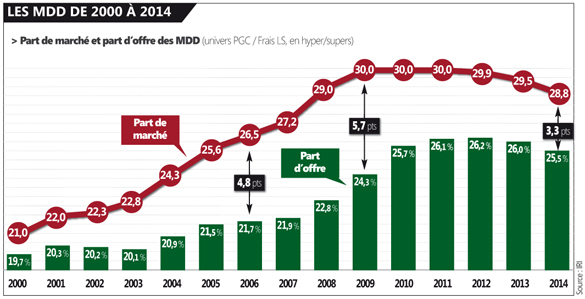
Here is the chart

The red lign marks the private label marketshares, while in green you have part of the category they represents in terms of SKUs.

As you can see, for quite a while the marketshare rose even faster than the number of SKUs. But starting in 2009, while the number of SKUs kept on growing, the market shares started plumetting. It showed a clear plateau: More products did not meant more sales.

Obviously, while managing a category, you have to study how many products you need in order to respond to your demand. And therefore sometimes it is wise to cut some SKUs in order to perform better, and leverage other items, such as pricing or store execution in order to lift sales.

Friday, May 01, 2015

Carrefour opération maquillage: de l'utilisation du marketing direct et du CRM en grande distribution

Pour ceux qui lisent mon blog fréquemment, vous savez que j'ai deux sujets qui me préoccuppent particulièrement: le retail (distribution) et la relation client (CRM). Souvent les 2 mondes sont en phase, puisque par définition la distribution est en contact direct avec le consommateur final.
Néanmoins, souvent, il est rare de voir le distributeur utiliser de technique de relation direct. En effet, dans le monde des FMCG, les rotations étant rapide, les compositions de paniers complexes, et les niveaux de rentabilité net faible, il est difficile d'avoir un impact via ce type de technique.

Néanmoins, je souhaitais revenir sur un mailing que j'ai reçu de la part de Carrefour dans le cadre de son opération beauté. En effet, j'ai reçu ce courrier via les informations de ma carte fidélité. L'offre est simple: pour 30 euros de produit de beauté acheté lors de l'opération beauté (représentant entre 8 et 10% du CA de la catégorie sur la dizaine de jours concernés) j'ai un chèque de 5 euros.

Objectif du courrier: Doper sa fréquentation sur cette période clé en terme de CA promo pour l'enseigne (certainement l'une des 5 plus grosses opérations de l'année), et sur la catégorie (voir plus haut). De plus, les opérations beauté ayant plus ou moins lieu en même temps, c'est se sécuriser la visite de son hyper plutôt que de son concurrent.

Quelques critiques:
  • Je trouve l'idée d'utiliser du mailing papier pour une opération de prestige sur la beauté très bonne. néanmoins, je trouve qu'il manque de la créativité sur l'utilisation du support papier. En effet, le mailing permet de pouvoir exprimé pleinement la créativité de l'enseigne. La, le mailing est finalement très simple.
  • Ce qui est intéressant, c'est  que cela sort de la communication prospectus qui est souvent répétitive, et donc capte l'attention.
  • le manque de communication: En effet, la catégorie beauté est stratégique, et le support papier coûtant cher, pourquoi ne pas avoir un mini descriptif des avantages d'acheter tout au long de l'année du maquillage chez Carrefour (garantie le prix le plus bas, choix, produits exclusifs, etc...)
  • Le manque de la signature du directeur de magasin: pour pouvoir vraiment lié l'opération au point de vente et créer du lien, je pense que mettre un nom et une signature sur un envoi marque bien plus. 
En tout cas, je pense que c'est une très bonne idée de support de communication pour ce type d'opérations spécifiques sur des clientèles spécifiques.